
On this page
- 01Key takeaways
- 02What is labour arbitrage?
- 03How big is the wage gap for a UK business?
- 04How much of a BPO saving comes from arbitrage?
- 05Where does labour arbitrage stop working?
- 06Is labour arbitrage ethical?
- 07How do you make an arbitrage saving last?
- 08What does this look like in practice?
- 09Labour arbitrage checklist
- 10Next step
- 11Sources and further reading
- 12Frequently asked questions
Key takeaways
Labour arbitrage is the saving a business makes by having work done where skilled labour costs less. It is the best-known reason BPO lowers costs, but it is rarely the whole saving. In our illustrative example it accounts for about four-fifths of the gross saving. The rest comes from a better method, and that part does not erode.
- Labour arbitrage is the gap between wage costs in two locations.
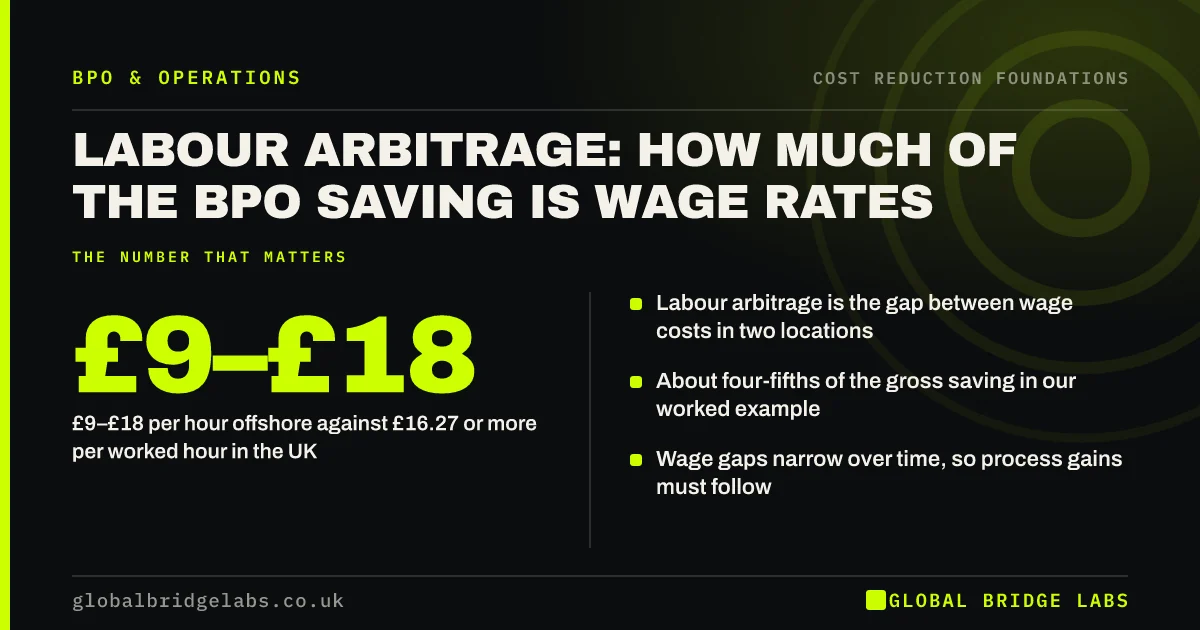
- £9–£18 per hour offshore against £16.27 or more per worked hour in the UK.
- About four-fifths of the gross saving in our worked example.
- Wage gaps narrow over time, so process gains must follow.
Want to know how much of your saving would be rate and how much process? Message us on WhatsApp.
Chat on WhatsApp →What is labour arbitrage?
Labour arbitrage is the practice of sourcing work from a location where equivalent skills cost less, and keeping the difference. In outsourcing it usually means a UK business buying customer service, administration or technical work from a team in a lower-cost country such as Sri Lanka, India or the Philippines.
The saving exists because living costs and wage levels differ between countries, not because the people are less able. A graduate in Colombo and a graduate in Leeds can do the same documented task to the same standard.
How big is the wage gap for a UK business?
The gap is narrower than headline salary comparisons suggest, because a provider's rate includes far more than a wage. As indicative market ranges, a managed offshore team costs UK businesses £9–£18 per hour, including supervision, cover, premises and tools. A UK employee on the 2026/27 National Living Wage costs about £16.27 per worked hour before any of those are added.
For a £30,000 role at about £19.81 per worked hour, an offshore rate of £12 is a gap of roughly 39%. Against a National Living Wage role, the same rate is a gap of about 26%. Neither figure is a GBL price.
How much of a BPO saving comes from arbitrage?
In our illustrative pillar example, 70 hours a week of routine work costs about £72,100 a year in-house at £19.81 per worked hour. Buying the same 70 hours at £12 would cost £43,680, a rate saving of about £28,400. Standardising the work so it takes 60 hours saves a further £6,240.
So roughly 82% of the gross saving is arbitrage and 18% is method. Where in-house staff are under-used or senior people do the work, the share from arbitrage is smaller and the share from utilisation and overhead is larger.
- Rate saving: about £28,400 a year.
- Method saving: about £6,240 a year.
- Arbitrage share of the gross saving: about 82%.
- How much can a small business save by outsourcing?
- The cost lever scorecard: find savings process by process
Want this split calculated for your own roles? Send us the hours and salaries on WhatsApp.
Chat on WhatsApp →Where does labour arbitrage stop working?
Labour arbitrage stops working when the lower rate is cancelled by lower output per hour, more rework or more of your own time. It also weakens as wages in outsourcing locations rise, as exchange rates move, and as simple tasks are automated. A saving built on rate alone tends to shrink every year.
- Productivity: fewer tasks completed per hour.
- Quality: corrections and repeat contacts.
- Oversight: more review time than planned.
- Currency and wage inflation at the provider's location.
Is labour arbitrage ethical?
Labour arbitrage is ethical when the people doing the work are paid well by local standards, employed lawfully and treated properly. Outsourced roles in established BPO centres are often sought-after professional jobs. The risk lies with providers who compete on rate alone and recover the margin from their staff.
Ask a provider how pay compares with the local market, what staff turnover is, and what their policy on working hours and overtime says. UK businesses above the statutory turnover threshold also have modern slavery reporting duties that extend to their supply chains.
How do you make an arbitrage saving last?
Make the saving last by adding process gains on top of the rate. Use the first year to stabilise and document. Use the second to remove steps, cut rework and automate the simplest tasks. A provider that only ever offers a rate has nothing else to give when the gap narrows.
What does this look like in practice?
A pattern we see in firms that outsourced for price: the first year looks excellent, the second looks flat, and by the third the provider's annual increase has eaten a noticeable share of the gain. The firms that keep their saving are the ones that asked for a process improvement plan from the start.
Labour arbitrage checklist
Check these points before you rely on a rate saving.
- Compare loaded UK cost per worked hour with the managed rate.
- Confirm what the rate includes: supervision, cover, tools.
- Measure tasks completed per hour, not just hours.
- Ask how the rate will change each year.
- Ask who carries exchange rate movement.
- Ask how staff pay compares with the local market.
Next step
Send us the roles and hours you are considering. We will show you how much of the likely saving is rate, how much is process, and what would protect each.
Message us on WhatsApp to talk through the rate and process saving, or book a 30-minute consultation.
Chat on WhatsApp →Sources and further reading
- National Minimum Wage and National Living Wage rates · GOV.UK
- Rates and thresholds for employers 2026 to 2027 · HM Revenue & Customs
- Slavery and human trafficking in supply chains: guidance for businesses · Home Office
- Exchange rates · Central Bank of Sri Lanka
Frequently asked questions
What does labour arbitrage mean?
Labour arbitrage means having work done in a location where equivalent skills cost less and keeping the difference as a saving. In business process outsourcing, it describes a company in a high-wage country buying services from a team in a lower-wage country at a lower cost per hour.
Is labour arbitrage the main benefit of BPO?
It is the most visible benefit and often the largest in year one. It should not be the only one. Managed teams also reduce paid idle time, rework and supervision overhead. Those gains continue after wage gaps narrow, which is why a provider's process capability matters as much as its rate.
Will labour arbitrage savings disappear?
They tend to narrow, not disappear. Wages in established outsourcing locations rise over time and currencies move. Businesses that rely only on the rate see their saving shrink. Those that also standardise, cut rework and automate simple tasks usually hold or grow it.
Is offshore labour lower quality?
Not inherently. Quality depends on recruitment, training, documentation and supervision, not on location. A well-managed offshore team working to a written process often produces more consistent work than an informal in-house arrangement. Poor results usually trace back to a vague scope or a provider chosen on price alone.
Written by

Global Bridge Labs (GBL) is a UK–Sri Lanka partner for social media, websites and BPO. Everything here comes from client delivery, not theory.


