
On this page
- 01Key takeaways
- 02Which costs do customers never see?
- 03Which costs do customers feel at once?
- 04Can a saving improve service?
- 05How do you change who does the work safely?
- 06Which measures warn you early?
- 07When is a small drop in service acceptable?
- 08What does this look like in practice?
- 09Service-safe cost checklist
- 10Next step
- 11Sources and further reading
- 12Frequently asked questions
Key takeaways
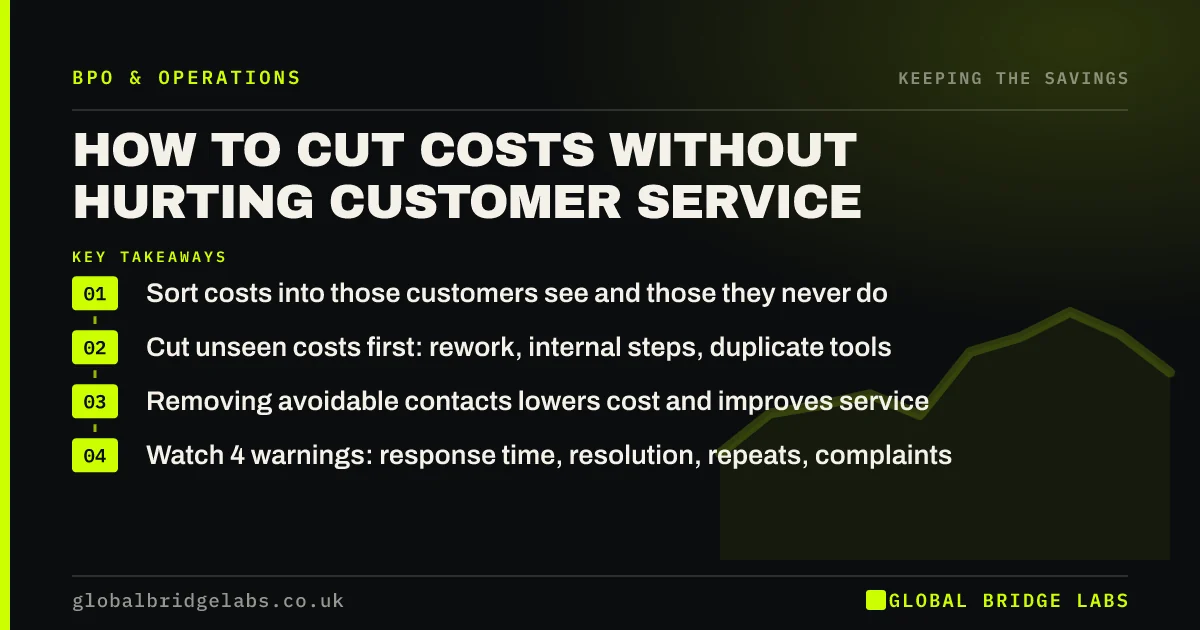
To cut costs without hurting customer service, divide your costs into those customers see and those they do not. Start with the unseen ones: internal steps, rework, duplicate tools, who does the routine work. Touch the visible ones only when you can show the customer experience is unchanged or better, and watch four measures that warn you early.
- Sort costs into those customers see and those they never do.
- Cut unseen costs first: rework, internal steps, duplicate tools.
- Removing avoidable contacts lowers cost and improves service.
- Watch 4 warnings: response time, resolution, repeats, complaints.
Want your cost list sorted into seen and unseen? Message us on WhatsApp with the lines you are considering.
Chat on WhatsApp →Which costs do customers never see?
Customers never see how many internal steps a task has, how many times data is typed, how many approvals an order passes or where the person replying is sitting. They see the result: was the answer right, was it quick, was it easy. Any cost that can be removed without changing those three is safe to cut.
- Internal handoffs and approvals.
- Rework and double entry.
- Reports and meetings with no outcome.
- Duplicate software.
- Senior staff doing routine tasks.
Which costs do customers feel at once?
Customers feel at once anything that makes them wait, repeat themselves or settle for less. The Institute of Customer Service, which publishes the UK Customer Satisfaction Index, consistently reports that getting things right first time and handling problems well are central to satisfaction.
- Longer waits for a reply or a callback.
- Fewer ways to reach a person.
- Staff with less authority to resolve.
- Lower product or delivery quality.
- Shorter opening hours with no alternative.
Can a saving improve service?
Yes, and these are the savings to look for first. Every avoidable contact you prevent saves handling time and spares the customer the trouble. Every error you stop saves a correction and an apology. In an illustrative business with 2,000 contacts a month at £2.50, preventing 300 avoidable contacts saves £750 a month and removes 300 frustrations.
Proactive updates, clearer invoices and accurate product information are all cheaper than the contacts they prevent.
- Failure demand: the customer contacts you pay for twice
- Right first time rate: the quality number that cuts cost
- Self-service on your website: let customers help themselves
Want to find the savings that improve service? Send us your top customer questions on WhatsApp.
Chat on WhatsApp →How do you change who does the work safely?
Change who does the work safely by moving the routine and keeping the judgement. A managed team can handle standard queries from a playbook at a lower cost per contact, often with longer hours of cover. Complex cases, complaints and key accounts stay with your own people.
- 1. Document the routine queries and the right answers.
- 2. Set clear rules for what is escalated.
- 3. Run both teams side by side for a few weeks.
- 4. Sample replies and compare satisfaction.
- 5. Expand only when quality matches.
Which measures warn you early?
Four measures move before customers leave. Track them weekly during any cost change and set a threshold at which you pause.
- First response time.
- First contact resolution.
- Repeat contact rate.
- Complaints and negative reviews.
When is a small drop in service acceptable?
A small drop is acceptable where customers do not value what is being removed. Answering email in four hours instead of one may make no difference to retention. Cutting a little-used channel may go unnoticed. Test on a small group, measure, and be ready to reverse. Do not assume in either direction.
What does this look like in practice?
A pattern we see when costs are under pressure: the first proposal is to reduce phone hours, because the phone is expensive. The calls are mostly customers checking on something they were never told. Sending that information removes the calls, lowers the cost further than shorter hours would have, and no customer loses anything.
Service-safe cost checklist
Use this for each planned saving.
- Is this cost visible to customers?
- If not, cut it first.
- If so, can we show service will hold?
- Have we removed avoidable contacts first?
- Are the four warning measures being tracked?
- Is there a threshold at which we pause?
- Can the change be reversed quickly?
Next step
Send us the savings you are considering in customer-facing areas. We will help you sort them into safe, testable and risky, and suggest what to measure.
Message us on WhatsApp to plan service-safe savings, or book a 30-minute consultation.
Chat on WhatsApp →Sources and further reading
- UK Customer Satisfaction Index · Institute of Customer Service
- Labour productivity · Office for National Statistics
Frequently asked questions
How can I reduce costs without affecting quality?
Target costs customers do not see: internal steps, rework, duplicate tools and senior staff doing routine work. Remove the causes of avoidable customer contact. Then lower the cost of routine work by standardising it and choosing the most economical way to run it.
Does outsourcing customer service reduce quality?
Not when the process is documented, replies are sampled and complex cases are escalated to your own team. Quality depends on preparation and oversight far more than on location. Poor results usually follow a vague scope or a provider chosen on price alone.
What are early warning signs that cuts are hurting service?
Watch first response time, first contact resolution, repeat contacts and complaints. These change within weeks of a damaging cut, well before customers start leaving. Set a threshold for each and pause the change if it is crossed.
Which cost savings improve customer experience?
Savings that remove the reasons customers need to contact you. Proactive delivery updates, clear invoices, accurate product information and useful help pages all reduce contact volume and cost while making life easier for customers.
Written by

Global Bridge Labs (GBL) is a UK–Sri Lanka partner for social media, websites and BPO. Everything here comes from client delivery, not theory.


