On this page
- 01Key takeaways
- 02Does outsourcing actually save money?
- 03Where do outsourcing savings come from?
- 04Why do cost-only outsourcing decisions backfire?
- 05What should you aim for instead of cost alone?
- 06Which processes save the most?
- 07What about existing staff?
- 08How do you check the savings are real?
- 09What does this look like in practice?
- 10Cost-saving checklist
- 11Next step
- 12Sources and further reading
- 13Frequently asked questions
Key takeaways
Outsourcing to reduce costs works for repeatable, measurable work, but a cost-only decision often backfires. The cheapest hourly rate rarely gives the lowest cost per task once rework, supervision and lost customers are counted. Aim for three outcomes together: lower cost per task, faster service and hours returned to the team.
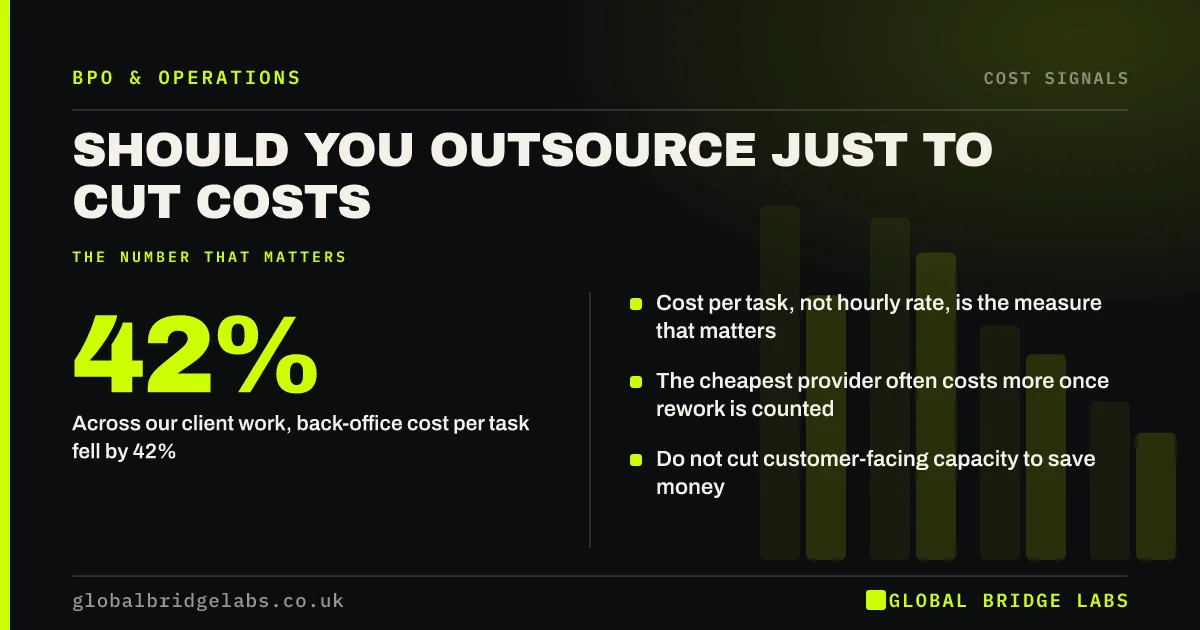
- Cost per task, not hourly rate, is the measure that matters.
- Across our client work, back-office cost per task fell by 42%.
- The cheapest provider often costs more once rework is counted.
- Do not cut customer-facing capacity to save money.
Looking for savings? Message us on WhatsApp and we will tell you where they are realistic.
Chat on WhatsApp →Does outsourcing actually save money?
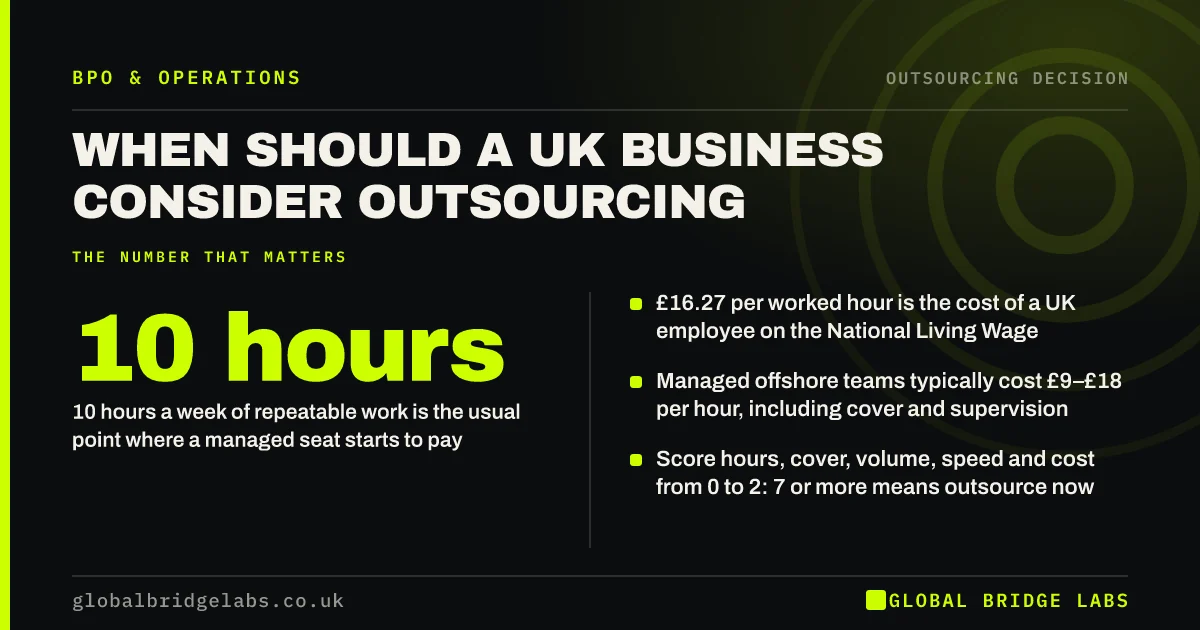
It usually does for repeatable support and admin work, because managed offshore teams at an indicative £9–£18 per hour cost less than UK staff at about £16.27 per worked hour plus overheads, and because a documented process reduces rework. It does not save money on work that needs constant checking or on volumes too small to justify setup.
Where do outsourcing savings come from?
Savings come from four places, and the hourly rate is only one of them. The other three, rework, idle time and senior hours, are often larger.
- Lower hourly cost for repeatable work.
- Less rework, because the process is written down and checked.
- No paying for idle time between peaks.
- Senior and owner hours moved to higher-value work.
Why do cost-only outsourcing decisions backfire?
Because they pick the lowest rate and ignore the rest. A cheap provider without supervision produces errors your team fixes. Long minimum terms lock in a poor service. Cutting in-house staff before the outsourced process is proven leaves nobody who knows the work. The saving on paper disappears in practice.
What should you aim for instead of cost alone?
Aim for three measures together: cost per task, service speed and hours returned. If cost per task falls but replies slow down, the saving is costing you customers. If replies speed up and owners get hours back at a similar cost, that is a good result even without a headline saving.
Want to set the right targets for your process? Ask us on WhatsApp.
Chat on WhatsApp →Which processes save the most?
The biggest savings usually come from high-volume back-office work currently done by skilled or senior staff: data entry, order processing, invoicing, CRM updates and document chasing. Customer contact often saves less on cost but gains more on speed and revenue.
What about existing staff?
If outsourcing means existing employees' work moves to a provider, TUPE may apply and staff may have the right to transfer. Many SMEs avoid this by outsourcing growth, cover and new volume rather than replacing people, or by moving staff to higher-value roles. Get advice before announcing any change that affects jobs.
How do you check the savings are real?
Measure before and after on the same basis. Record cost per task, reply times and internal hours for at least two weeks before the change, then compare monthly for the first quarter. Count everything: provider invoices, your management time and any rework still done in-house. If the saving only appears when those are left out, it is not a saving.
- Baseline cost per task and service speed before the change.
- Monthly comparison for the first three months.
- Internal hours still spent on the process.
- Customer complaints and rework against the baseline.
What does this look like in practice?
A pattern we see in UK logistics firms: the first provider chosen on price alone misses delivery queries at peak, and the in-house team ends up checking every reply. Switching to a managed team with supervision and a weekly scorecard costs a little more per hour but less per resolved query, and the in-house team stops double-handling.
Cost-saving checklist
Check these before outsourcing for savings.
- Measure cost per task, not only hourly rates.
- Include rework and supervision in both options.
- Set targets for cost, speed and hours returned.
- Avoid long minimum terms until results are proven.
- Keep in-house knowledge until the new process is stable.
- Check TUPE if existing roles are affected.
Next step
Tell us where you expect savings. We will tell you honestly whether they are realistic and what else you should measure.
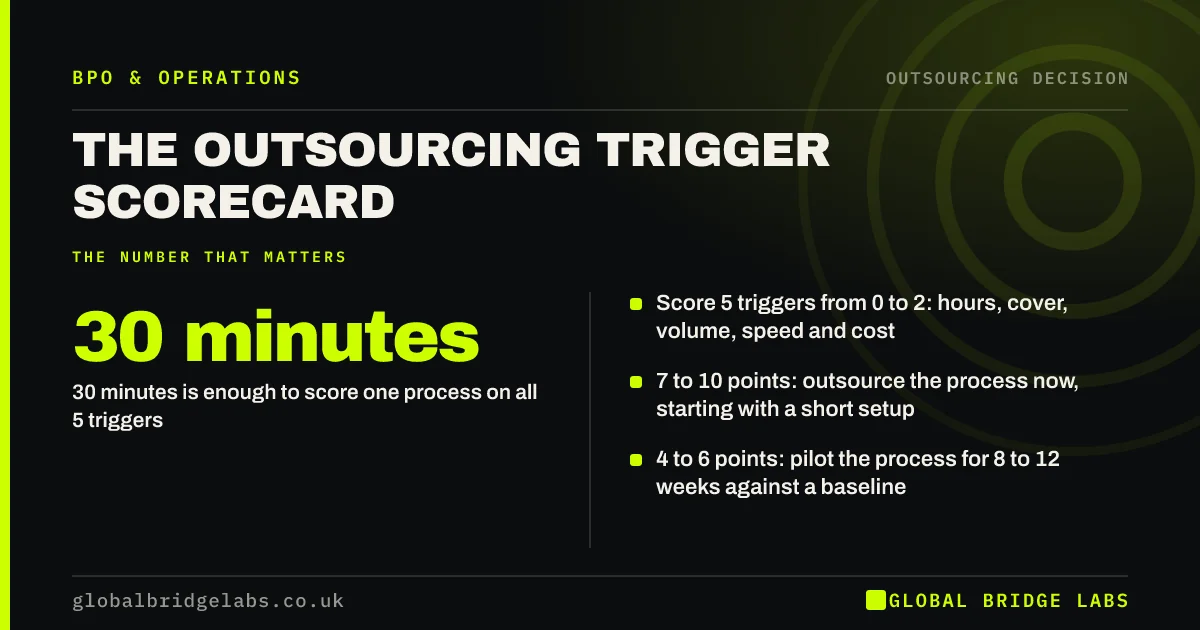
Message us on WhatsApp about your savings target, or book a 30-minute consultation.
Chat on WhatsApp →Sources and further reading
- National Minimum Wage and National Living Wage rates · GOV.UK
- Rates and thresholds for employers 2026 to 2027 · HM Revenue & Customs
- Business transfers, takeovers and TUPE · GOV.UK
Frequently asked questions
Is outsourcing always cheaper?
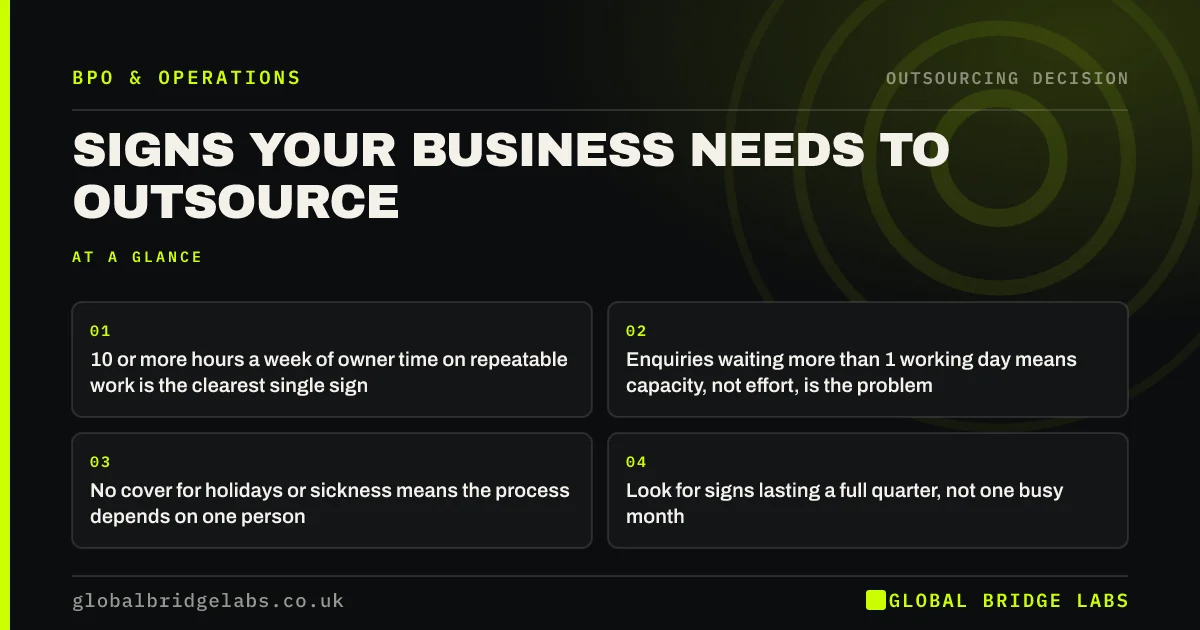
No. It is usually cheaper for repeatable, documented work of 10 or more hours a week. It is often not cheaper for small volumes, unstable processes or work that needs constant checking. Compare cost per task, including rework and management time.
How much can a small business save by outsourcing?
It depends on who does the work today. Moving repeatable work off senior staff gives the largest savings. Across our client work, back-office cost per task has fallen by 42% once the process was documented and run by a managed team.
What are the risks of outsourcing only to cut costs?
Choosing the cheapest provider without supervision, accepting long minimum terms, losing in-house knowledge too early and damaging customer service. Aim for lower cost per task together with faster service and hours returned to the team.
Written by

Global Bridge Labs (GBL) is a UK–Sri Lanka partner for social media, websites and BPO. Everything here comes from client delivery, not theory.