
On this page
- 01Key takeaways
- 02What is failure demand?
- 03What does failure demand look like?
- 04How do you measure it?
- 05What does it cost?
- 06How do you remove it?
- 07Should you outsource failure demand?
- 08What does this look like in practice?
- 09Failure demand checklist
- 10Next step
- 11Sources and further reading
- 12Frequently asked questions
Key takeaways
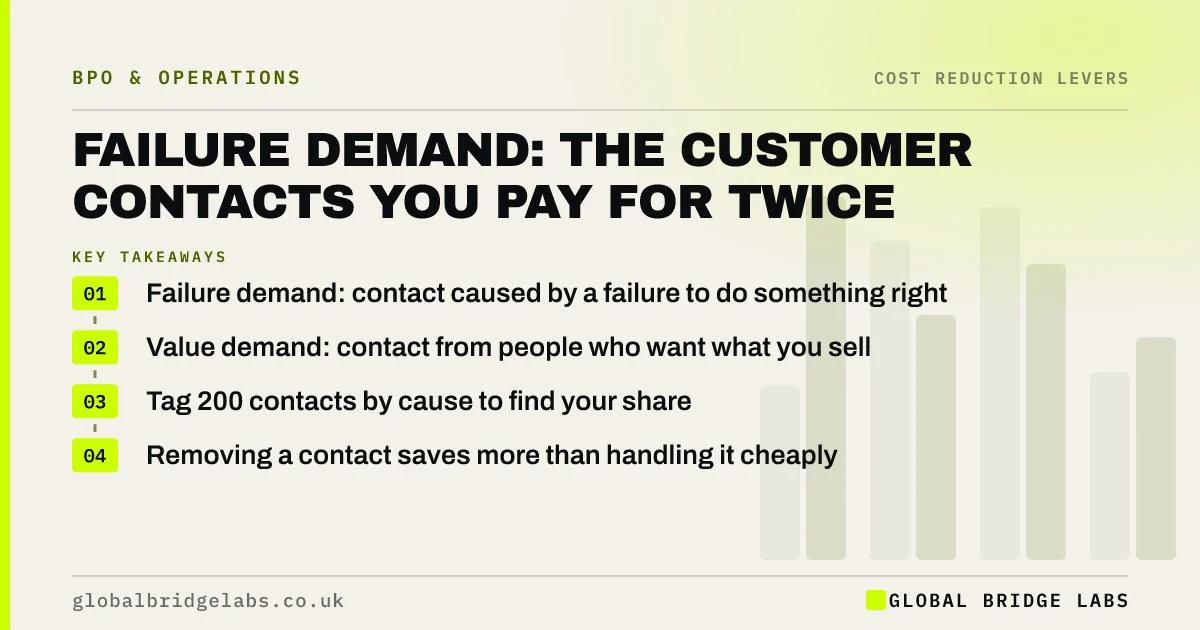
Failure demand is customer contact caused by something the business failed to do or failed to do right. Chasing a late delivery, querying a confusing invoice and asking again after no reply are all failure demand. It is the cheapest cost to remove in customer service, because the best outcome is that the contact never happens.
- Failure demand: contact caused by a failure to do something right.
- Value demand: contact from people who want what you sell.
- Tag 200 contacts by cause to find your share.
- Removing a contact saves more than handling it cheaply.
Want help tagging your contacts by cause? Message us on WhatsApp with your monthly volume.
Chat on WhatsApp →What is failure demand?
Failure demand is demand placed on an organisation by its own failure to do something, or to do something right, for the customer. The term comes from John Seddon, the occupational psychologist behind the Vanguard Method. Its opposite is value demand: the contacts a business exists to serve, such as orders, bookings and genuine questions.
What does failure demand look like?
Failure demand looks like customers doing your chasing for you. It appears whenever something was late, unclear, wrong or unanswered. It is easy to miss because it arrives through the same inbox as real enquiries and is counted as workload.
- Where is my order, engineer or refund?
- I do not understand this invoice.
- I emailed last week and heard nothing.
- You sent the wrong item or the wrong document.
- Your website says one thing and your email another.
How do you measure it?
Measure it by tagging a sample of contacts by cause. Take 200 recent emails, calls or chats and ask of each: would this person have contacted us if we had done everything right first time? Sort the failure contacts by reason. Five or six causes will usually account for most of them.
- 1. Pull 200 recent contacts across all channels.
- 2. Mark each as value or failure demand.
- 3. Group the failure contacts by cause.
- 4. Rank causes by number of contacts.
- 5. Assign each top cause to whoever can fix it.
What does it cost?
Failure demand costs the handling time of every avoidable contact, plus the goodwill lost. In an illustrative business handling 2,000 contacts a month at £2.50 each, a failure share of 35% is 700 contacts and £1,750 a month, or £21,000 a year. Halving it saves £10,500 a year and makes customers happier.
Compare that with making all 2,000 contacts 20% cheaper to handle, which saves £12,000 and leaves every cause in place. The two are not alternatives. But the first should come before the second.
- Cost per contact: compare in-house and outsourced support
- How to reduce customer service costs without slower replies
Want your own failure demand cost estimated? Send us your contact volume on WhatsApp.
Chat on WhatsApp →How do you remove it?
Remove it at the cause, which is usually outside the support team. Late delivery queries are fixed with proactive updates. Invoice queries are fixed by a clearer invoice. Repeat chasers are fixed by replying sooner. Each fix belongs to the part of the business that created the contact.
Should you outsource failure demand?
Outsourcing failure demand makes it cheaper to handle but does not reduce it, and it can hide it. If the provider is paid per contact, nobody in the arrangement gains from contacts falling. Ask for contacts to be tagged by cause and reported weekly, so the team that handles the problem also tells you where it came from.
What does this look like in practice?
A pattern we see in e-commerce and trades alike: a large share of the inbox asks when something will happen. The business answers each one politely and promptly, and counts that as good service. Sending the date before the customer has to ask removes the contact and the anxiety behind it.
Failure demand checklist
Run this once a quarter.
- Sample 200 contacts across channels.
- Tag each as value or failure.
- Rank the failure causes.
- Give each top cause an owner outside support.
- Fix one cause and re-sample after 30 days.
- Report the failure share alongside volume.
Next step
Send us a rough idea of your monthly contacts and the questions you hear most. We will help you separate value from failure demand and work out what the avoidable part is costing.
Message us on WhatsApp for a failure demand review, or book a 30-minute consultation.
Chat on WhatsApp →Sources and further reading
- UK Customer Satisfaction Index · Institute of Customer Service
- Labour productivity · Office for National Statistics
Frequently asked questions
What is an example of failure demand?
A customer emailing to ask where their order is because no dispatch update was sent is failure demand. So is a call to query an unclear invoice, or a second message because the first was not answered. In each case the contact exists only because something was not done right.
What is the difference between failure demand and value demand?
Value demand is contact from customers who want the service you provide: placing an order, booking, asking a genuine question. Failure demand is contact caused by a failure, such as a delay or an error. A business wants more of the first and as little as possible of the second.
How much customer contact is failure demand?
It varies widely by business and can only be known by sampling your own contacts. Tag 200 recent contacts as value or failure. Many firms are surprised by the result, because failure contacts are normally counted as ordinary workload.
Who should fix failure demand?
The team that causes it, which is rarely customer service. Delivery queries belong to operations, invoice queries to finance and unclear information to marketing or the website owner. Customer service can measure and report the causes, but cannot remove them alone.
Written by

Global Bridge Labs (GBL) is a UK–Sri Lanka partner for social media, websites and BPO. Everything here comes from client delivery, not theory.


