On this page
- 01Key takeaways
- 02What is BPO quality assurance?
- 03How much work should be sampled?
- 04What should a QA scorecard include?
- 05What is calibration and why does it matter?
- 06How should coaching work?
- 07How do you fix recurring errors?
- 08What does QA cost?
- 09What are the limits of QA?
- 10What does this look like in practice?
- 11Checklist: set up QA
- 12Next step
- 13Sources and further reading
- 14Frequently asked questions
Key takeaways
BPO quality assurance is the routine that keeps an outsourced team consistent: sample the work every week, score it against a short form, coach on what the scores show, and fix the root cause when the same error repeats. Without it, quality drifts slowly and nobody notices until customers do.
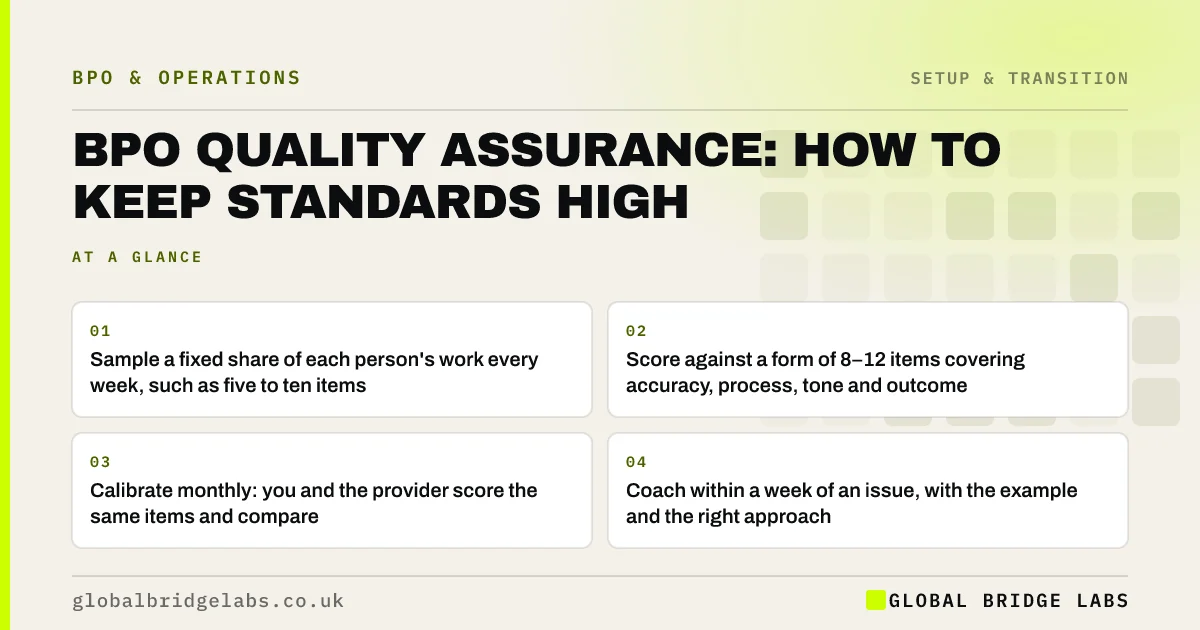
- Sample a fixed share of each person's work every week, such as five to ten items.
- Score against a form of 8–12 items covering accuracy, process, tone and outcome.
- Calibrate monthly: you and the provider score the same items and compare.
- Coach within a week of an issue, with the example and the right approach.
- When an error repeats, fix the procedure, not only the person.
Want our QA scorecard template for support or admin work? Message us on WhatsApp and ask for it.
Chat on WhatsApp →What is BPO quality assurance?
BPO quality assurance (QA) is the systematic checking of an outsourced team's work against defined standards, using sampling and scoring, so that errors are caught, people are coached and processes are improved. It sits alongside service-level measures, which show speed, by showing whether the work was right.
QA is the provider's job in a managed business process outsourcing arrangement, but you should see the results, sample some work yourself, and agree the standard.
How much work should be sampled?
Sample enough to see patterns for each person every week. A common approach is 3% to 5% of each person's contacts or records, or a fixed number such as five to ten items per person per week, whichever gives a meaningful picture. Sample more in the first months and for new team members.
Choose samples randomly, then add targeted samples: complaints, long conversations, escalations and anything flagged by customers.
What should a QA scorecard include?
Keep the form short: 8 to 12 items, each scored clearly. Split items into critical ones, where any failure fails the item, and standard ones that contribute to a score.
- Critical: correct information given; data protection followed; escalation rules followed.
- Process: correct steps followed and system updated.
- Communication: tone matches the guide; clear and complete answer.
- Outcome: issue resolved or next step clearly set.
- Back office: fields accurate; formats correct; exceptions flagged.
What is calibration and why does it matter?
Calibration is a session where you and the provider's QA lead score the same sample independently, then compare and agree. It keeps everyone's standards aligned. Without it, the provider may score 95% on work you would score 80%, and the monthly report stops meaning anything.
Run calibration monthly at first, then quarterly once scores consistently match.
How should coaching work?
Coaching should be quick, specific and balanced. Share the scored example, explain what good looks like, and agree one thing to change. Recognise good work publicly and address problems privately. Most issues are fixed in one conversation; repeated issues need a short improvement plan.
How do you fix recurring errors?
When the same error appears across people, the cause is usually the procedure, the training or the system, not the individuals. Look for the root cause: an unclear step, a missing scenario, a confusing field. Fix it and tell everyone. Tracking error types over time shows whether fixes worked.
What does QA cost?
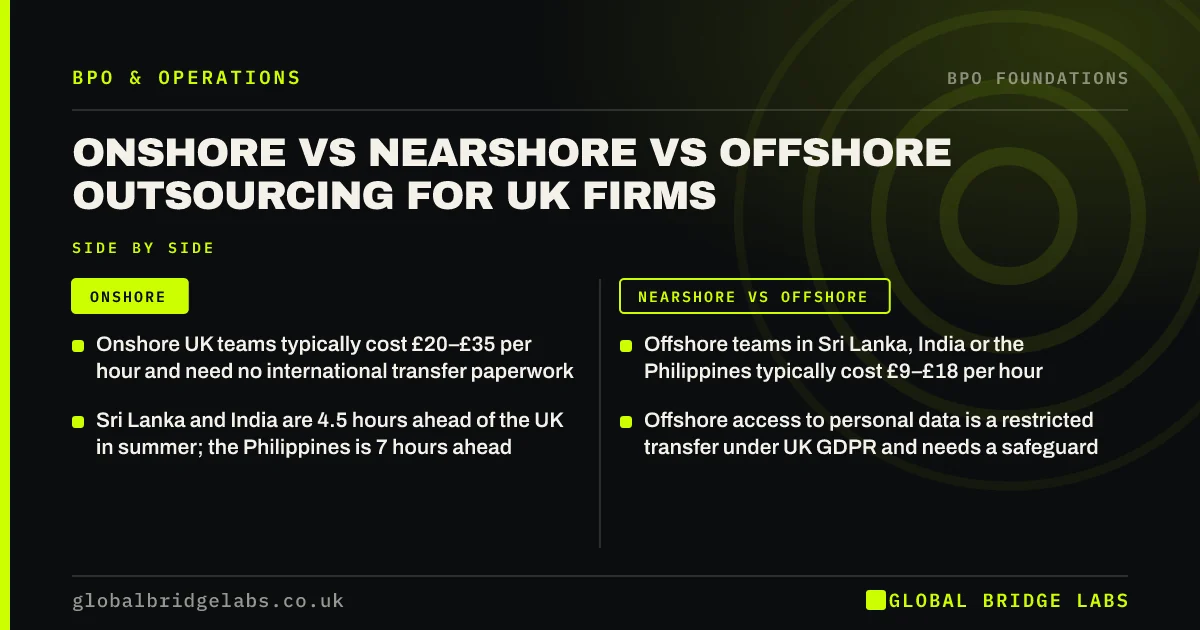
In a managed service, QA should be included in the rate. As indicative market ranges, managed offshore BPO costs around £9–£18 per hour and onshore around £20–£35; if a quote excludes quality checks, the true price is higher than it looks. On your side, calibration and reviewing samples take an hour or two a month once things are stable.
Want a managed team with QA built into the price? Send us your process on WhatsApp and we will discuss your requirements.
Chat on WhatsApp →What are the limits of QA?
QA checks a sample, so it can miss rare errors, and scores can become a target in themselves. Balance QA with customer feedback, complaint analysis and outcome measures such as first contact resolution. And read real conversations yourself sometimes; numbers never tell the whole story.
What does this look like in practice?
At Global Bridge Labs (GBL), we hire, train and quality-check the team against the client's standards, and quality scores appear on the monthly one-page report alongside hours saved, cost per task and response times. Clients can sample work directly in their own systems at any time.
Checklist: set up QA
Agree these with your provider.
- Agree the QA form, with critical and standard items.
- Set the sample size per person per week.
- Add targeted samples for complaints and escalations.
- Run a monthly calibration session.
- Agree how quickly coaching follows an issue.
- Track error types and fix root causes in the procedure.
- Show quality scores on the monthly report.
Next step
Send us your process and we will share a QA form and sampling plan suited to it, whether or not you work with us. 30 minutes, no pitch.
Message us on WhatsApp for the QA scorecard template, or book a 30-minute consultation.
Chat on WhatsApp →Sources and further reading
- UK Customer Satisfaction Index · Institute of Customer Service
- The Sourcing and Consultancy Playbooks · Cabinet Office
- Contracts and liabilities between controllers and processors · Information Commissioner's Office
Frequently asked questions
What is QA in a call centre?
QA in a call centre means listening to a sample of calls, scoring them against a form covering accuracy, process, tone and outcome, and using the results to coach agents and improve procedures. The same approach applies to email, chat and back-office work.
How many calls or tickets should be QA'd?
A common approach is 3% to 5% of each person's work, or five to ten items per person per week, plus targeted samples of complaints and escalations. Sample more for new team members and during the first months of an engagement.
What is a good QA score?
Many teams target 85% or above on standard items, with zero tolerance on critical items such as giving wrong information or breaching data protection. The exact number matters less than calibration: both you and the provider must score the same work the same way.
Who should do quality assurance, us or the provider?
In a managed service, the provider runs QA as part of the service. You agree the standard, see the results, take part in calibration and sample some work yourself. That shared approach keeps standards aligned without you doing the day-to-day checking.
Written by

Global Bridge Labs (GBL) is a UK–Sri Lanka partner for social media, websites and BPO. Everything here comes from client delivery, not theory.