On this page
- 01Key takeaways
- 02Why do outsourcing savings disappear?
- 03Are you paying twice?
- 04Is rework eating the saving?
- 05Are extras creeping onto invoices?
- 06Has your management time gone up?
- 07Are the freed hours being used?
- 08When should you stop and reassess?
- 09How do you set a baseline before outsourcing?
- 10What does this look like in practice?
- 11Savings recovery checklist
- 12Next step
- 13Sources and further reading
- 14Frequently asked questions
Key takeaways
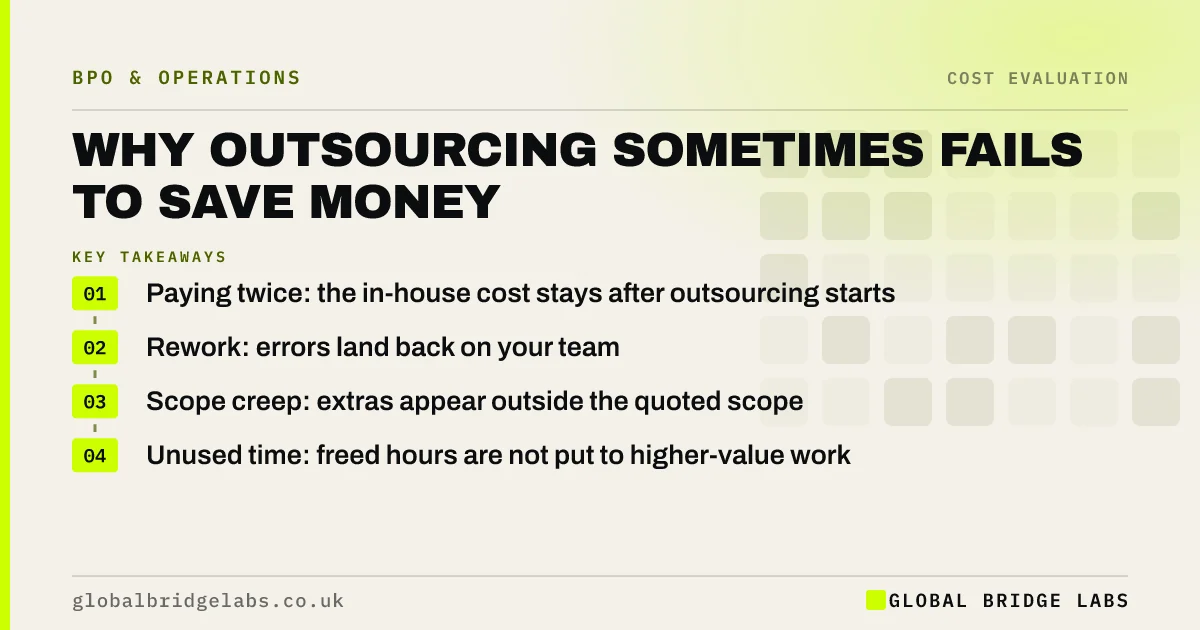
Outsourcing does not save money when costs are added without others being removed. The common causes are paying twice (keeping the in-house cost too), rework, extras outside the quote, your own management time rising, and freed hours that nobody uses. Each has a simple fix if spotted early.
- Paying twice: the in-house cost stays after outsourcing starts.
- Rework: errors land back on your team.
- Scope creep: extras appear outside the quoted scope.
- Unused time: freed hours are not put to higher-value work.
Outsourcing not delivering the saving? Message us on WhatsApp for a second opinion.
Chat on WhatsApp →Why do outsourcing savings disappear?
Savings disappear when the business case counted a reduction that did not happen, or missed a cost that did. The provider's invoice is only one line. If in-house hours, rework or extras rise at the same time, the net saving shrinks or vanishes.
Are you paying twice?
The most common failure. The work is outsourced but the in-house person keeps doing parts of it, or checks everything, or the role is not redeployed. You then pay for both. Decide before starting what the in-house person will stop doing and what they will do instead.
Is rework eating the saving?
If your team fixes the provider's mistakes, their hours are part of the outsourcing cost. The cause is usually an undocumented process or missing examples. Write the process down, sample-check work weekly, and feed errors back as training until the error rate falls.
Are extras creeping onto invoices?
Extra charges for out-of-hours work, new tasks, tool licences or reporting can add up. Agree a written scope with prices for common extras, and ask for a monthly invoice breakdown against it. New tasks should be priced before they start.
Want an invoice checked against its scope? Send it to us on WhatsApp.
Chat on WhatsApp →Has your management time gone up?
Expect more of your time in the first four to eight weeks. If it is still high after three months, something is wrong: too many questions, unclear decision rules or a provider without its own supervision. Batch questions into one daily slot and write the answers into the process.
Are the freed hours being used?
If the business case relied on staff doing more valuable work, check that they are. Freed time often fills with other low-value tasks. Set a target for the freed hours and review it monthly alongside the outsourcing cost.
When should you stop and reassess?
If after three months cost per task is not below the baseline and quality is not at the agreed standard, stop and diagnose. The problem may be the process, the scope, the pricing model or the provider. Switching provider or moving to a hybrid can fix it without abandoning outsourcing.
How do you set a baseline before outsourcing?
Measure for four weeks before the switch: hours spent on the process, cost per task, error rate and speed. Keep the same measures afterwards. Without a baseline, nobody can say whether outsourcing saved money, and the debate becomes opinion rather than numbers.
What does this look like in practice?
A pattern we see in UK SMEs that have outsourced before: the provider's invoice is lower than the old salary, but the office manager spends half the day checking and correcting. Documenting the process and adding weekly sampling brings the checking time down, and the saving appears.
Savings recovery checklist
Check these if savings are missing.
- Has the in-house work actually stopped?
- How many hours go on rework each week?
- Are there charges outside the agreed scope?
- Is your oversight time above an hour a week after month three?
- What are the freed hours being used for?
Next step
Tell us what you outsourced and what the numbers show. We will help find where the saving is leaking in a 30-minute call.
Message us on WhatsApp for a savings review, or book a 30-minute consultation.
Chat on WhatsApp →Sources and further reading
- The Sourcing and Consultancy Playbooks · Cabinet Office
- Rates and thresholds for employers 2026 to 2027 · HM Revenue & Customs
Frequently asked questions
Why does outsourcing fail to save money?
Usually because the in-house cost is not removed, errors create rework, extras appear outside the quoted scope, management time stays high, or freed hours are not used. Each is visible if you measure cost per task and internal hours against a baseline taken before the switch.
How long before outsourcing should show savings?
Usually two to three months. The first weeks take more of your time while the team learns the process. If cost per task is still above the baseline after three months, diagnose the process, scope, pricing model or provider rather than waiting longer.
What should I do if outsourcing is costing more?
Check whether the in-house work has actually stopped, measure rework, review invoices against the agreed scope and cut your oversight time with better documentation. If that fails, consider switching provider, changing the pricing model or moving to a hybrid model.
Is paying twice common when outsourcing?
Yes, especially in the first months. The in-house person keeps doing parts of the work, re-checks everything or is not redeployed, so the business pays for both. Decide before starting what the in-house person will stop doing and what they will do instead.
Written by

Global Bridge Labs (GBL) is a UK–Sri Lanka partner for social media, websites and BPO. Everything here comes from client delivery, not theory.