On this page
- 01Key takeaways
- 02What drives the cost of customer service?
- 03Which lever should you pull first?
- 04What does the saving look like in numbers?
- 05What should you never cut?
- 06Where does a managed team fit?
- 07What does this look like in practice?
- 08Customer service cost checklist
- 09Next step
- 10Sources and further reading
- 11Frequently asked questions
Key takeaways
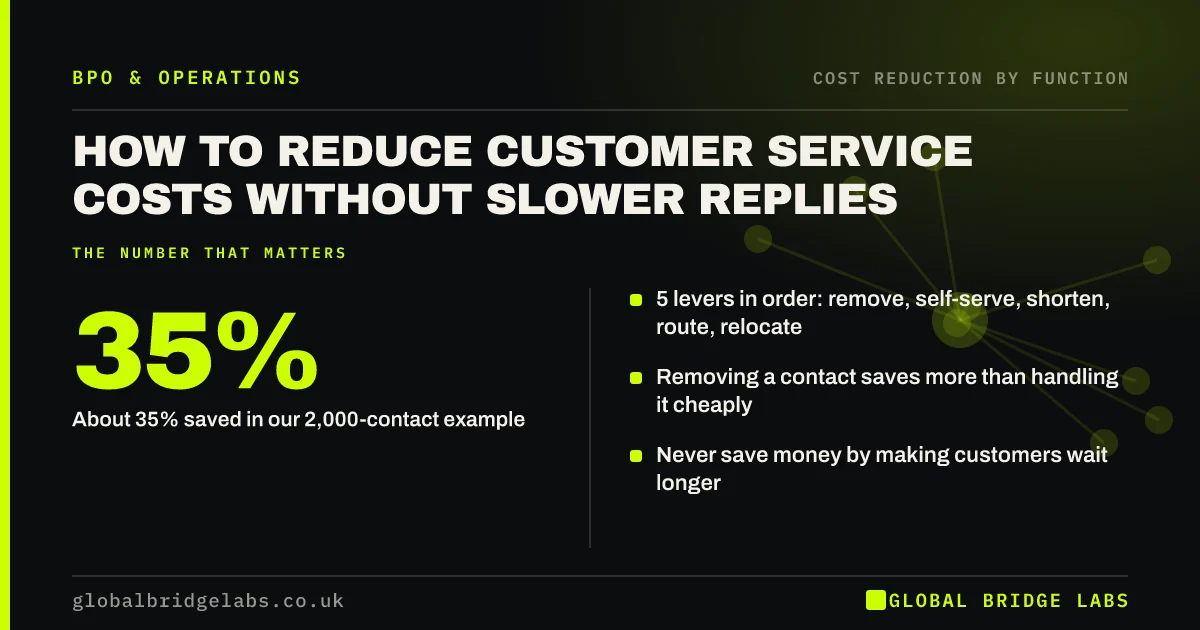
To reduce customer service costs without slowing replies, work through five levers in order: remove avoidable contacts, let customers help themselves, shorten handling with better replies, route each query to the right level, and only then lower the hourly cost. In our example, removing 15% of contacts and lowering the cost of the rest cuts the monthly bill by about 35%.
- 5 levers in order: remove, self-serve, shorten, route, relocate.
- About 35% saved in our 2,000-contact example.
- Removing a contact saves more than handling it cheaply.
- Never save money by making customers wait longer.
Want to know which lever would save you most? Message us on WhatsApp with your monthly contact volume.
Chat on WhatsApp →What drives the cost of customer service?
Customer service cost is driven by four things: how many contacts arrive, how long each takes, who handles it and how often it has to be handled again. Cost per contact brings these together into one number. Lowering the total means changing at least one of the four without damaging the customer's experience.
Which lever should you pull first?
Pull the levers in order of how little they affect the customer. Removing the reason for a contact pleases customers and costs least. Moving the work to a cheaper team comes last, because it is the only lever that leaves every contact in place.
- 1. Remove: fix the causes of avoidable contacts.
- 2. Self-serve: publish answers to the routine questions.
- 3. Shorten: use tested replies and better tools.
- 4. Route: send each query to the right level of skill.
- 5. Relocate: run the remaining volume at a lower cost per hour.
What does the saving look like in numbers?
Take an illustrative business handling 2,000 contacts a month at £2.50 each, or £5,000 a month. Fixing the top two causes of avoidable contact removes 15% of volume, leaving 1,700. Better replies and a managed team bring the cost of each remaining contact down to £1.90.
The new monthly cost is £3,230, a saving of £1,770 or about 35%. Around £750 of that comes from contacts that no longer happen. These are example figures to show the mechanism, not a quote.
- Before: 2,000 contacts at £2.50, £5,000 a month.
- After: 1,700 contacts at £1.90, £3,230 a month.
- Saving: £1,770 a month, about 35%.
- How much can a small business save by outsourcing?
- In-house vs outsourced customer service: the real cost
Want this sum run on your own volumes? Send them on WhatsApp and we will discuss your requirements.
Chat on WhatsApp →What should you never cut?
Never cut response speed on enquiries from people about to buy, access to a person for complaints, or the time needed to solve a problem properly. Savings made by rushing contacts return as repeat contacts. Savings made by hiding the phone number return as lost customers.
Where does a managed team fit?
A managed team fits once the routine contacts are understood and documented. As indicative market ranges, a managed offshore team costs UK businesses £9–£18 per hour and an onshore provider £20–£35 per hour, with supervision and cover included. A UK employee on the 2026/27 National Living Wage costs about £16.27 per worked hour before either.
The better providers also tag contacts by cause and report the list weekly, which feeds the first lever.
What does this look like in practice?
A pattern we see in firms with a small support team: every proposal to save money starts with headcount. Tagging one week of contacts shows a large share are status questions that a proactive update would prevent. The team did not need to shrink. The workload did.
Across our client work, back-office cost per task has fallen by 42% once the process was written down and run by a managed team.
Customer service cost checklist
Complete these before changing the team.
- Calculate cost per contact today.
- Tag 200 contacts by cause.
- Fix the top two avoidable causes.
- Publish answers to the five commonest questions.
- Write tested replies for routine queries.
- Decide which queries need a specialist.
- Compare the cost of the remaining volume in-house and managed.
Next step
Send us your monthly contact numbers by channel and who answers them. We will show you which of the five levers is worth pulling first and what it is likely to save.
Message us on WhatsApp for a customer service cost review, or book a 30-minute consultation.
Chat on WhatsApp →Sources and further reading
- UK Customer Satisfaction Index · Institute of Customer Service
- National Minimum Wage and National Living Wage rates · GOV.UK
- Rates and thresholds for employers 2026 to 2027 · HM Revenue & Customs
Frequently asked questions
What is the best way to reduce customer service costs?
Remove avoidable contacts first by fixing what causes them, then publish answers so customers can help themselves. After that, shorten handling time with tested replies, route queries to the right skill level and lower the hourly cost of the remaining volume. This order protects service.
Does outsourcing customer service save money?
It usually does for routine contacts, because a managed team costs less per hour and includes supervision and cover. The saving is larger when the process is documented and avoidable contacts have been removed first. Compare cost per contact, not hourly rate, at the same quality.
Will cutting customer service costs hurt satisfaction?
It will if the saving comes from longer waits or rushed answers. It will not if it comes from fewer avoidable contacts, clearer information and faster resolution. Track response time and first contact resolution alongside cost so any harm is visible early.
How much does a customer contact cost?
It depends on wages, handling time and channel. Work it out by dividing the total monthly cost of customer service, including wages, tools and management time, by the number of contacts handled. Small UK businesses often find the figure is higher than they assumed.
Written by

Global Bridge Labs (GBL) is a UK–Sri Lanka partner for social media, websites and BPO. Everything here comes from client delivery, not theory.