
On this page
- 01Cost cutting vs cost optimisation: key takeaways
- 02What is the difference between the two?
- 03What does each look like in numbers?
- 04When is plain cost cutting the right call?
- 05How do you optimise costs instead of cutting them?
- 06What are the risks of optimisation?
- 07What does this look like in practice?
- 08Cost optimisation checklist
- 09Next step
- 10Sources and further reading
- 11Frequently asked questions
Cost cutting vs cost optimisation: key takeaways
Cost cutting vs cost optimisation comes down to what happens to output. Cost cutting removes spend and usually removes capacity with it. Cost optimisation lowers the cost of each unit of work while keeping the output and the standard. Cutting is faster. Optimisation lasts longer and does not push cost back onto customers.
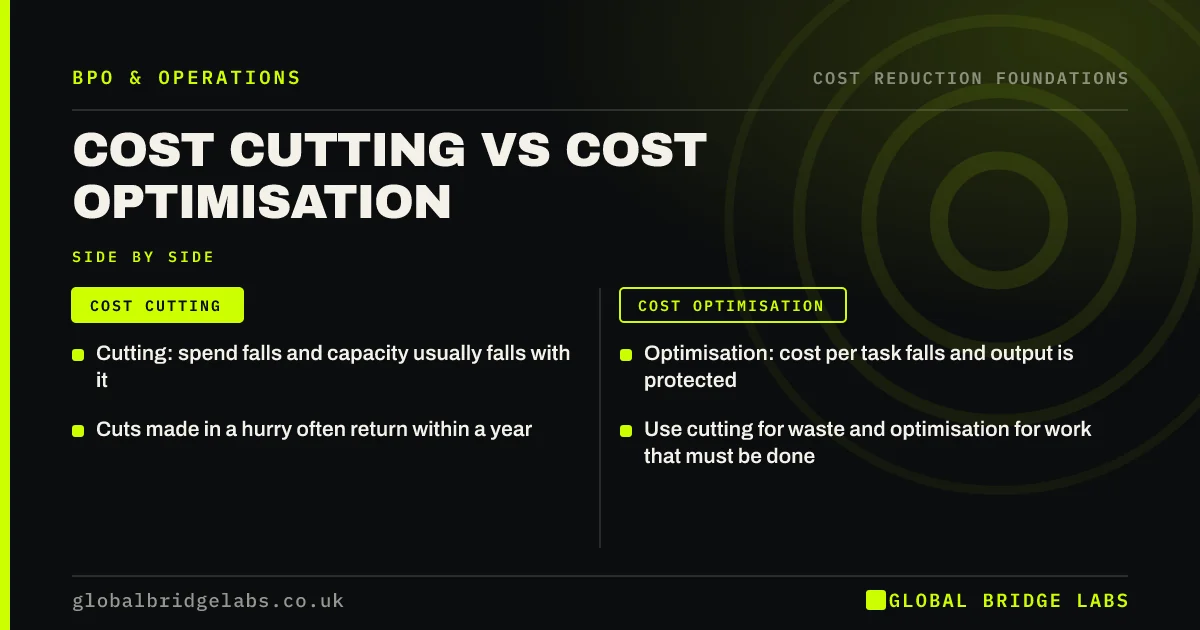
- Cutting: spend falls and capacity usually falls with it.
- Optimisation: cost per task falls and output is protected.
- Cuts made in a hurry often return within a year.
- Use cutting for waste and optimisation for work that must be done.
Unsure which approach your situation needs? Message us on WhatsApp with what is driving the review.
Chat on WhatsApp →What is the difference between the two?
Cost cutting is the removal of a cost, usually quickly and across the board. Cost optimisation is the redesign of how work is done so that the same result costs less. The first asks what can be stopped. The second asks what each task should cost and why it currently costs more.
What does each look like in numbers?
Take an illustrative support team of three costing £103,500 a year and handling 30,000 customer contacts, or £3.45 per contact. Cutting one role saves £34,500, but the remaining two cannot handle the volume, so replies slow and repeat contacts rise.
Optimising keeps the capacity. Removing avoidable contacts, standardising replies and moving routine queries to a managed team could bring the same 30,000 contacts down towards £2 each. The saving is similar, and customers do not notice the change. These are example figures to show the mechanism.
- Cut: £34,500 saved, capacity down by a third.
- Optimise: a similar saving, capacity unchanged.
- Cut: effect seen in a month.
- Optimise: effect seen in a quarter.
When is plain cost cutting the right call?
Plain cost cutting is right when the spend produces nothing: unused software seats, duplicate subscriptions, reports nobody reads, a service that customers no longer buy. It is also right in a cash emergency, when survival matters more than efficiency. In both cases, speed is the point.
How do you optimise costs instead of cutting them?
Optimise by working on the process before the budget. Measure what a task costs today, remove steps that add nothing, standardise what remains, and then choose the cheapest reliable way to run it: software, a managed team or your own staff. The budget falls as a result of the redesign.
- 1. Measure cost per task today.
- 2. Remove steps and contacts that should not exist.
- 3. Standardise the steps that remain.
- 4. Choose who or what runs the process.
- 5. Measure cost per task again after 90 days.
- Cost baseline: measure today's cost before you change it
- Process standardisation: one best way, lower cost per task
- The cost lever scorecard: find savings process by process
Want to see what optimising one process would save? Send us the process on WhatsApp.
Chat on WhatsApp →What are the risks of optimisation?
Optimisation takes longer, needs measurement the business may not have, and can become an excuse to avoid a hard decision. If cash is short this quarter, a three-month redesign does not help. A sensible plan often does both: cut obvious waste now, and optimise the work that has to continue.
What does this look like in practice?
A pattern we see after a difficult year: a firm trims its admin team to save money, then finds invoices going out late and senior staff answering the phone. The saving on paper is replaced by a larger cost in delayed cash and lost fee-earning hours. Rebuilding the process first, then deciding the team, avoids paying twice.
Cost optimisation checklist
Ask these questions before any budget line is cut.
- What output does this cost produce?
- Who notices if it stops?
- What does one unit of that output cost today?
- Which steps could be removed without loss?
- Could the same output be delivered a cheaper way?
- How will we know in 90 days that quality held?
Next step
Tell us the cost you are under pressure to reduce and what it currently delivers. We will show you whether it is a candidate for cutting, optimising or leaving alone.
Message us on WhatsApp to talk through a cost optimisation plan, or book a 30-minute consultation.
Chat on WhatsApp →Sources and further reading
- Labour productivity · Office for National Statistics
- The Green Book: appraisal and evaluation in central government · HM Treasury
Frequently asked questions
What is cost optimisation?
Cost optimisation is the practice of lowering the cost of delivering a result without lowering the result. It works on processes, methods and sourcing, so the cost per task falls while output and quality are protected. It is slower than a budget cut but the saving is more likely to last.
Is cost reduction the same as cost cutting?
The terms are often used interchangeably. Where a distinction is made, cost cutting means removing spend quickly, while cost reduction or optimisation means lowering the cost of work that continues. The practical question is whether capacity and quality fall with the spend.
Why do cost cuts often fail to stick?
Cuts fail to stick when the work still has to be done. If a role is removed but its tasks remain, they move to other staff, overtime or contractors, and the cost reappears under a different heading. Lasting savings come from changing the work itself.
Can outsourcing be cost optimisation?
Yes, when it lowers cost per task at the same standard. Moving a documented, measurable process to a managed team keeps the output and reduces what each unit costs. Outsourcing only to buy the cheapest hourly rate, with no process change, is closer to cost cutting and carries the same risks.
Written by

Global Bridge Labs (GBL) is a UK–Sri Lanka partner for social media, websites and BPO. Everything here comes from client delivery, not theory.


