
On this page
- 01Key takeaways
- 02What is the cost of complexity?
- 03Where does complexity come from?
- 04How do you measure it?
- 05How do you reduce complexity?
- 06When is complexity worth paying for?
- 07Can outsourcing absorb complexity?
- 08What does this look like in practice?
- 09Complexity checklist
- 10Next step
- 11Sources and further reading
- 12Frequently asked questions
Key takeaways
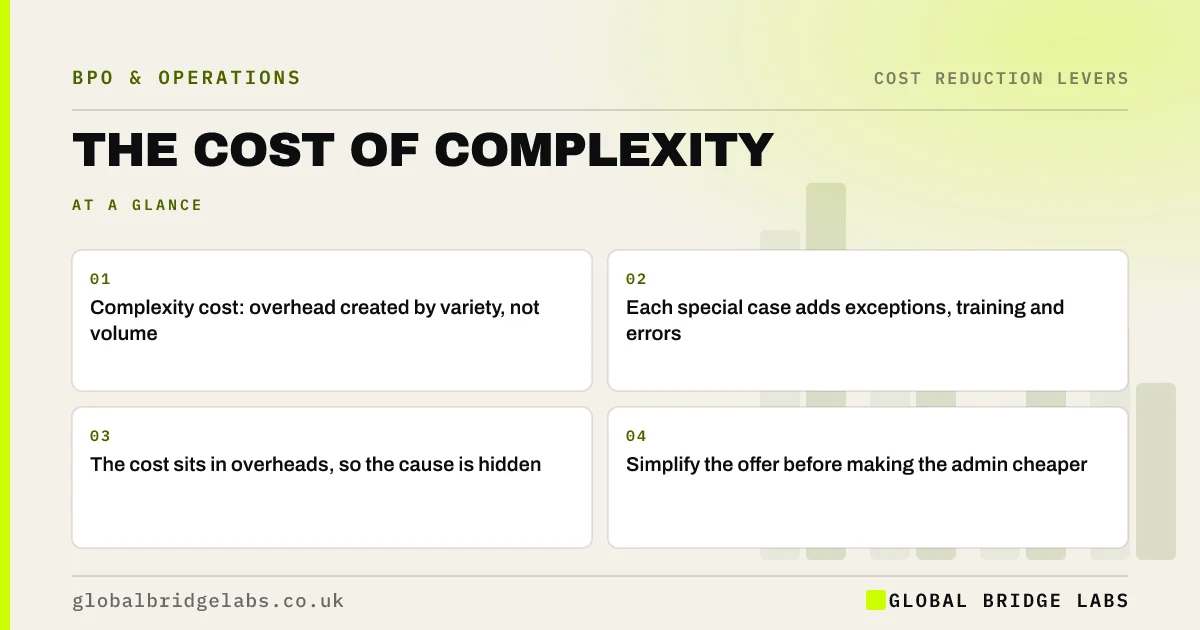
The cost of complexity is the extra operating cost created by variety: more products, options, price lists, customer terms and ways of doing things. Each addition looks cheap on its own. Together they multiply exceptions, training and errors. Complexity costs are hard to see because they sit in overheads, not against the product that caused them.
- Complexity cost: overhead created by variety, not volume.
- Each special case adds exceptions, training and errors.
- The cost sits in overheads, so the cause is hidden.
- Simplify the offer before making the admin cheaper.
Want a view on where complexity is costing you? Message us on WhatsApp with what you sell and how.
Chat on WhatsApp →What is the cost of complexity?
The cost of complexity is the additional cost a business incurs because of the number of different things it sells, the ways it sells them and the exceptions it allows. It is separate from the cost of volume. Selling twice as much of one product doubles some costs. Selling the same amount across twenty variants adds costs that volume never would.
Where does complexity come from?
Complexity comes from saying yes one reasonable request at a time. A custom payment term for a good client. A product variant for one order. A separate process for a customer who prefers fax. Each decision made sense. Nobody decided to have forty price lists.
- Product and service variants with small sales.
- Customer-specific prices, terms and paperwork.
- Several systems or channels doing the same job.
- Legacy processes kept for a handful of customers.
- Different ways of working at each site.
How do you measure it?
Measure it by ranking products, customers and processes by revenue and by the effort they consume. Most firms find a long tail: a large share of variants producing a small share of revenue and a disproportionate share of work.
In an illustrative firm with 60 product lines, the bottom 30 bring in 8% of revenue. A two-week log shows they generate 30% of customer queries and most of the special handling. The tail is not paying for the admin it creates.
- 1. Rank products and customers by revenue.
- 2. Log queries, exceptions and admin time against each.
- 3. Compare share of revenue with share of effort.
- 4. Flag anything with a large gap.
Want help running this comparison? Send us your product or customer list on WhatsApp.
Chat on WhatsApp →How do you reduce complexity?
Reduce complexity by removing, standardising or charging for it. Remove variants nobody would miss. Standardise terms so most customers share one set. Where a special arrangement is worth keeping, price it so it pays for its own handling.
- Retire low-selling variants.
- Move customers onto standard terms at renewal.
- Set a price or minimum for non-standard requests.
- Close duplicate channels and systems.
- Agree one process across sites.
When is complexity worth paying for?
Complexity is worth paying for when customers value it and pay for it. A bespoke service is complexity sold at a premium. The problem is unpriced complexity: variety given away because nobody knew what it cost. The aim is deliberate complexity, not none.
Can outsourcing absorb complexity?
Outsourcing can absorb complexity, at a price. A managed team will handle forty price lists if you document all forty, but training takes longer, errors are likelier and the cost per task is higher than for a simple process. Simplify first. Providers quote more keenly, and deliver more reliably, for work with clear rules.
What does this look like in practice?
A pattern we see in established firms: a new starter takes months to become useful because of everything they must remember about individual customers. The business reads that as a training problem. It is a complexity problem. Halving the number of special arrangements does more for training time than any manual.
Complexity checklist
Review these once a year.
- How many products or services bring in the last 10% of revenue?
- How many customers have non-standard terms?
- How many price lists are live?
- How many systems hold customer data?
- How long does a new starter take to work alone?
- Which special arrangements are priced to cover their cost?
Next step
Tell us how many products, price lists and special terms your team has to manage. We will help you see which are earning their keep and which are quietly raising your costs.
Message us on WhatsApp to review complexity in your operations, or book a 30-minute consultation.
Chat on WhatsApp →Sources and further reading
- Labour productivity · Office for National Statistics
- Business population estimates for the UK and regions 2025 · Department for Business and Trade
Frequently asked questions
What are complexity costs?
Complexity costs are the extra operating costs caused by variety in products, customers, processes and systems. They include additional training, more exceptions, more errors, more stock or records to maintain and more management attention. They rise with the number of different things a business does, not with how much it sells.
Why is complexity hard to see in the accounts?
Because its cost is spread across overheads. The time spent handling a special case appears as wages for the admin or support team, not as a cost of the product or customer that caused it. Standard accounts therefore make complex items look more profitable than they are.
How do you simplify a business without losing customers?
Start with what customers would not miss: variants with tiny sales and legacy processes used by a few. For valued special arrangements, move customers to standard terms at renewal or charge for the extra handling. Most accept a clear standard when it is explained.
Does growth always increase complexity?
Growth usually adds complexity unless it is actively managed, because each new customer and product brings its own requirements. Businesses that keep complexity in check review their range and terms regularly and treat every new exception as a decision with a cost.
Written by

Global Bridge Labs (GBL) is a UK–Sri Lanka partner for social media, websites and BPO. Everything here comes from client delivery, not theory.


