
On this page
- 01Key takeaways
- 02How do you use the checklist?
- 03Measurement: do you know what work costs?
- 04Process: is the work designed well?
- 05People: is the right person doing the work?
- 06Suppliers: are bought-in costs managed?
- 07What does your score mean?
- 08What should you not conclude from it?
- 09What does this look like in practice?
- 10Next step
- 11Sources and further reading
- 12Frequently asked questions
Key takeaways
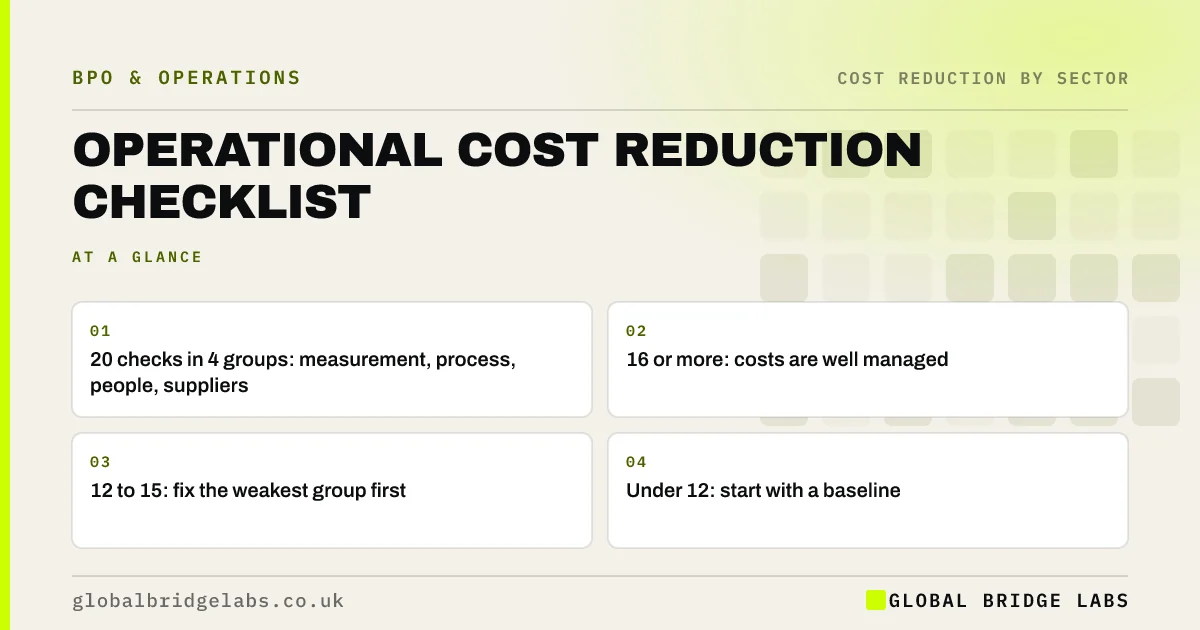
This operational cost reduction checklist has 20 checks in four groups of five: measurement, process, people and suppliers. Answer yes or no to each. A score of 16 or more means costs are well managed. A score of 12 to 15 means fix the weakest group. Under 12, start with a baseline before changing anything.
- 20 checks in 4 groups: measurement, process, people, suppliers.
- 16 or more: costs are well managed.
- 12 to 15: fix the weakest group first.
- Under 12: start with a baseline.
Want to go through the 20 checks with someone? Message us on WhatsApp and we will score it with you.
Chat on WhatsApp →How do you use the checklist?
Use the checklist once a quarter with whoever runs operations. Answer each check yes only if you could show evidence today. Count the yes answers per group and in total. The group with the lowest score is where to work next, whatever the overall total.
Measurement: do you know what work costs?
The first five checks ask whether you can see your costs at the level where they can be changed. Most small businesses score lowest here, because the accounts show totals, not tasks.
- 1. We know our operating expense ratio for the last three years.
- 2. We know the cost per task for our three largest routine processes.
- 3. We have logged where admin time goes in the last 12 months.
- 4. We track error or rework rates for key processes.
- 5. We review the five largest budget variances every month.
Process: is the work designed well?
The next five ask whether routine work is done in a consistent, lean way. A no here usually means savings are available without spending anything.
- 6. Our main routine processes are written down.
- 7. Everyone doing a task follows the same method.
- 8. Data is entered once and not retyped between systems.
- 9. We have removed reports and approvals nobody uses.
- 10. We know our top causes of avoidable customer contact.
- Process standardisation: one best way, lower cost per task
- Double data entry: what rekeying costs and how to stop it
- Failure demand: the customer contacts you pay for twice
Scoring low on process? Send us one process on WhatsApp and we will suggest what to remove.
Chat on WhatsApp →People: is the right person doing the work?
These five ask whether expensive time is spent on work that needs it. At the 2026/27 National Living Wage, an employee costs about £16.27 per worked hour. A senior person costs two or three times that, so who does the task matters as much as how long it takes.
- 11. Owners and senior staff spend under five hours a week on routine admin.
- 12. Regular overtime is under control and its cause is known.
- 13. Every vacancy is reviewed before it is replaced.
- 14. Holiday and sickness are covered without a backlog.
- 15. Staff are asked regularly where time is wasted.
Suppliers: are bought-in costs managed?
The last five cover what you buy. They apply to software and agencies as much as to an outsourcing provider. If existing work transfers to a provider, TUPE may apply, and under UK GDPR any provider handling personal data needs a written contract.
- 16. We have compared in-house cost per task with a market quote.
- 17. Every supplier has a written scope we can check invoices against.
- 18. We know how each contract's price changes each year.
- 19. We review key suppliers at least quarterly.
- 20. We report savings as a recurring annual figure, net of our own time.
What does your score mean?
Count one point per yes. The total shows how well costs are managed overall, and the group scores show where to act. These cut-offs are GBL's working guide, not an industry standard.
- 16 to 20: well managed. Keep reviewing quarterly.
- 12 to 15: sound in places. Fix the weakest group first.
- Under 12: start with a time log and a baseline.
- Any group at 2 or below: make it this quarter's priority.
What should you not conclude from it?
A low score does not mean the business is badly run. It means costs have not been looked at in this way, which is true of most small firms. A high score does not mean there is nothing to save. It means you have the information to find it quickly. The checklist tests visibility and control, not thrift.
What does this look like in practice?
A pattern we see when owners score themselves: confident answers on suppliers and people, and a row of no answers under measurement. They negotiate hard and manage carefully, and have never been shown what a single invoice or customer reply costs to produce. Two weeks of logging usually changes which costs they think matter.
Next step
Score the 20 checks and send us your four group totals. In a 30-minute call we will go through the weakest group with you and suggest the first three actions.
Message us on WhatsApp with your checklist score, or book a 30-minute consultation.
Chat on WhatsApp →Sources and further reading
- National Minimum Wage and National Living Wage rates · GOV.UK
- Contracts and liabilities between controllers and processors · Information Commissioner's Office
- Business transfers, takeovers and TUPE · GOV.UK
Frequently asked questions
What should a cost reduction checklist cover?
It should cover four areas: whether you measure what work costs, whether processes are consistent and free of waste, whether the right people are doing the work, and whether bought-in costs are scoped, reviewed and compared with the market.
How often should a business review its operating costs?
Quarterly is a sensible rhythm for a small business. It is frequent enough to catch drifting costs and infrequent enough to see the effect of changes. Monthly review of the largest budget variances fills the gap between full reviews.
Where should a small business start with cost reduction?
Start with measurement. Log where routine time goes for two weeks and work out the cost per task for the three largest processes. Without that, it is hard to tell which costs are worth attention and impossible to prove a saving later.
Does a high checklist score mean there are no savings?
No. A high score means costs are visible and controlled, which makes savings easier to find and prove. Businesses that measure well often keep finding improvements, because they can see small changes in cost per task as they happen.
Written by

Global Bridge Labs (GBL) is a UK–Sri Lanka partner for social media, websites and BPO. Everything here comes from client delivery, not theory.


