On this page
- 01Key takeaways
- 02What does cost-effective mean for in-house vs outsourcing?
- 03What does an in-house employee really cost per hour?
- 04What does outsourcing cost per hour?
- 05How do in-house and outsourced teams compare?
- 06What does a worked example look like?
- 07When is in-house more cost-effective?
- 08When is outsourcing more cost-effective?
- 09Which costs are most often left out?
- 10How do you score in-house vs outsourcing?
- 11Does outsourcing cost you quality or control?
- 12Can you combine in-house and outsourced teams?
- 13How does the answer change by business size?
- 14What does this look like in practice?
- 15In-house vs outsourcing cost checklist
- 16Next step
- 17Sources and further reading
- 18Frequently asked questions
Key takeaways
In-house vs outsourcing cost comes down to cost per productive hour at the quality you need. For repeatable support and back-office work, outsourcing is usually 30% to 50% cheaper for UK SMEs once employer costs, overheads, idle time and cover are counted. In-house wins for core, judgement-heavy or fully used roles.
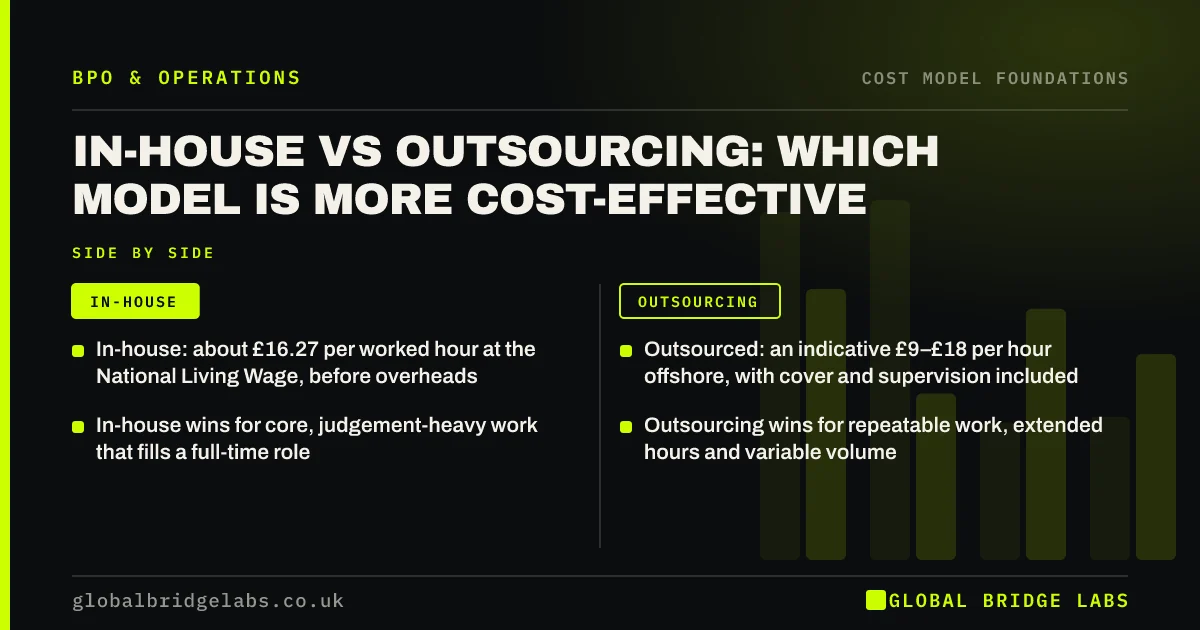
- In-house: about £16.27 per worked hour at the National Living Wage, before overheads.
- Outsourced: an indicative £9–£18 per hour offshore, with cover and supervision included.
- In-house wins for core, judgement-heavy work that fills a full-time role.
- Outsourcing wins for repeatable work, extended hours and variable volume.
Want this comparison run on your own roles? Message us on WhatsApp with the tasks and hours.
Chat on WhatsApp →What does cost-effective mean for in-house vs outsourcing?
Cost-effectiveness is the cost of each unit of useful work delivered at the quality and speed you need. It is not the cheapest hourly rate. An in-house team is cost-effective when its people are fully used on work that needs them; outsourcing is cost-effective when it delivers the same output for less once every cost is counted on both sides.
This article compares the two operating models across a whole business. If you are deciding about one specific role, the decision guide on whether to outsource or hire covers that narrower question.
What does an in-house employee really cost per hour?
A UK employee costs far more than their salary. Using 2026/27 GOV.UK rates, a full-time employee on the National Living Wage of £12.71 costs about £28,309 a year after employer National Insurance at 15% above £5,000 and the 3% minimum pension contribution. With 28 days of statutory holiday, that is about 1,740 worked hours, or £16.27 per worked hour.
The same calculation at higher salaries is below. Recruitment, equipment, software, desk space, training, sick pay and management time all come on top, which typically adds several thousand pounds a year per person.
- £25,000 salary: about £28,563 a year, or £16.42 per worked hour.
- £30,000 salary: about £34,463 a year, or £19.81 per worked hour.
- £35,000 salary: about £40,363 a year, or £23.20 per worked hour.
- £45,000 salary: about £52,163 a year, or £29.98 per worked hour.
- £60,000 salary: about £69,571 a year, or £39.98 per worked hour.
What does outsourcing cost per hour?
As indicative market ranges, UK businesses pay around £9–£18 per hour for a managed offshore team and £20–£35 per hour for an onshore UK provider. A managed rate should include recruitment, training, supervision, quality checks and holiday cover. Skilled or specialist work, nights and weekends, and small volumes sit at the top of each range.
These are ranges, not quotes. Always compare two or three providers against the same written scope, and check what the rate includes before comparing it with a salary.
How do in-house and outsourced teams compare?
The comparison below is for office-based support and back-office work that can be done remotely. It shows where each model tends to carry cost, not which is always better.
- Rate: in-house carries salary plus employer costs; outsourced is one all-in rate.
- Idle time: in-house pays for every contracted hour; outsourced pay can follow volume.
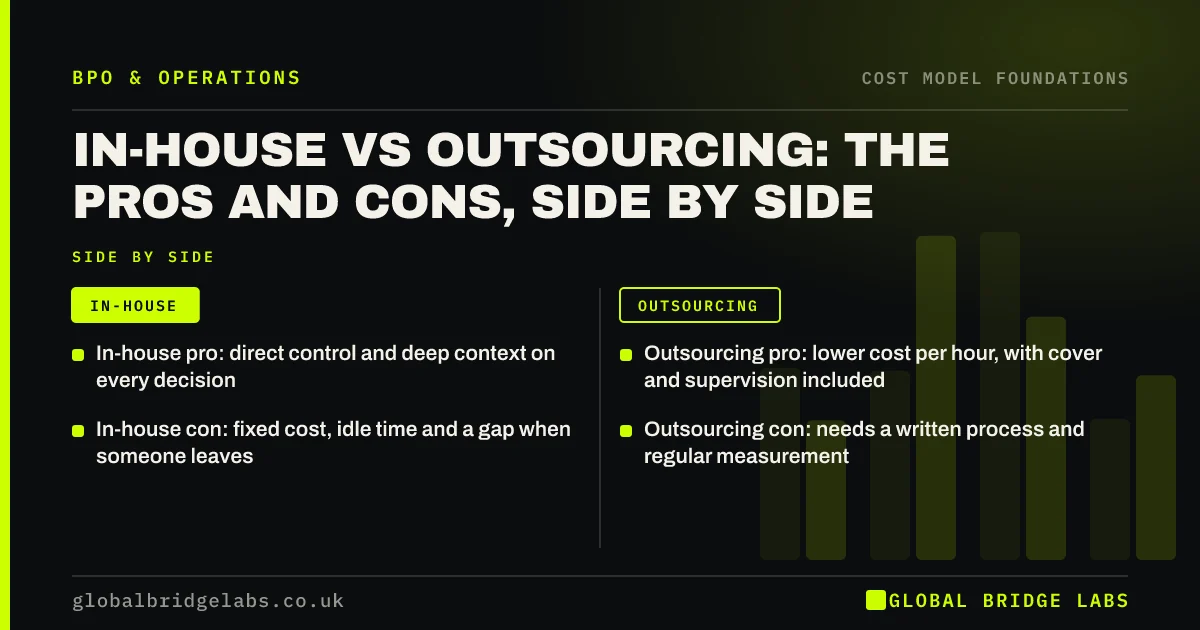
- Cover: in-house needs a second person for holidays and sickness; managed teams include it.
- Hiring: in-house pays recruitment and training each time someone leaves; the provider absorbs it.
- Control: in-house gives direct day-to-day control; outsourced control runs through a process and SLAs.
- Knowledge: in-house keeps deep context; outsourced needs documentation to keep it.
- Exit: in-house exit means notice, and possibly redundancy; outsourced exit means contract notice.
What does a worked example look like?
Take a UK SME with about 1,400 productive hours a year of email, order and admin work, roughly 27 hours a week. In-house, that needs one full-time hire. At a £28,000 salary the employment cost is about £32,103; add about £3,000 for software, equipment and desk space and 2 hours a week of management at £40 an hour, and the total is about £39,300 a year.
Outsourced at an indicative £12–£15 per hour, the same 1,400 hours cost £16,800–£21,000, plus about 1 hour a week of management, £2,080. The total is roughly £18,900–£23,100 a year, a saving of about £16,000–£20,000, or 41% to 52%. Cover for holidays and sickness is included on the outsourced side and missing on the in-house side.
Want this worked example rebuilt with your salaries and volumes? Send them to us on WhatsApp and we will discuss your requirements.
Chat on WhatsApp →When is in-house more cost-effective?
In-house is more cost-effective when the work is core to what you sell, needs judgement built over years, is used for a full working week, or needs someone physically present. It also wins when volume is tiny, because setup and management time cost more than the hours saved.
- The role is fully used, with little idle time.
- The work is your product, or the relationship customers pay for.
- Decisions need deep context that cannot be written down.
- Someone must be on site, with your equipment or customers.
- Volume is only a few hours a week.
When is outsourcing more cost-effective?
Outsourcing is more cost-effective for repeatable, rules-based work that can be documented, done remotely and measured. The saving is largest when the work needs cover beyond one person's hours, when volume moves up and down, or when it currently sits with senior staff whose time is worth more elsewhere.
- Customer email, chat, phones and WhatsApp.
- Data entry, order processing and CRM updates.
- Invoicing, credit control and supplier admin.
- Appointment booking and diary management.
- Work that needs extended or UK-hours cover.
Which costs are most often left out?
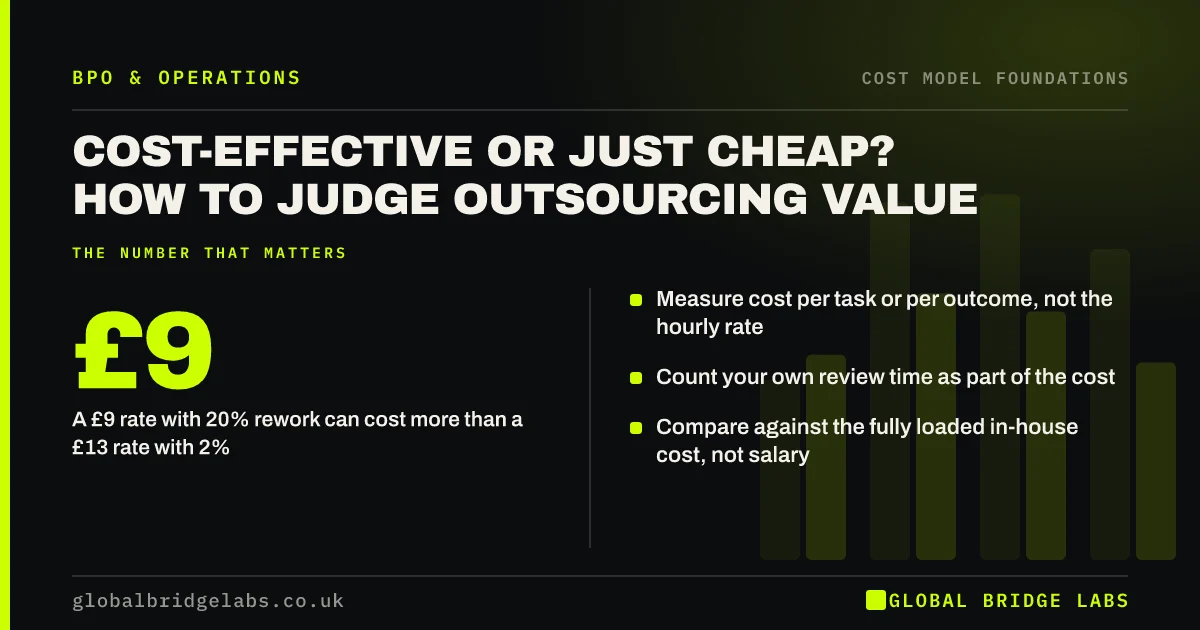
Most in-house vs outsourcing comparisons go wrong because one side is costed fully and the other is not. On the in-house side, people forget idle time, turnover and management. On the outsourced side, they forget their own review time, transition effort and exit terms.
- In-house: recruitment, training, turnover, sickness, idle time and overheads.
- In-house: the manager's time spent supervising, reviewing and covering.
- Outsourced: setup, documentation and your review time in the first months.
- Outsourced: minimum terms, notice periods, tool licences and exit costs.
How do you score in-house vs outsourcing?
The GBL Cost-Effectiveness Scorecard rates five factors from 0 to 2, where 0 favours in-house, 1 is neutral and 2 favours outsourcing: rate, utilisation, cover, quality and flexibility. A score of 8 to 10 points to outsourcing, 5 to 7 to a hybrid or a pilot, and 4 or below to keeping the work in-house.
- Rate: is the loaded in-house cost per hour well above the outsourced rate?
- Utilisation: are in-house people idle or doing low-value work for part of the week?
- Cover: does the work need holiday, sickness or extended-hours cover?
- Quality: can the work be documented and checked against a standard?
- Flexibility: does volume change, or might you need to scale down?
Does outsourcing cost you quality or control?
It can, if the process is handed over undocumented and nobody measures the result. With a written process, agreed service levels and a monthly scorecard, quality is usually as good as in-house and more consistent, because a managed team has supervision and quality checks that a single employee does not. Control moves from watching people to measuring outcomes.
Can you combine in-house and outsourced teams?
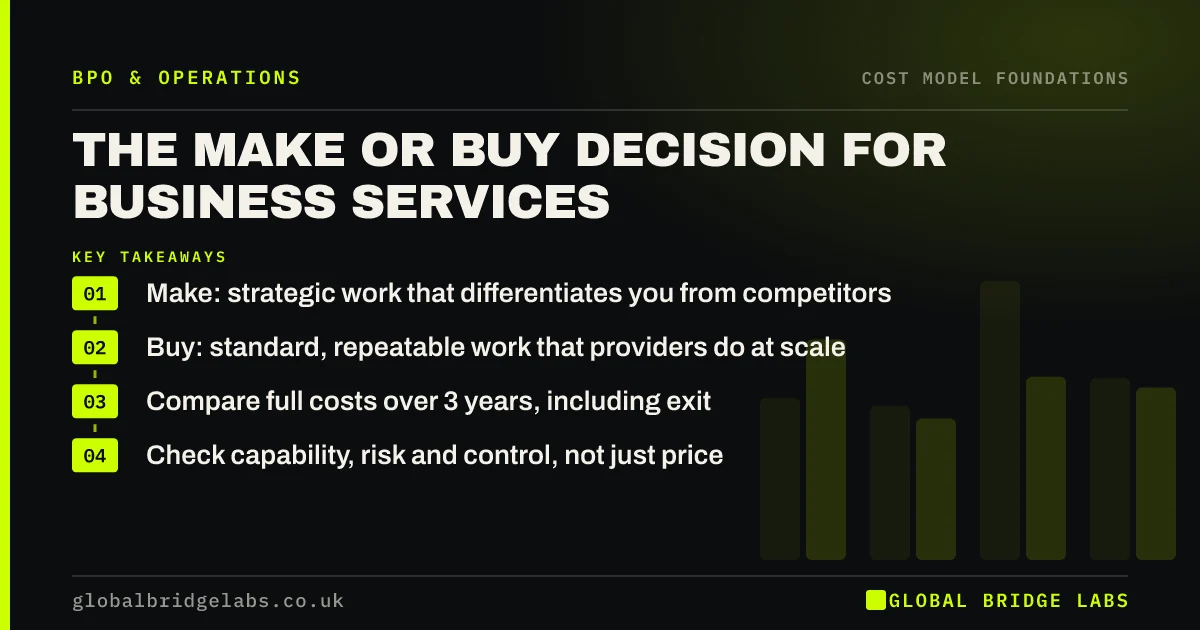
Yes, and for most SMEs the cheapest model is a mix. Keep the core, relationship and judgement work in-house, and outsource the repeatable volume, the overflow and the out-of-hours cover. The in-house team then works on what only it can do, and the outsourced team absorbs the peaks.
How does the answer change by business size?
Business size changes the comparison because fixed costs are spread differently. A micro business with one administrator has no cover and a key-person risk on every task, so outsourcing often wins on resilience before cost. A business with 20 to 50 staff can keep a small in-house core fully used and outsource overflow, peaks and extended hours.
Larger SMEs with steady, high volumes sometimes find a well-run in-house team is cheaper for their core processes, and use outsourcing for specialist skills and cover. The GBL Cost-Effectiveness Scorecard applies at every size; only the answers change.
- Under 10 staff: outsourcing usually wins on cover and key-person risk.
- 10 to 50 staff: a hybrid of in-house core and outsourced volume is most common.
- 50 staff and above: in-house can win for steady, high-volume core work.
What does this look like in practice?
A pattern we see in UK professional services firms: two administrators cover email, document chasing and diary work, but the workload peaks at month end and drops mid-month. Costed fully, the second role is used for about 60% of its hours. Moving the overflow and chasing to a managed team, while keeping one in-house administrator for client-facing work, lowers total cost and removes the month-end backlog.
Across our client work, back-office cost per task has fallen by 42% once the process was written down and run by a managed team, and owners have got 31 hours a week back.
In-house vs outsourcing cost checklist
Use these steps before deciding either way.
- List the tasks and measure the hours each takes per month.
- Cost in-house hours at the loaded rate, including overheads and idle time.
- Get outsourced quotes for the same written scope.
- Add your management time to both sides.
- Score the five factors on the Cost-Effectiveness Scorecard.
- Pilot one process for 60 to 90 days before moving more.
- Review cost per task and quality against the baseline.
Next step
Send us the roles, tasks and hours you are weighing up. In a 30-minute call we will cost the in-house and outsourced options side by side with real market ranges, and tell you plainly if in-house is the better answer.
Message us on WhatsApp for an in-house vs outsourcing comparison, or book a 30-minute consultation.
Chat on WhatsApp →Sources and further reading
- National Minimum Wage and National Living Wage rates · GOV.UK
- Rates and thresholds for employers 2026 to 2027 · HM Revenue & Customs
- Workplace pensions: what you, your employer and the government pay · GOV.UK
- Holiday entitlement · GOV.UK
- Sickness absence in the UK labour market · Office for National Statistics
Frequently asked questions
Is outsourcing cheaper than in-house staff in the UK?
For repeatable support and back-office work, usually yes. A UK employee on the National Living Wage costs about £16.27 per worked hour before overheads, while managed offshore teams cost an indicative £9–£18 per hour including cover and supervision. For core, judgement-heavy or fully used roles, keeping the work in-house is often better value.
How much can a business save by outsourcing instead of hiring?
For documented, repeatable work, UK SMEs commonly save 30% to 50% of the fully loaded in-house cost. The saving is smaller when the in-house role is already fully used and low-paid, and larger when the work currently sits with senior staff or owners, or needs holiday, sickness and extended-hours cover.
What costs should I include when comparing in-house and outsourcing?
For in-house, include salary, employer National Insurance, pension, holiday, recruitment, training, equipment, software, desk space, sickness, idle time and management. For outsourcing, include the provider rate, setup, your own review time, tool licences, minimum terms and exit costs. Leaving out either side makes the comparison misleading.
When should a business keep work in-house?
Keep work in-house when it is core to what you sell, needs deep judgement or context, fills a full-time role with little idle time, or needs someone physically on site. Also keep it when the volume is so small that setup and management time would outweigh any saving from outsourcing.
Is a mix of in-house and outsourcing cost-effective?
Often it is the most cost-effective option. Keep core, relationship and judgement work in-house, and outsource repeatable volume, overflow and out-of-hours cover. This avoids hiring for peaks, keeps skilled staff busy on the work that needs them, and adds cover that a small in-house team cannot provide on its own.
Written by

Global Bridge Labs (GBL) is a UK–Sri Lanka partner for social media, websites and BPO. Everything here comes from client delivery, not theory.