
On this page
- 01Key takeaways
- 02What are run-rate savings?
- 03How do the three types differ?
- 04How do you calculate a run-rate saving?
- 05Why does the distinction matter?
- 06Is cost avoidance worth reporting?
- 07How should savings be adjusted for volume?
- 08What does this look like in practice?
- 09Savings reporting checklist
- 10Next step
- 11Sources and further reading
- 12Frequently asked questions
Key takeaways
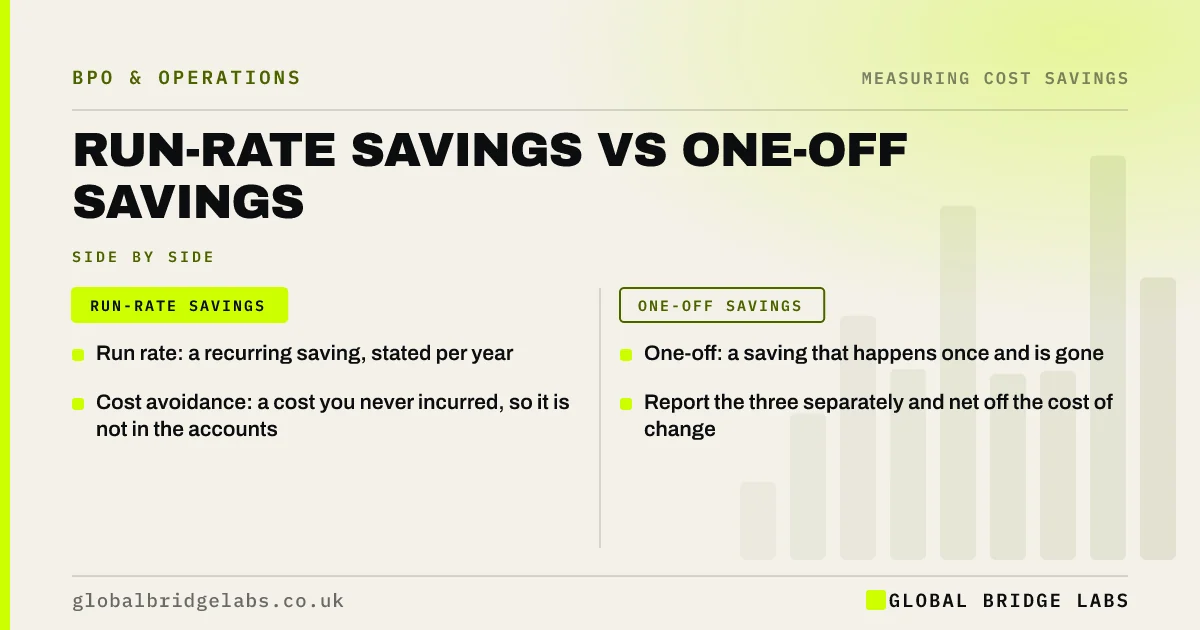
Run rate savings are savings that recur every period once a change is made, expressed as an annual figure. One-off savings happen once. Cost avoidance is spending you would have incurred and did not. Mixing the three overstates results and is the usual reason a reported saving cannot be found in the accounts.
- Run rate: a recurring saving, stated per year.
- One-off: a saving that happens once and is gone.
- Cost avoidance: a cost you never incurred, so it is not in the accounts.
- Report the three separately and net off the cost of change.
Want your savings sorted into the right categories? Message us on WhatsApp with what you have counted so far.
Chat on WhatsApp →What are run-rate savings?
A run-rate saving is the ongoing reduction in cost that results from a permanent change, measured as the difference between the old and new cost for a period and usually scaled to a year. If a process costs £1,000 a month less from April onwards, the run-rate saving is £12,000 a year.
How do the three types differ?
They differ in whether they repeat and whether they appear in the accounts. Run-rate savings repeat and can be seen as lower spend. One-off savings appear once. Cost avoidance never appears, because it is the difference between what happened and what might have.
- Run rate: process cost down £1,000 every month.
- One-off: a £2,500 refund for an overcharge.
- Avoidance: not hiring a £34,500 role you had planned to add.
How do you calculate a run-rate saving?
Subtract the new recurring cost from the baseline recurring cost for the same volume, and multiply to a year. Then show separately how much falls in the current financial year and what the change cost to make.
In an illustrative case, a process cost £5,400 a month and costs £3,500 from 1 July. The run-rate saving is £1,900 a month, or £22,800 a year. In a calendar financial year, six months fall in year one: £11,400. Setup cost £3,000, so the net benefit in year one is £8,400.
- Run-rate saving: £22,800 a year.
- In-year saving: £11,400 for six months.
- One-off cost of change: £3,000.
- Net year-one benefit: £8,400.
Want your run rate and in-year figures separated? Send us the dates and costs on WhatsApp.
Chat on WhatsApp →Why does the distinction matter?
The distinction matters because budgets are built on what repeats. A firm that reports £40,000 of savings made up of £15,000 recurring, £10,000 one-off and £15,000 avoided will find only £15,000 less in next year's cost base. Plans made on the larger figure will be short.
Is cost avoidance worth reporting?
Cost avoidance is worth reporting, labelled as what it is. Absorbing 30% more orders without adding a role is a real achievement. It just is not a reduction. Report it as avoided cost with the assumption stated, and never add it to the savings total.
How should savings be adjusted for volume?
Adjust for volume by comparing unit costs. If volume rises 20% after a change, total cost may rise even though each unit is cheaper. If volume falls, total cost drops with no improvement at all. State the saving as the change in cost per task multiplied by current volume.
What does this look like in practice?
A pattern we see at year end: a savings figure announced in spring cannot be reconciled with the accounts. Part of it was a supplier credit, part was a hire that did not happen, and the recurring part started halfway through the year. Nothing was wrong except that three different things had been added together.
Savings reporting checklist
Apply these rules to every saving you report.
- Each saving is labelled run rate, one-off or avoidance.
- Run rate is stated per year with a start date.
- In-year effect is shown separately.
- The cost of making the change is netted off.
- Unit cost and volume are both shown.
- Avoidance is never added to savings.
- Finance can trace each figure to the accounts.
Next step
Send us the savings you have recorded this year and how each was calculated. We will help you separate the recurring part and state it in a way your accountant will recognise.
Message us on WhatsApp to tidy up your savings reporting, or book a 30-minute consultation.
Chat on WhatsApp →Sources and further reading
Frequently asked questions
What does run rate mean for savings?
Run rate is the level of saving that will continue if nothing else changes, usually expressed as an annual amount. A saving of £1,900 a month is a run rate of £22,800 a year. It describes the ongoing effect, not what has been banked so far.
What is the difference between cost savings and cost avoidance?
A cost saving reduces spending below its previous level and can be seen in the accounts. Cost avoidance prevents a future cost that would otherwise have been incurred, such as a hire that was not needed. Avoidance is real but does not lower existing costs.
How do you annualise a saving?
Multiply the recurring monthly saving by twelve. Use only savings that will repeat. Also state how many months fall in the current financial year, because the in-year effect is smaller when a change starts part-way through.
Should one-off savings be reported?
Yes, but separately from recurring savings. A one-off refund or a single negotiated discount helps this year's profit and does nothing for next year's cost base. Combining the two gives a misleading picture of ongoing costs.
Written by

Global Bridge Labs (GBL) is a UK–Sri Lanka partner for social media, websites and BPO. Everything here comes from client delivery, not theory.


