On this page
- 01Key takeaways
- 02What is BPO?
- 03Why are UK businesses looking at BPO now?
- 04How can BPO help a UK business?
- 05Which business processes can you outsource?
- 06How does BPO work in practice?
- 07Onshore, nearshore or offshore: where should the work go?
- 08What does BPO cost compared with hiring?
- 09Is offshore BPO compatible with UK GDPR?
- 10When is BPO the wrong answer?
- 11What does this look like in practice?
- 12How do you choose a BPO partner?
- 13The BPO starter checklist
- 14Next step
- 15Sources and further reading
- 16Frequently asked questions
Key takeaways
What is BPO? Business process outsourcing (BPO) means handing a repeatable business process, such as customer support, admin or finance operations, to a specialist provider that staffs, runs and reports on it for you. For UK businesses it helps in three ways: it frees owner and team time, speeds up replies to customers, and lowers the cost per task.
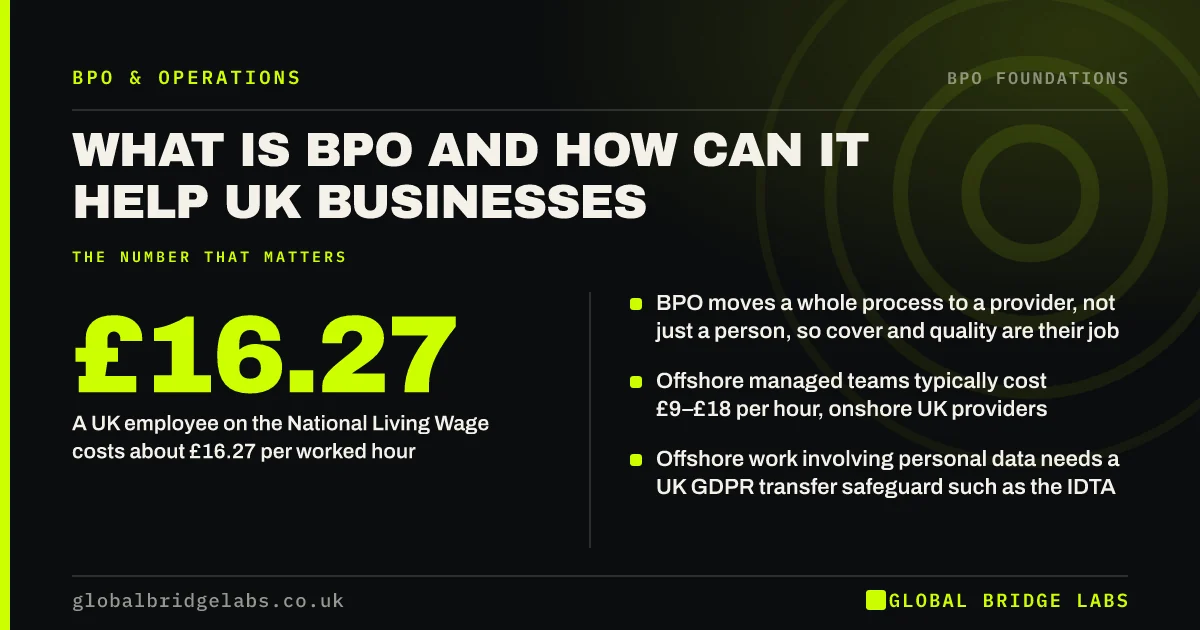
- BPO moves a whole process to a provider, not just a person, so cover and quality are their job.
- A UK employee on the National Living Wage costs about £16.27 per worked hour.
- Offshore managed teams typically cost £9–£18 per hour, onshore UK providers £20–£35.
- Offshore work involving personal data needs a UK GDPR transfer safeguard such as the IDTA.
- Outsource stable, documented, repeatable work first; keep strategy and final sign-off in-house.
Want to know which of your processes would outsource well? Message us on WhatsApp with where the hours go and we will tell you honestly.
Chat on WhatsApp →What is BPO?
BPO (business process outsourcing) is a service model in which a business contracts a specialist provider to run a defined operational process, such as answering customers, processing data or chasing invoices, to agreed standards and service levels.
The key word is process. Hiring a freelancer gives you a person's time. BPO gives you an outcome: every email answered within two hours, every invoice raised by the third working day, every call picked up within five rings. The provider recruits, trains, schedules, supervises and replaces the people doing the work, and reports to you on whether the outcome was met.
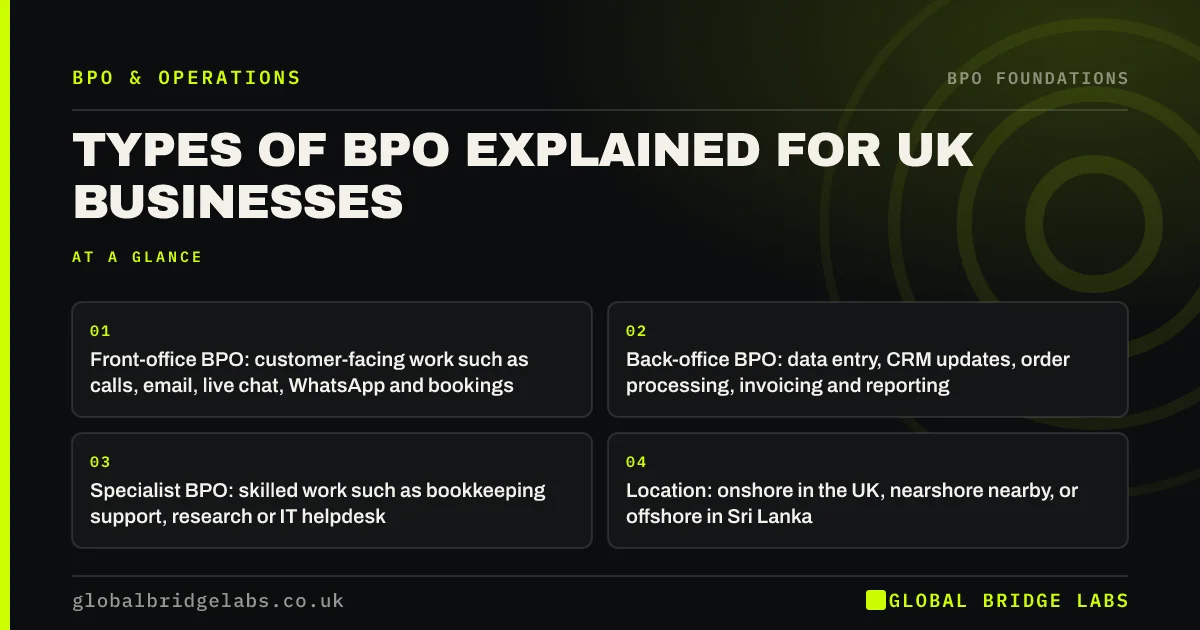
BPO is usually split into two halves. Front-office BPO covers customer-facing work: phone, email, live chat, WhatsApp and bookings. Back-office BPO covers work customers never see: data entry, CRM updates, order processing, invoicing, reconciliation and reporting. Most UK SMEs start with one of each.
Why are UK businesses looking at BPO now?
UK businesses are looking at BPO because the cost of employing people has risen faster than many small firms can pass on. From April 2025 employer National Insurance rose to 15% and the threshold at which it starts fell to £5,000 a year. From April 2026 the National Living Wage rose to £12.71 an hour for workers aged 21 and over.
At the same time, customers expect faster replies across more channels. The Institute of Customer Service's UK Customer Satisfaction Index stood at 78.3 out of 100 in July 2026, and the organisations that score well are the ones that answer quickly and resolve issues first time. For a small team, adding WhatsApp and live chat on top of phone and email often means someone's evenings disappear.
The Department for Business and Trade counted 5.7 million private sector businesses in the UK at the start of 2025, and 99.8% of them are small or medium-sized. Most do not have the scale to run a 9-to-5 support rota with holiday and sickness cover. BPO gives them that cover without hiring a team.
How can BPO help a UK business?
BPO helps a UK business by turning work that currently depends on the owner or one key person into a managed service with cover, standards and a monthly report. The benefits show up in time, speed, cost and resilience, in roughly that order for most SMEs.
- Time: owners and senior staff stop doing admin, data entry and inbox triage in the evenings.
- Speed: enquiries get answered in minutes during trading hours instead of the next morning.
- Cost: the cost per completed task falls because the provider runs the process at scale.
- Resilience: holiday, sickness and resignations stop creating backlogs, because cover is the provider's problem.
- Scalability: seats can be added before a busy season and removed after, usually on a monthly notice period.
- Visibility: a written process and a monthly scorecard replace "it's all in Sarah's head".
Which business processes can you outsource?
Almost any process that is repeatable, rules-based and can be done inside your systems can be outsourced. The best first candidates are high-volume, time-sensitive tasks that pull senior people away from revenue-earning work.
- Customer support by email, phone, live chat and WhatsApp, with escalation to your team.
- Call answering, quote requests and appointment booking into your diary.
- Inbox management: triage, tagging, drafting replies and chasing.
- Data entry, CRM updates and document processing.
- Invoicing, credit control, supplier bills and reconciliation support.
- Order processing, returns and delivery queries for e-commerce and manufacturers.
How does BPO work in practice?
BPO works as a short project followed by a managed service. The project documents the process and trains the team, usually over two to six weeks. The service then runs to agreed service levels, with a named manager, weekly check-ins in the first months and a monthly performance review.
- Scope: agree which process, what volumes, which hours and what "good" looks like.
- Document: write the process down, including the exceptions and who to escalate to.
- Set up access: give the team logins to your own tools with role-based permissions.
- Train and shadow: the team shadows your staff, then your staff review the team's work.
- Go live in stages: start with part of the volume, then expand as quality holds.
- Review: weekly at first, then monthly, against the same scorecard every time.
Onshore, nearshore or offshore: where should the work go?
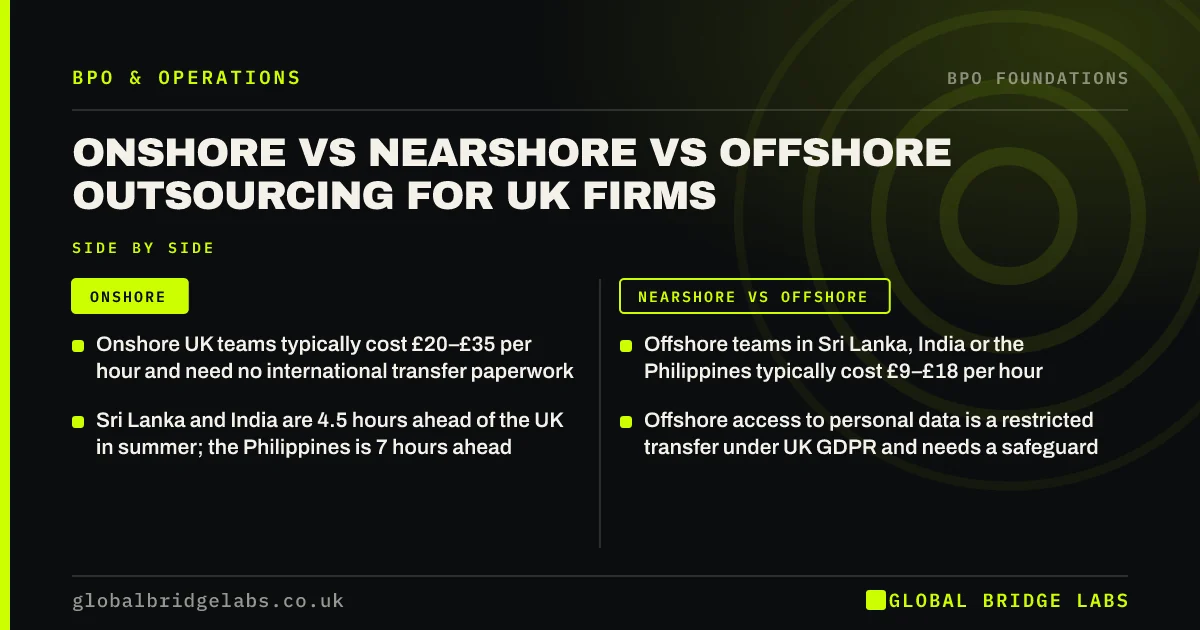
Onshore BPO keeps the team in the UK, nearshore places it in a nearby country with a small time difference, and offshore places it further away, commonly in Sri Lanka, India or the Philippines. Offshore is cheapest per hour; onshore is simplest for regulated or highly local work.
For UK businesses the practical questions are time zone, English quality, data protection and cost. Sri Lanka and India sit at UTC+5:30, so UK business hours fall in the local afternoon and evening. The Philippines is at UTC+8, so UK hours become a night shift there. That affects who you can hire and how long they stay.
What does BPO cost compared with hiring?
Indicative market ranges for UK buyers are £9–£18 per hour for a managed offshore team and £20–£35 per hour for an onshore UK provider, depending on skills, hours and volume. The honest comparison is against the fully loaded cost of an employee, not their salary.
Here is that comparison using official 2026/27 rates. A full-time employee on the National Living Wage (£12.71 × 1,950 hours) earns about £24,785 a year. Employer National Insurance at 15% above £5,000 adds about £2,968, and the 3% minimum pension contribution on qualifying earnings adds about £556. That is £28,309 before recruitment, equipment, software, management time and sick cover.
Statutory holiday is 28 days, so the same person works roughly 1,740 hours a year. That puts the cost at about £16.27 per worked hour at the legal minimum wage, and more for experienced staff. Eligible small employers can offset up to £10,500 of National Insurance through the Employment Allowance, which narrows the gap for the first few hires.
- UK employee on the National Living Wage: about £16.27 per worked hour before overheads.
- UK employee on £26,000: about £17.09 per worked hour before overheads.
- Onshore UK BPO provider: roughly £20–£35 per hour, fully managed.
- Offshore managed BPO (Sri Lanka, India, Philippines): roughly £9–£18 per hour, fully managed.
Want the same comparison run on your own roles and hours? Send us the job and the volumes on WhatsApp and we will discuss your requirements.
Chat on WhatsApp →Is offshore BPO compatible with UK GDPR?
Yes, provided the transfer is set up properly. When a provider outside the UK can access personal data you control, the ICO treats it as a restricted transfer. For countries without UK adequacy regulations, such as Sri Lanka, India and the Philippines, you need an appropriate safeguard such as the ICO's International Data Transfer Agreement (IDTA) or the UK Addendum, plus a transfer risk assessment.
You also need a written controller-processor contract covering the points the ICO lists: documented instructions, confidentiality, security, sub-processors, audit rights and what happens to the data at the end. A good provider will offer these documents before you ask, and will work inside your systems rather than copying data into theirs.
When is BPO the wrong answer?
BPO is the wrong answer when the process is not yet stable. If you change how you handle refunds every fortnight, an outsourced team will spend its time catching up and you will spend yours correcting it. Fix the process first, then outsource it.
It is also wrong for work that is your competitive edge, work that needs deep judgement on every case, and very low volumes where a few hours of a part-time employee would do. And it is wrong if nobody in the business has time to own the relationship for the first 90 days: every outsourcing failure we hear about starts with an unowned handover.
What does this look like in practice?
One public example is on our projects page: a vehicle service centre whose missed calls were costing it bookings. Its founder describes a contact centre that answers in the business's brand, cuts wait times and turns price checks into diary slots, with upsells now part of the conversation.
The pattern is common across UK service businesses. The phone rings while everyone is busy with customers, voicemail catches a fraction of callers, and the rest ring the next business on Google. Across our client work, response time to enquiries has fallen by 71% and back-office cost per task by 42% once the process was written down and handed to a managed team.
How do you choose a BPO partner?
Choose a BPO partner on evidence of how they run a process, not on the hourly rate. Ask to see a written procedure they have produced, a sample monthly report, their quality-assurance method, how they replace staff who leave, and the data protection documents they will sign.
Then check the commercial terms: notice period, minimum seats, what is included in the rate, and how you get your data and documentation back if you leave. A provider that is confident in its service will offer a short notice period rather than a long lock-in.
The BPO starter checklist
Work through these steps before you speak to any provider. They take an afternoon and they make every quote you receive comparable.
- List every recurring task and the hours it takes each week.
- Mark which tasks are repeatable, rules-based and done inside your own systems.
- Pick one front-office and one back-office process to start with.
- Write down the volumes, hours of cover and response times you need.
- Calculate the fully loaded hourly cost of doing that work in-house today.
- Document the process, including exceptions and escalation contacts.
- Check which personal data the team would access and where it is stored.
- Name one internal owner for the first 90 days.
- Agree a scorecard of five to eight measures before go-live.
Next step
If you want to know what BPO would take off your plate, book 30 minutes with us. Tell us where the hours go, and we will show you which processes would outsource well, what a managed team would cost against hiring, and what we would leave in-house. No pitch deck, and you keep the notes.
Message us on WhatsApp for a BPO capacity plan, or book a 30-minute consultation.
Chat on WhatsApp →Sources and further reading
- Rates and thresholds for employers 2026 to 2027 · HM Revenue & Customs
- National Minimum Wage and National Living Wage rates · GOV.UK
- International transfers of personal data · Information Commissioner's Office
- UK Customer Satisfaction Index · Institute of Customer Service
- Business population estimates for the UK and regions 2025 · Department for Business and Trade
Frequently asked questions
What does BPO stand for?
BPO stands for business process outsourcing. It means contracting a specialist provider to run a defined business process, such as customer support, data entry or invoicing, to agreed service levels. The provider hires, trains, manages and replaces the people doing the work, and reports to you on the results.
What is an example of BPO?
A UK plumbing firm that hands its phone lines and booking diary to an outsourced team is using BPO. So is an online retailer whose order queries and returns are handled by a managed support team, or a mortgage broker whose case admin and document chasing is run by a back-office team.
Is BPO only for large companies?
No. Small businesses often benefit most, because they cannot afford a full rota with holiday and sickness cover. Many providers start from a single part-time or full-time seat, and monthly notice periods mean an SME can test BPO on one process without a long commitment.
Is BPO the same as a call centre?
A call centre is one type of BPO. BPO also covers email, live chat and WhatsApp support, and back-office work customers never see, such as data entry, CRM updates, order processing and credit control. Most SMEs outsource a mix of front-office and back-office tasks.
How long does it take to set up BPO?
A single seat on a well-documented process can go live in about two weeks. Larger or more complex processes usually take four to eight weeks, including documentation, system access, training, shadowing and a staged go-live. Undocumented processes take longest, so writing them down first saves time.
Written by

Global Bridge Labs (GBL) is a UK–Sri Lanka partner for social media, websites and BPO. Everything here comes from client delivery, not theory.