
On this page
- 01Key takeaways
- 02What is a cost driver?
- 03What are the five drivers of operating cost?
- 04How do you find the driver behind a cost?
- 05What does that look like in numbers?
- 06Which drivers can BPO change?
- 07When is the driver outside operations?
- 08What does this look like in practice?
- 09Cost driver checklist
- 10Next step
- 11Sources and further reading
- 12Frequently asked questions
Key takeaways
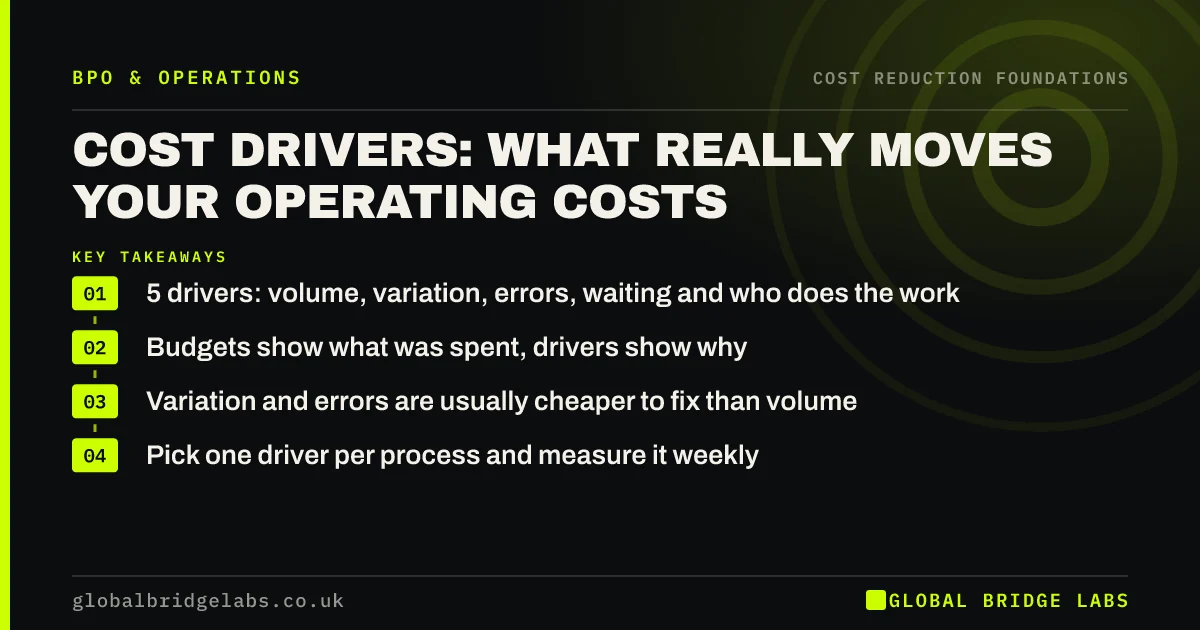
Cost drivers are the factors that cause a cost to rise or fall. In routine business work there are five: volume, variation, errors, waiting and who does the work. Budgets show what was spent. Cost drivers show why, and only the why can be changed. Most small businesses can name their costs but not their drivers.
- 5 drivers: volume, variation, errors, waiting and who does the work.
- Budgets show what was spent, drivers show why.
- Variation and errors are usually cheaper to fix than volume.
- Pick one driver per process and measure it weekly.
Want help naming the driver behind your biggest cost? Message us on WhatsApp with the process.
Chat on WhatsApp →What is a cost driver?
A cost driver is any factor that causes the cost of an activity to change. If the cost of customer service rises when order numbers rise, order volume is a driver. If it rises when the website is unclear, confusion is a driver. Identifying the driver tells you which action will lower the cost.
What are the five drivers of operating cost?
The five drivers of routine operating cost are volume, variation, errors, waiting and who does the work. Volume is how many items arrive. Variation is how many different ways they have to be handled. Errors create work twice. Waiting adds chasing and delay. And the same task costs more when a senior person does it.
- Volume: orders, enquiries, invoices, bookings.
- Variation: special cases, options, formats and exceptions.
- Errors: corrections, credits, repeat contacts.
- Waiting: approvals, missing information, handovers.
- Who does it: the loaded hourly cost of the person.
How do you find the driver behind a cost?
Find the driver by asking what would have to change for the cost to halve. Then test the answer against data. Log two weeks of items for one process and record, for each, how long it took, whether it was standard, whether it was right first time, and who handled it.
- 1. Pick one process and count items for two weeks.
- 2. Record time, type, corrections and handler for each.
- 3. Sort by time taken and look at the slowest tenth.
- 4. Name what the slow items have in common.
What does that look like in numbers?
Take an illustrative firm processing 400 orders a month. Standard orders take 6 minutes each. One in five is non-standard and takes 20 minutes. The 320 standard orders use 32 hours and the 80 non-standard ones use about 27 hours. A fifth of the volume consumes nearly half the time.
Here the driver is variation, not volume. Hiring another person to cope with volume would treat the wrong cause. Reducing the non-standard share from 20% to 10% would save more than 9 hours a month.
- Work out your cost per task before you outsource
- Process standardisation: one best way, lower cost per task
Want the same analysis on your orders or enquiries? Send us a sample on WhatsApp.
Chat on WhatsApp →Which drivers can BPO change?
BPO directly changes who does the work, and indirectly reduces errors and variation because the process has to be documented before handover. It does not change volume, and it can only reduce waiting if approvals and information reach the team on time. A provider handed a messy process will run the mess more cheaply, which is a smaller saving than fixing it.
When is the driver outside operations?
Sometimes the driver sits in sales, pricing or product. A sales team that promises bespoke terms creates exceptions for everyone downstream. A confusing invoice creates calls. In those cases the operational cost is real but the fix belongs elsewhere, and cutting the operations budget only moves the problem.
What does this look like in practice?
A pattern we see in growing firms: the support inbox is described as overwhelmed, and the request is for more people. A week of tagging shows a large share of messages asking the same two questions, both about delivery dates that the confirmation email never mentions. One sentence added to that email does more than an extra hire would.
Cost driver checklist
Work through these for your most expensive routine process.
- Count the items handled in two weeks.
- Tag each as standard or non-standard.
- Record which needed correcting.
- Record which waited for someone else.
- Note who handled each and their loaded rate.
- Name the single biggest driver and one action against it.
Next step
Tell us which process costs you most and how many items it handles a month. We will help you work out which driver is doing the damage and what would change it.
Message us on WhatsApp to find your cost drivers, or book a 30-minute consultation.
Chat on WhatsApp →Sources and further reading
- Labour productivity · Office for National Statistics
- Running a limited company: company and accounting records · GOV.UK
Frequently asked questions
What is an example of a cost driver?
The number of customer orders is a cost driver for order processing: more orders mean more time spent. The share of orders with special requirements is another, because each one takes longer. Machine hours, miles driven and number of invoices raised are other common examples.
Why do cost drivers matter?
Cost drivers matter because they show what to change. Knowing that customer service costs £100,000 gives no direction. Knowing that a third of contacts are caused by unclear delivery information tells you exactly where to act, and that the fix may cost very little.
What is the difference between a cost and a cost driver?
A cost is the amount spent, such as wages for an accounts team. A cost driver is the cause of that spend, such as the number of invoices, the share with errors, or the time spent waiting for approval. Costs appear in the accounts. Drivers have to be measured in the work.
How many cost drivers should a small business track?
One per major process is enough to start. Tracking a single driver weekly, such as non-standard orders or repeat contacts, is more useful than a long list reviewed once a year. Add a second only when the first is under control.
Written by

Global Bridge Labs (GBL) is a UK–Sri Lanka partner for social media, websites and BPO. Everything here comes from client delivery, not theory.


