
On this page
- 01Key takeaways
- 02What is the cost lever scorecard?
- 03What are the five cost levers?
- 04How do you score a process?
- 05What does a worked score look like?
- 06What do you do with the result?
- 07Where does the scorecard fall short?
- 08What does this look like in practice?
- 09Scorecard checklist
- 10Next step
- 11Sources and further reading
- 12Frequently asked questions
Key takeaways
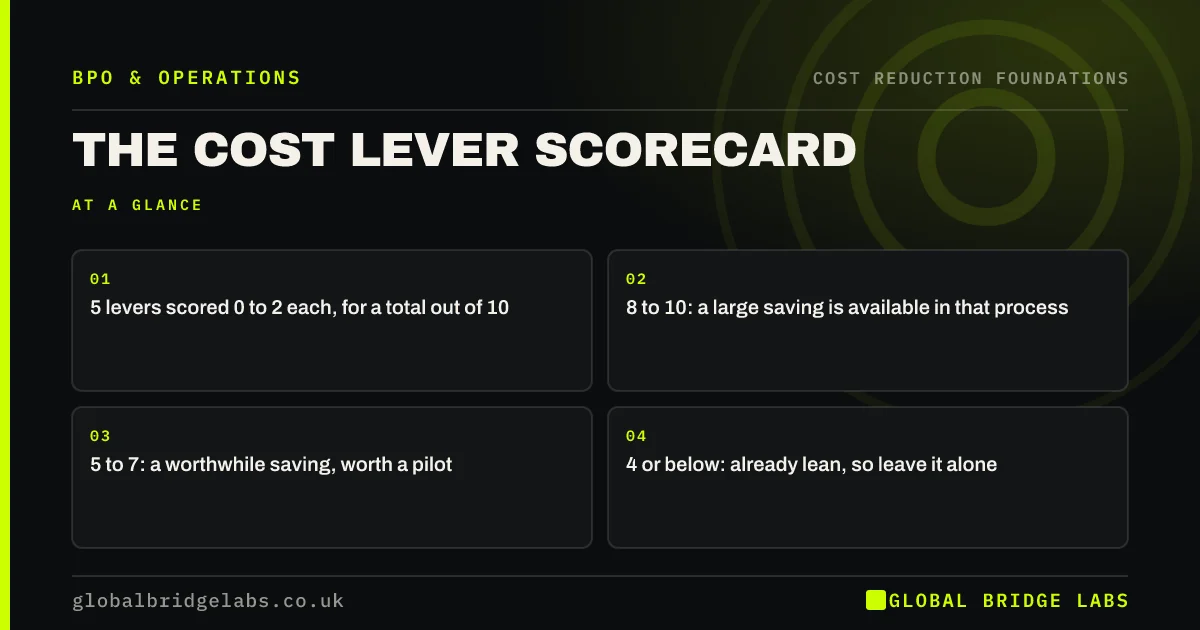
An operational cost reduction assessment should score processes, not budget lines. The GBL Cost Lever Scorecard rates each process from 0 to 2 on five levers: rate, utilisation, rework, method and overhead. A total of 8 to 10 means a large saving is available, 5 to 7 a worthwhile one, and 4 or below means the process is already lean.
- 5 levers scored 0 to 2 each, for a total out of 10.
- 8 to 10: a large saving is available in that process.
- 5 to 7: a worthwhile saving, worth a pilot.
- 4 or below: already lean, so leave it alone.
Want your top three processes scored? Message us on WhatsApp with what they are and who does them.
Chat on WhatsApp →What is the cost lever scorecard?
The GBL Cost Lever Scorecard is a five-line assessment that shows how much cost can be removed from one business process and where the saving would come from. Each line is a lever. A high score on a lever means that source of saving is still untouched.
It exists because budget reviews look at totals. Totals show what a department costs, not why, and they tend to produce cuts instead of improvements.
What are the five cost levers?
The five levers are rate, utilisation, rework, method and overhead. Together they explain almost all of the difference between what a routine process costs and what it could cost. Score each from 0, meaning nothing left to gain, to 2, meaning a clear gap.
- Rate: is the work done by someone paid more than it needs?
- Utilisation: are you paying for hours that are not used?
- Rework: how often is the work corrected or done twice?
- Method: is there one written way of doing it, or several?
- Overhead: how much management, cover and tooling does it carry?
How do you score a process?
Score a process using two weeks of real data: who did the work, how long it took, how many items were completed and how many needed correcting. Without those four numbers the scores are opinions. With them, the scoring takes about ten minutes per process.
- Rate 2: done by staff costing over £25 per worked hour. Rate 0: at or near the National Living Wage.
- Utilisation 2: the role is busy under 70% of the time. 0: over 85%.
- Rework 2: more than one item in ten needs correcting. 0: fewer than one in fifty.
- Method 2: nothing written down. 0: documented and followed.
- Overhead 2: a manager or owner supervises closely. 0: runs itself.
What does a worked score look like?
Take sales invoicing in an illustrative 15-person firm. It is done by the office manager at a loaded £23.20 per worked hour (rate 1), fills about half her week (utilisation 1 for the role overall), produces a query on roughly one invoice in eight (rework 2), follows no written steps (method 2) and is checked by the owner each Friday (overhead 2). The total is 8.
A score of 8 says the saving is large and that most of it sits in rework, method and overhead, not in the hourly rate. Writing the process down would capture much of it before anything is outsourced.
- Work out your cost per task before you outsource
- How to reduce debtor days and the cost of waiting for cash
Want a worked score for one of your processes? Send us the details on WhatsApp.
Chat on WhatsApp →What do you do with the result?
Use the total to decide whether to act and the individual lines to decide how. High rework and method scores call for documentation and quality checks. High rate and utilisation scores call for moving the work to a managed team. A high overhead score points to supervision that a provider's team leader could carry.
- 8 to 10: document it, then pilot a managed team within a quarter.
- 5 to 7: fix the weakest lever first and re-score.
- 4 or below: leave it and look elsewhere.
Where does the scorecard fall short?
The scorecard measures cost, so it will recommend changes to work that should stay with you for other reasons: client relationships, regulated judgement or commercial sensitivity. Treat a high score on core work as a prompt to simplify it, not to hand it over. It also depends on honest data, and two weeks may not capture a seasonal process.
What does this look like in practice?
A pattern we see when owners score their own processes: the one they expected to top the list, usually customer email, scores in the middle because it is already handled by a junior and reasonably well. The surprise is a finance or reporting task done by a senior person, with no written method, that nobody had thought of as a cost.
Scorecard checklist
Follow these steps to complete the assessment.
- List your ten most time-consuming routine processes.
- Log two weeks of time, volume and corrections for each.
- Score each process on the five levers.
- Rank them by total score.
- Note which lever contributes most for the top three.
- Choose one process to change this quarter.
Next step
Send us your list of routine processes and who does each. In a 30-minute call we will score the top three with you and say where the saving is most likely to be found.
Message us on WhatsApp for a cost lever scorecard session, or book a 30-minute consultation.
Chat on WhatsApp →Sources and further reading
- National Minimum Wage and National Living Wage rates · GOV.UK
- Rates and thresholds for employers 2026 to 2027 · HM Revenue & Customs
- Earnings and hours worked, occupation by four-digit SOC: ASHE Table 14 · Office for National Statistics
Frequently asked questions
How do you identify cost reduction opportunities?
Look at processes instead of budget lines. For each routine process, record who does it, how long it takes, how often it is corrected, whether it is written down and how much supervision it needs. Processes that are done by expensive staff, with frequent rework and no written method, hold the largest savings.
What is a cost lever?
A cost lever is a factor you can change to lower the cost of a process. The GBL Cost Lever Scorecard uses five: the rate paid per hour, the share of paid time that is used, the amount of rework, the method followed and the overhead carried around the work.
How long does a cost reduction assessment take?
The scoring takes about an hour for ten processes. The preparation takes longer: two weeks of logging time, volume and corrections, so the scores rest on data. A business that already tracks tickets, invoices or orders in software can often pull the numbers in a day.
Which lever usually gives the biggest saving?
It depends on who does the work. Where fully used junior staff do it, the rate lever matters most. Where senior or under-used staff do it, utilisation and overhead are larger. Where the process has never been written down, method and rework often outweigh the rate.
Written by

Global Bridge Labs (GBL) is a UK–Sri Lanka partner for social media, websites and BPO. Everything here comes from client delivery, not theory.


