
On this page
- 01Key takeaways
- 02What are economies of scale in outsourcing?
- 03Which costs does a provider share?
- 04What does that mean in numbers for a small firm?
- 05Do economies of scale ever run out?
- 06How do you check you are getting the benefit?
- 07What does this look like in practice?
- 08Economies of scale checklist
- 09Next step
- 10Sources and further reading
- 11Frequently asked questions
Key takeaways
Economies of scale in outsourcing mean a provider can run the same work for less because it spreads fixed costs across many clients. Supervision, quality checking, recruitment, training, cover and software are shared. A small business cannot employ a sixth of a team leader. Through a provider, it can buy exactly that.
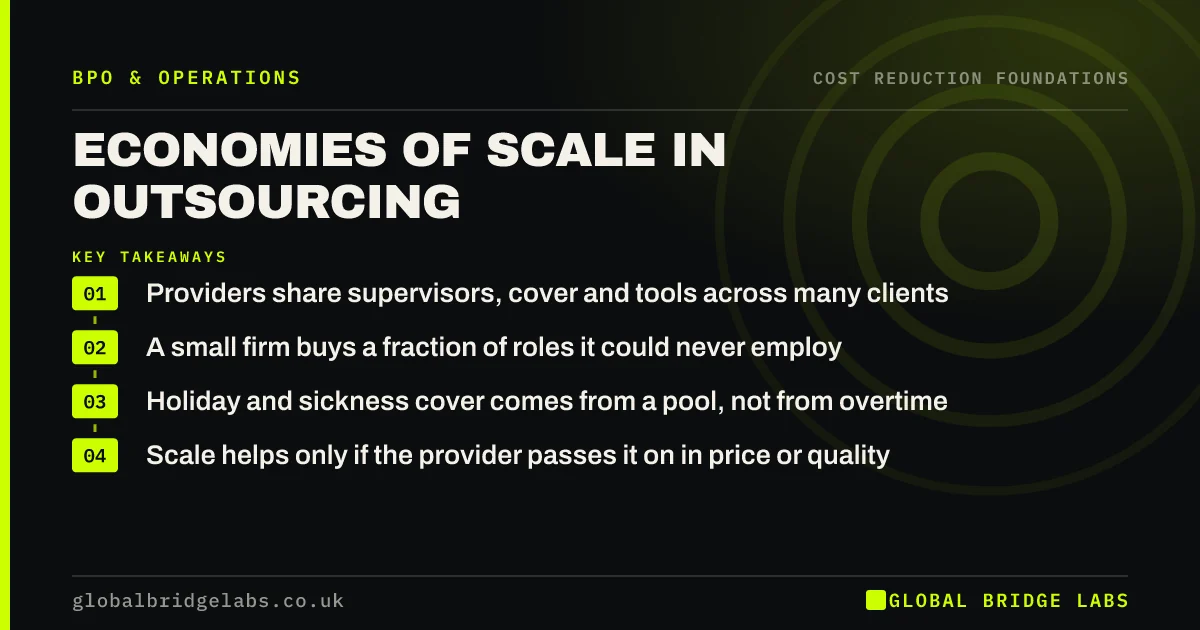
- Providers share supervisors, cover and tools across many clients.
- A small firm buys a fraction of roles it could never employ.
- Holiday and sickness cover comes from a pool, not from overtime.
- Scale helps only if the provider passes it on in price or quality.
Want to see which shared costs you are carrying alone? Message us on WhatsApp with your team structure.
Chat on WhatsApp →What are economies of scale in outsourcing?
Economies of scale are the fall in cost per unit that comes from doing more of the same thing. In outsourcing, the provider's costs for management, premises, systems and recruitment are divided across hundreds of seats, so each seat carries a small share. An in-house team of two or three carries all of those costs alone.
Which costs does a provider share?
A provider shares the costs that come in whole units and are under-used by any single small team. The clearest is supervision: one team leader can look after around 10 to 12 people, so each seat pays for a fraction. The same applies to quality checkers, trainers, recruiters, IT support and workforce planning.
- Supervision: a team leader shared across a floor.
- Quality: dedicated reviewers who sample work daily.
- Recruitment and training: a pipeline that runs all year.
- Cover: a pool to fill holiday, sickness and leavers.
- Tools: telephony, ticketing and security bought at volume.
What does that mean in numbers for a small firm?
Take an illustrative UK firm with two administrators. Supervising them takes the owner about four hours a week. Valued at an illustrative £40 an hour, that is £8,320 a year of management for two people. A provider's team leader covering 12 seats spreads a similar cost so that each seat carries a twelfth.
Cover works the same way. With 28 days of statutory holiday and an average of 4.4 days of sickness absence per worker in the UK in 2024 (ONS), each employee is away more than six weeks a year. A team of two has no slack to absorb it. A pool does.
Want your own supervision and cover costs worked out? Send us your team size on WhatsApp.
Chat on WhatsApp →Do economies of scale ever run out?
Yes. Scale stops helping when the provider becomes so large that small clients get little attention, or when your work is so specific that nothing can be shared. A specialist process run by two trained people on a large provider's floor gains the building and the tools but not the pooled knowledge.
Bigger is not automatically cheaper for you. A mid-sized provider with relevant experience often passes on more of the benefit than a very large one.
How do you check you are getting the benefit?
Check that the price includes the shared services and that you can see them working. Ask who supervises your seats and how many others they manage, how cover is provided, how often work is sampled, and what tools are included. If each of those is charged as an extra, the scale benefit is staying with the provider.
- Named team leader and their span of seats.
- Cover policy for holiday, sickness and leavers.
- Quality sampling rate and who does it.
- Tools and licences included in the rate.
What does this look like in practice?
A pattern we see in firms with a single administrator: when that person takes two weeks of holiday, the owner does the job in the evenings and a backlog builds anyway. Moving the work to a managed team does not just change the hourly cost. It removes the fortnight every year when the business runs at half speed.
Economies of scale checklist
Use these questions when comparing a provider with your own team.
- How many hours a week do you spend supervising routine work?
- Who covers holiday and sickness today, and at what cost?
- What do you spend each year on recruitment and training?
- Which tools are licensed for only one or two users?
- Is the provider's supervision included in the rate?
- How many clients share the team leader?
Next step
Tell us how many people do routine work in your business and who manages them. We will show you which costs you are carrying alone and what sharing them would change.
Message us on WhatsApp to compare your overheads with a managed team, or book a 30-minute consultation.
Chat on WhatsApp →Sources and further reading
- Sickness absence in the UK labour market · Office for National Statistics
- Holiday entitlement · GOV.UK
- Business population estimates for the UK and regions 2025 · Department for Business and Trade
Frequently asked questions
Why is outsourcing cheaper than doing work in-house?
Outsourcing can be cheaper because a provider spreads fixed costs across many clients and often operates where wages are lower. Supervision, quality checking, recruitment, training, cover and software are shared, so each seat carries a small part. A small in-house team has to fund all of those alone.
Do small businesses benefit from a provider's scale?
Small businesses often benefit most, because they are least able to fund supervisors, cover and specialist tools themselves. Through a provider they buy a share of each. The condition is that the provider is not so large that a small account gets little attention.
What is the difference between economies of scale and labour arbitrage?
Labour arbitrage is the saving from lower wage levels in another location. Economies of scale are the saving from sharing fixed costs across a large operation. A UK onshore provider offers scale without arbitrage. An offshore provider usually offers both.
Can a provider be too big?
Yes. Very large providers are built for very large contracts. A small client may be served by a standard process with little flexibility and slow escalation. For a few seats of varied work, a smaller provider with experience of similar businesses is often the better fit.
Written by

Global Bridge Labs (GBL) is a UK–Sri Lanka partner for social media, websites and BPO. Everything here comes from client delivery, not theory.


