On this page
- 01Key takeaways
- 02What is staff utilisation rate?
- 03How do you measure utilisation?
- 04How does utilisation change the cost per hour?
- 05Why does utilisation matter for in-house vs outsourcing?
- 06Does outsourcing remove idle time?
- 07Is low utilisation always bad?
- 08How do you raise utilisation without burning people out?
- 09What does this look like in practice?
- 10Utilisation checklist
- 11Next step
- 12Sources and further reading
- 13Frequently asked questions
Key takeaways
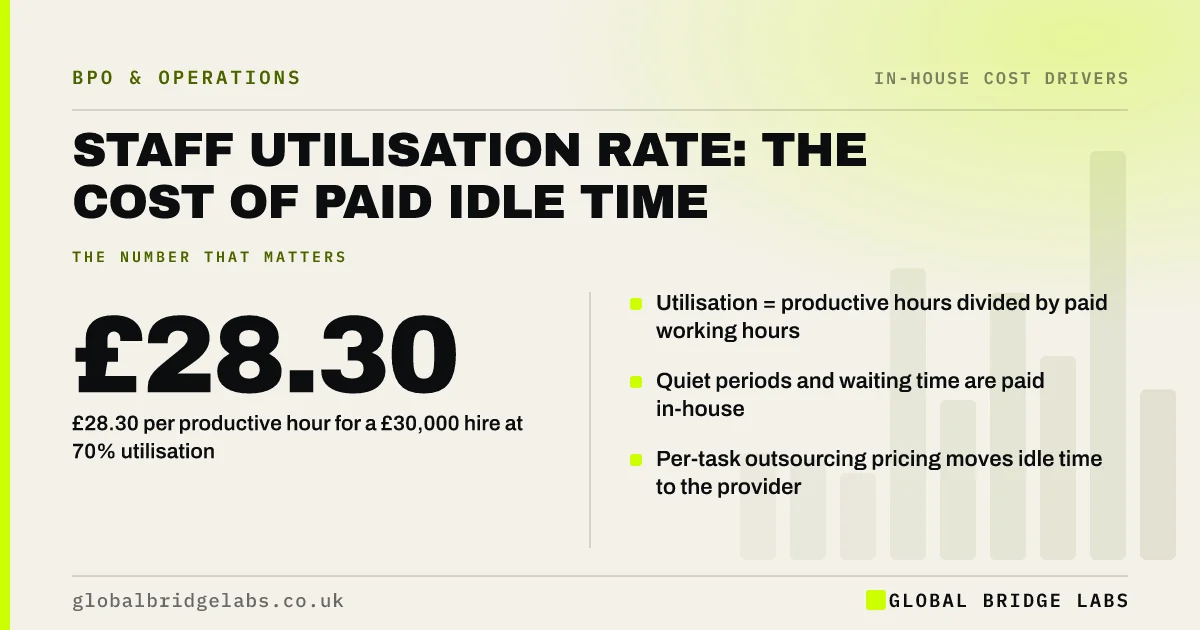
Staff utilisation rate is the share of paid hours spent on productive work. At 70% utilisation, a £30,000 employee costs about £28.30 per productive hour, not £19.81 per worked hour. Idle time is the single cost that most often decides whether in-house or outsourcing is cheaper.
- £28.30 per productive hour for a £30,000 hire at 70% utilisation.
- Utilisation = productive hours divided by paid working hours.
- Quiet periods and waiting time are paid in-house.
- Per-task outsourcing pricing moves idle time to the provider.
Want your team's utilisation measured? Message us on WhatsApp.
Chat on WhatsApp →What is staff utilisation rate?
Staff utilisation rate is productive hours divided by available working hours, shown as a percentage. Productive hours are time spent on the work the role exists for. Available hours exclude holidays. A rate of 100% is neither realistic nor healthy; the question is how much paid time is idle or spent on low-value work.
How do you measure utilisation?
Track time for two to four weeks, including quiet days. Many support tools already log handling time. Divide productive hours by available hours, and note when idle time happens, because patterns such as quiet mornings or seasonal lulls show where cost is wasted.
- Available hours: contracted hours minus holiday.
- Productive hours: time on the core work of the role.
- Utilisation: productive hours divided by available hours.
- Pattern: which days, hours or months are quiet.
How does utilisation change the cost per hour?
Divide the annual employment cost by productive hours, not worked hours. A £30,000 hire costs about £34,463 a year over 1,740 worked hours, £19.81 each. At 90% utilisation that is £22.01 per productive hour; at 70%, £28.30; at 50%, £39.62.
Want your cost per productive hour compared with outsourced rates? Send us the numbers on WhatsApp.
Chat on WhatsApp →Why does utilisation matter for in-house vs outsourcing?
Because you pay for every contracted hour in-house, but an outsourced service can be priced on hours used or tasks completed. When work arrives unevenly, an in-house team has idle time that a provider spreads across many clients. The lower your utilisation, the more outsourcing tends to save.
Does outsourcing remove idle time?
Partly, depending on the pricing model. With per-task or per-transaction pricing, idle time is the provider's cost. With a dedicated hourly seat, you still pay for quiet hours, but the provider can fill them with other agreed tasks. Choose the model that matches how your work arrives.
Is low utilisation always bad?
No. Some roles need spare capacity to respond fast, such as reception or on-call support. The cost of that readiness should be a choice, not an accident. If you need someone available but busy only half the time, a shared or outsourced service is usually cheaper than a dedicated hire.
How do you raise utilisation without burning people out?
Fill quiet periods with planned, useful work rather than pushing people harder at peaks. Keep a backlog of projects for quiet times, cross-train so people can move between tasks, and move the unpredictable peaks to a flexible outsourced service. Sustained utilisation near 100% raises errors and resignations.
What does this look like in practice?
A pattern we see in UK e-commerce brands: two customer service staff are overwhelmed in November and December and quiet from January to March. Annual utilisation is low even though the team feels stretched at peak. A smaller in-house team with outsourced peak cover costs less and handles Christmas better.
Utilisation checklist
Use these steps to measure and act on it.
- Track time for two to four weeks, quiet days included.
- Calculate utilisation per role.
- Recalculate cost per productive hour.
- Map when idle time happens.
- Compare with outsourced pricing that fits the pattern.
Next step
Send us two weeks of workload data. We will calculate utilisation and cost per productive hour, and compare with outsourcing, in a 30-minute call.
Message us on WhatsApp for a utilisation check, or book a 30-minute consultation.
Chat on WhatsApp →Sources and further reading
- Rates and thresholds for employers 2026 to 2027 · HM Revenue & Customs
- Workplace pensions: what you, your employer and the government pay · GOV.UK
- Holiday entitlement · GOV.UK
Frequently asked questions
How do you calculate staff utilisation rate?
Divide productive hours by available working hours and multiply by 100. Available hours are contracted hours minus holiday; productive hours are time spent on the core work of the role. Track for two to four weeks, including quiet days, to get a figure you can rely on.
What is a good utilisation rate?
It depends on the role. Work that needs fast response, such as reception, needs spare capacity by design. For back-office work, sustained utilisation under about 75% usually means paid idle time that a shared or outsourced service could absorb more cheaply.
How does idle time affect staffing cost?
It raises the cost of every productive hour. A £30,000 employee costs about £19.81 per worked hour using 2026/27 rates, but £28.30 per productive hour at 70% utilisation, which changes the comparison with an outsourced rate considerably. Measure utilisation before comparing any quotes.
Is utilisation the same as productivity?
No. Utilisation measures how much paid time is spent on productive work; productivity measures how much output each productive hour produces. A team can be fully used but slow, or fast but often idle. Track both to understand the real cost of each task.
Written by

Global Bridge Labs (GBL) is a UK–Sri Lanka partner for social media, websites and BPO. Everything here comes from client delivery, not theory.