On this page
- 01Key takeaways
- 02What counts as back-office cost?
- 03Why is back-office cost hard to see?
- 04What does the cost look like in numbers?
- 05What should you simplify before handing anything over?
- 06Which back-office tasks hand over well?
- 07What are the risks?
- 08What does this look like in practice?
- 09Back-office cost checklist
- 10Next step
- 11Sources and further reading
- 12Frequently asked questions
Key takeaways
To reduce back office costs, find where the hours go before deciding who should do the work. Most small businesses underestimate admin time because it is spread across several people. In our example, 62 hours a week of admin costs about £63,900 a year. Simplifying it and moving routine tasks to a managed team brings that near £32,400.
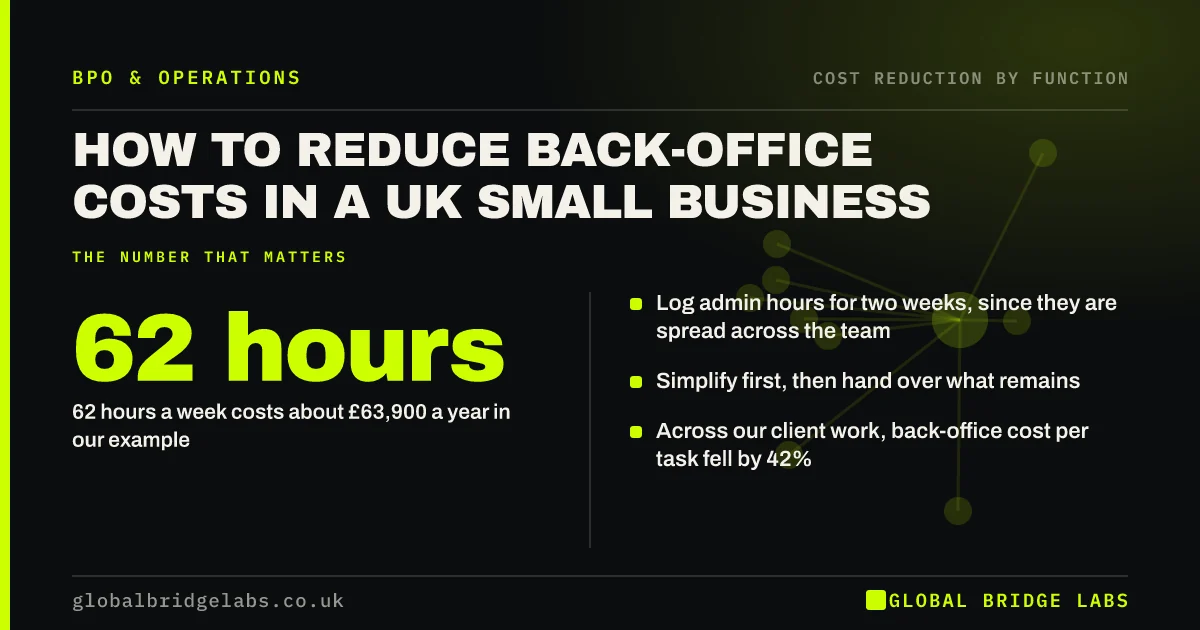
- Log admin hours for two weeks, since they are spread across the team.
- 62 hours a week costs about £63,900 a year in our example.
- Simplify first, then hand over what remains.
- Across our client work, back-office cost per task fell by 42%.
Want your admin hours priced? Message us on WhatsApp with your team size and main admin tasks.
Chat on WhatsApp →What counts as back-office cost?
Back-office cost is what a business spends on the work customers never see: data entry, order and booking administration, invoicing, payment chasing, document handling, record keeping and reporting. It is mostly staff time, plus the software and supervision around it.
Why is back-office cost hard to see?
Back-office cost is hard to see because it rarely belongs to one job. A salesperson raises their own quotes, an engineer writes up job sheets, the owner does the invoicing on Sunday. No budget line says administration, so nobody manages it.
A two-week time log is the only reliable way to find it. Ask everyone to record admin tasks in 15-minute blocks.
What does the cost look like in numbers?
In an illustrative 14-person firm, a time log finds 62 hours a week of back-office work: 18 on order and booking admin, 14 on invoicing and payment chasing, 12 on data entry and CRM updates, 10 on documents and filing, and 8 on reports. At a loaded £19.81 per worked hour, that is 3,224 hours and about £63,900 a year.
Removing unused reports and duplicate entry cuts 10 hours. Running the remaining 52 hours through a managed team at an indicative £12 an hour costs about £32,400 a year. That is roughly half, before allowing a few hours a week for review. These are example figures, not a quote.
- Orders and bookings: 18 hours a week.
- Invoicing and chasing: 14 hours a week.
- Data entry and CRM: 12 hours a week.
- Documents: 10 hours. Reports: 8 hours.
Want this breakdown for your own business? Send us your task list on WhatsApp and we will discuss your requirements.
Chat on WhatsApp →What should you simplify before handing anything over?
Simplify the work that should not exist at all. Every business has reports nobody reads, data typed twice and approvals that add a day and catch nothing. Removing them costs nothing and makes whatever remains cheaper to run, whoever runs it.
- Stop reports with no reader.
- Enter data once and connect systems.
- Replace approvals with limits.
- Standardise templates for quotes and invoices.
Which back-office tasks hand over well?
Tasks hand over well when they follow rules, happen often and can be done remotely with system access. Keep in-house anything that needs commercial judgement, a client relationship or physical presence.
- Order entry, booking and scheduling.
- Invoice raising and payment reminders.
- Supplier invoice matching.
- CRM updates and data cleansing.
- Routine reports from agreed data.
What are the risks?
The risks are handing over work nobody has documented, giving wide system access without controls, and underestimating your own review time. Under UK GDPR you remain responsible for personal data a provider handles. Start with one process, limit access to what it needs, and sample the output weekly.
What does this look like in practice?
A pattern we see in owner-led firms: the owner does the invoicing because it matters and they do not trust anyone else to get it right. It takes most of a day each week and still goes out late. Writing down the rules they apply, then having a managed team raise invoices for the owner to approve in ten minutes, gets invoices out sooner and the day back.
Across our client work, owners have got 31 hours a week back.
Back-office cost checklist
Work through these in order.
- Log admin time across the whole team for two weeks.
- Total hours by task and price them at loaded rates.
- Delete tasks with no user.
- Remove duplicate entry and needless approvals.
- Write down the three largest remaining tasks.
- Pilot a managed team on one of them.
- Compare cost per task after 90 days.
Next step
Send us a rough list of who does which admin tasks and for how long. We will price it with you and show which tasks to simplify, which to keep and which a managed team could take.
Message us on WhatsApp for a back-office cost review, or book a 30-minute consultation.
Chat on WhatsApp →Sources and further reading
- National Minimum Wage and National Living Wage rates · GOV.UK
- Rates and thresholds for employers 2026 to 2027 · HM Revenue & Customs
- Contracts and liabilities between controllers and processors · Information Commissioner's Office
Frequently asked questions
How can a small business reduce administrative costs?
Measure where admin time goes, remove tasks nobody needs, eliminate duplicate entry, standardise the rest and then decide who should do it. Routine, rule-based tasks can often be run by a managed team at a lower cost per task. Simplifying first makes every later step cheaper.
What back-office functions can be outsourced?
Commonly outsourced functions include data entry, order and booking administration, invoicing, payment chasing, supplier invoice processing, CRM maintenance and routine reporting. They are repeatable, measurable and can be done remotely. Work needing commercial judgement or client relationships usually stays in-house.
How much do UK businesses spend on admin?
It varies too widely to quote a reliable average. The only useful figure is your own. A two-week time log across the whole team usually shows admin taking more hours than the owner expected, because the work is shared across roles with other job titles.
Is automation or outsourcing better for back-office work?
They suit different work and are usually combined. Automation is best for stable, rule-based steps with clean data. A managed team is better where judgement, exceptions or messy inputs are involved. Simplify the process first so you automate or hand over less.
Written by

Global Bridge Labs (GBL) is a UK–Sri Lanka partner for social media, websites and BPO. Everything here comes from client delivery, not theory.