
On this page
- 01Key takeaways
- 02What is an operational cost reduction plan?
- 03Days 1 to 30: what do you measure?
- 04Days 31 to 60: what do you simplify?
- 05Days 61 to 90: what do you relocate and prove?
- 06What might the result look like?
- 07Who should own the plan?
- 08What can go wrong?
- 09What does this look like in practice?
- 1090-day plan checklist
- 11Next step
- 12Sources and further reading
- 13Frequently asked questions
Key takeaways
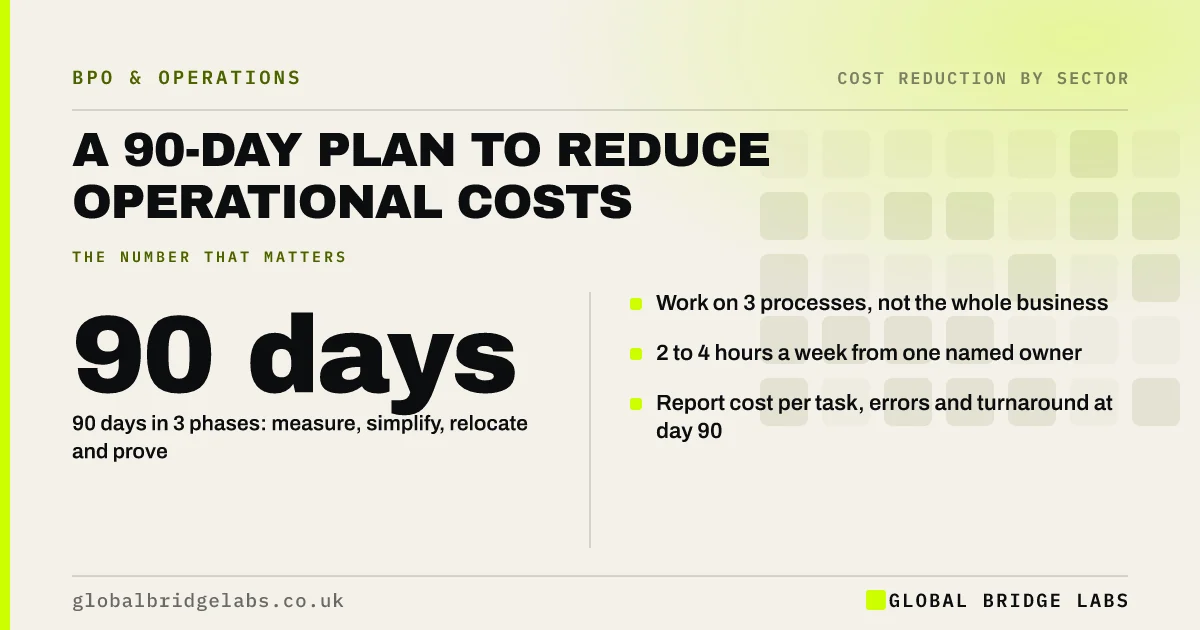
An operational cost reduction plan works when it is short, focused on a few processes and measured from a baseline. This one runs for 90 days in three phases: measure in days 1 to 30, simplify in days 31 to 60, and relocate and prove in days 61 to 90. It needs about 2 to 4 hours a week from one named owner.
- 90 days in 3 phases: measure, simplify, relocate and prove.
- Work on 3 processes, not the whole business.
- 2 to 4 hours a week from one named owner.
- Report cost per task, errors and turnaround at day 90.
Want this plan tailored to your business? Message us on WhatsApp with your team size and biggest admin tasks.
Chat on WhatsApp →What is an operational cost reduction plan?
An operational cost reduction plan is a time-bound programme that identifies where running costs can be lowered, sets targets, assigns owners and tracks results. A good one names specific processes and specific changes. A weak one names a percentage and hopes.
Days 1 to 30: what do you measure?
In the first 30 days, measure where routine time goes and choose three processes. Do not change anything yet. The output of this phase is a baseline cost per task for each chosen process and a score on the five cost levers.
- Week 1: list routine processes and brief the team.
- Weeks 2 and 3: log time, volume and corrections.
- Week 4: price each process and score it on the five levers.
- End of month: pick the three highest-scoring processes.
Days 31 to 60: what do you simplify?
In the second 30 days, simplify the three processes before deciding who should run them. Map each one, remove steps nobody needs, and write down the method that remains. Many firms bank a meaningful saving in this phase alone.
- Map each process and time the waits.
- Delete unused reports, duplicate entry and needless approvals.
- Write a one-page standard method for each.
- Fix the top cause of errors or avoidable contact.
- Set a target cost per task with quality conditions.
- Value stream mapping for service and admin processes
- Process standardisation: one best way, lower cost per task
- How to set cost reduction targets your team can hit
Want help with the simplify phase? Send us one process on WhatsApp.
Chat on WhatsApp →Days 61 to 90: what do you relocate and prove?
In the final 30 days, move one simplified process to the most economical reliable way of running it, and measure. That may be a tool, a different person in-house or a managed team. Run a pilot on one process, not all three, with a weekly scorecard.
- Choose the delivery route for the first process.
- Agree scope, access and service levels in writing.
- Run the pilot with a weekly review.
- Measure cost per task, errors and turnaround.
- Report against the baseline at day 90.
What might the result look like?
Take an illustrative firm that selects invoicing, customer email and order admin, together costing £58,000 a year. Simplification in phase two removes 12% of the hours, worth about £7,000. Moving invoicing, which then costs about £10,000 a year, to a managed team in phase three lowers its cost per task by 40%.
By day 90 the run-rate saving is about £11,000 a year, with two processes still to move. If they follow in the next quarter with similar results, the annual figure approaches £25,000. These are example figures, not a forecast.
Who should own the plan?
One person should own the plan, with the authority to change how work is done and 2 to 4 hours a week to give it. In a small business that is usually the owner or operations lead. The team does the logging and suggests the fixes. Without a single owner, the plan stalls after the measurement phase.
What can go wrong?
Three things commonly go wrong: trying to change too many processes at once, skipping the baseline, and handing over a process before simplifying it. A fourth is treating day 90 as the end. It is the first review. The savings that last come from repeating the cycle on the next three processes.
What does this look like in practice?
A pattern we see in firms that complete the cycle: the largest surprise comes in the first month, when the time log shows where hours really go. The largest saving often comes in the second, from deleting work. The third month, where a provider comes in, is the easiest, because the process is finally clear enough to hand to anyone.
Across our client work, back-office cost per task has fallen by 42% once the process was written down and run by a managed team.
90-day plan checklist
Confirm each milestone as you reach it.
- Day 7: process list agreed and team briefed.
- Day 21: two weeks of time and volume logged.
- Day 30: three processes chosen with baselines.
- Day 45: processes mapped and waste removed.
- Day 60: standard methods written and targets set.
- Day 75: pilot running with a weekly scorecard.
- Day 90: results reported and next three processes chosen.
Next step
Tell us your team size and the routine work that takes the most time. In a 30-minute call we will help you choose the three processes to start with and set up the first month's measurement.
Message us on WhatsApp to start your 90-day plan, or book a 30-minute consultation.
Chat on WhatsApp →Sources and further reading
- National Minimum Wage and National Living Wage rates · GOV.UK
- Rates and thresholds for employers 2026 to 2027 · HM Revenue & Customs
- Contracts and liabilities between controllers and processors · Information Commissioner's Office
Frequently asked questions
How do you create a cost reduction plan?
Measure what your main routine processes cost, choose the few with the most waste, simplify them, then decide the most economical way to run each. Set targets with quality conditions, name an owner and report cost per task against the baseline.
How long does it take to reduce operating costs?
A first measurable saving is realistic within 90 days for one or two processes: a month to measure, a month to simplify and a month to change how the work is run. Larger programmes continue in further 90-day cycles.
What should a cost reduction plan include?
It should include the processes in scope, a baseline cost for each, the specific changes planned, target cost per task, quality and speed conditions, an owner, a timeline and the measures that will be reported. A plan without a baseline cannot prove its result.
When should outsourcing come into a cost reduction plan?
After the process has been measured and simplified. Handing over a process before removing waste locks the waste in. In a 90-day plan, a pilot with a provider fits best in the final month, on one process, with a weekly scorecard.
Written by

Global Bridge Labs (GBL) is a UK–Sri Lanka partner for social media, websites and BPO. Everything here comes from client delivery, not theory.


