On this page
- 01Key takeaways
- 02What are the hidden costs of outsourcing?
- 03How much of your own time will it take?
- 04What does transition cost?
- 05Which contract terms hide costs?
- 06What about tools and software?
- 07What does leaving cost?
- 08Do hidden costs make outsourcing not worth it?
- 09What does this look like in practice?
- 10Checklist: find the hidden costs
- 11Next step
- 12Sources and further reading
- 13Frequently asked questions
Key takeaways
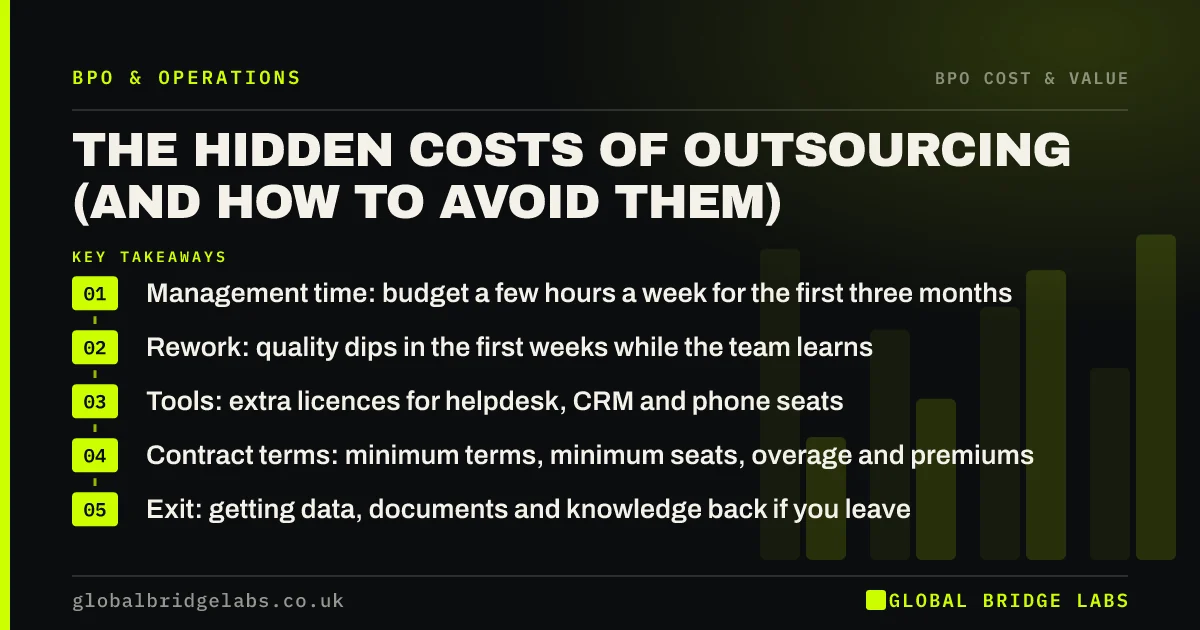
The hidden costs of outsourcing are the ones that do not appear in the hourly rate: your own management time, rework during training, extra software licences, premiums for evenings and weekends, minimum terms and the cost of leaving. None is a reason not to outsource, but ignoring them makes the saving look bigger than it is.
- Management time: budget a few hours a week for the first three months.
- Rework: quality dips in the first weeks while the team learns.
- Tools: extra licences for helpdesk, CRM and phone seats.
- Contract terms: minimum terms, minimum seats, overage and premiums.
- Exit: getting data, documents and knowledge back if you leave.
Want to check a quote for hidden costs? Send it to us on WhatsApp and we will point out what is missing.
Chat on WhatsApp →What are the hidden costs of outsourcing?
The hidden costs of outsourcing are the expenses and effort involved in a business process outsourcing (BPO) arrangement that are not included in the provider's headline price. They fall into four groups: internal effort, transition, contract terms and exit.
They are predictable, which means they can be planned for. The businesses that are disappointed by outsourcing are usually the ones that compared an hourly rate with a salary and stopped there.
How much of your own time will it take?
More than zero. Someone in your business has to explain the process, answer questions, review early work and attend weekly reviews. As a rule of thumb, budget two to four hours a week for the first three months, falling to about an hour a week once the process is stable.
If nobody has that time, the engagement will struggle. This is the most important hidden cost and the one most often skipped.
What does transition cost?
Transition costs include documenting the process, setting up access, training the team and absorbing lower productivity while they learn. Expect four to eight weeks of reduced output or extra review on complex processes. Some providers charge a setup fee; others build it into the rate.
Documentation is a cost you would face anyway for any new hire, and it has lasting value: the process becomes an asset of your business.
Which contract terms hide costs?
Most hidden costs sit in the contract. Read these clauses before comparing prices.
- Minimum term: months you pay for even if you leave early.
- Minimum seats or volumes: charges if you fall below them.
- Overage: price per unit above forecast.
- Premiums: evenings, weekends and bank holidays.
- Price reviews: annual increases and what they are linked to.
- Charges for extra reports, changes to procedures or training.
Want a quote checked for these terms? Send it to us on WhatsApp and we will discuss your requirements.
Chat on WhatsApp →What about tools and software?
If the team works inside your systems, which it should, you may need extra licences for your helpdesk, CRM, phone system or shared inbox. Per-user pricing adds up. Check your plans before go-live and include licence costs in the comparison.
What does leaving cost?
Exit costs include notice-period fees, time to transfer the work to another provider or back in-house, and any knowledge lost if the provider holds the only copy of the procedures. Protect yourself by keeping procedures in your own systems and making sure the contract gives you all documentation, data and reports at exit.
Check whether TUPE could apply when work moves between providers or back in-house. It usually affects UK-based staff; take advice if it might apply.
Do hidden costs make outsourcing not worth it?
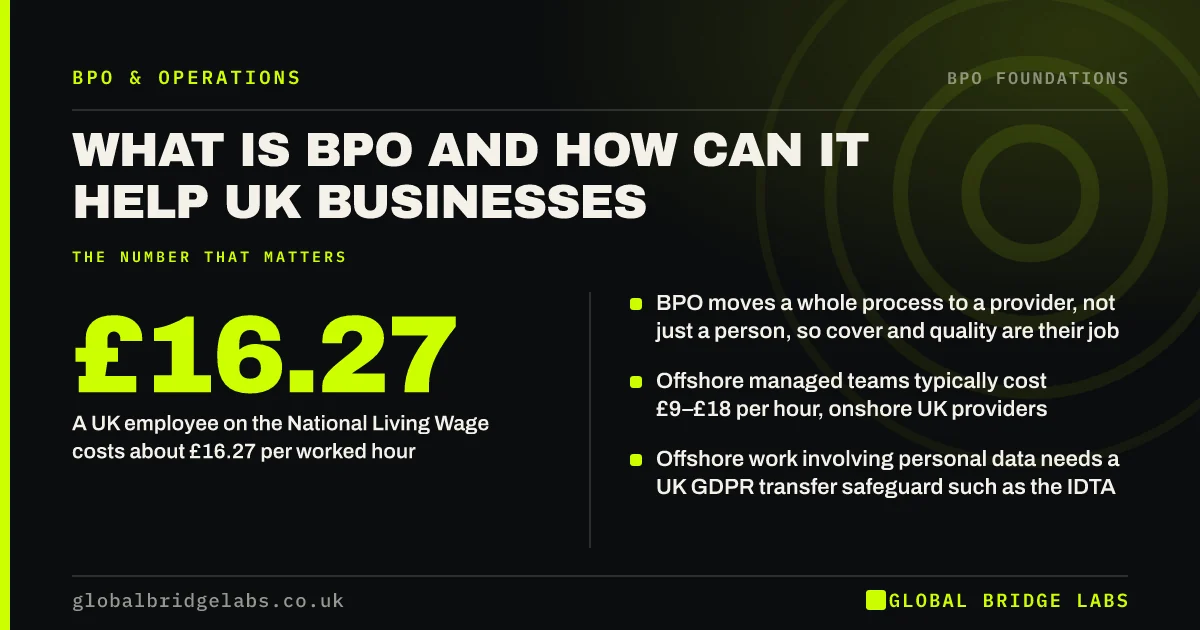
Usually not. Hiring has hidden costs too: recruitment, equipment, training, management and cover. A UK employee on the April 2026 National Living Wage costs about £16.27 per worked hour after employer National Insurance, pension and holiday, before any of those. The point is to compare like with like, with all costs included on both sides.
What does this look like in practice?
A pattern we see in failed first attempts at outsourcing: a low hourly rate with a 12-month minimum, a setup fee, weekend premiums and extra charges for reporting. By month four the effective rate is far above the headline, the service is disappointing, and leaving means paying for eight more months.
The alternative is a costed plan on one page, with everything included and 30-day terms. It looks more expensive per hour and usually is not.
Checklist: find the hidden costs
Ask these questions of every quote.
- What exactly does the rate include?
- Is there a setup fee or exit fee?
- What are the minimum term, seats and volumes?
- What are the premiums for out-of-hours work?
- How are price increases calculated?
- What software licences will we need to add?
- What do we get back if we leave?
Next step
Send us a quote you have received, or your requirements, and we will lay out the full cost including the parts quotes usually leave out. 30 minutes, no pitch.
Message us on WhatsApp to check a quote, or book a 30-minute consultation.
Chat on WhatsApp →Sources and further reading
- Business transfers, takeovers and TUPE · GOV.UK
- National Minimum Wage and National Living Wage rates · GOV.UK
- Rates and thresholds for employers 2026 to 2027 · HM Revenue & Customs
Frequently asked questions
What is the biggest hidden cost of outsourcing?
Your own management time. Someone must explain the process, review early work and attend weekly reviews, typically two to four hours a week for the first three months. Without that time, quality suffers and the engagement disappoints, whatever the hourly rate.
Are there setup fees for outsourcing?
Some providers charge setup fees for documentation, recruitment and training; others absorb them into the monthly rate. Compare the total first-year cost including any setup fee and minimum term, rather than the hourly rate alone.
What does it cost to switch outsourcing providers?
Costs include any remaining notice or minimum term, a transition period of overlap, and the effort of training the new team. They are much lower if procedures live in your own systems and the contract guarantees the return of documents, data and reports at exit.
How do I avoid hidden outsourcing costs?
Send every provider the same written scope, ask exactly what the rate includes, check minimum terms, premiums and exit clauses, budget your own management time, and prefer short rolling terms for a first engagement. Keep procedures and data in your own systems from day one.
Written by

Global Bridge Labs (GBL) is a UK–Sri Lanka partner for social media, websites and BPO. Everything here comes from client delivery, not theory.