On this page
- 01Key takeaways
- 02What is BPO ROI?
- 03How do you calculate the cost side?
- 04How do you calculate the benefit side?
- 05What does a worked example look like?
- 06What baseline do you need before starting?
- 07When does BPO fail to pay back?
- 08What does this look like in practice?
- 09Checklist: build your ROI case
- 10Next step
- 11Sources and further reading
- 12Frequently asked questions
Key takeaways
BPO ROI is the return you get from outsourcing a process compared with what it costs. For a UK SME, it has three parts: direct cost saved versus doing the work in-house, the value of owner and senior hours freed, and revenue protected by faster replies. Most businesses count only the first and underestimate the return.
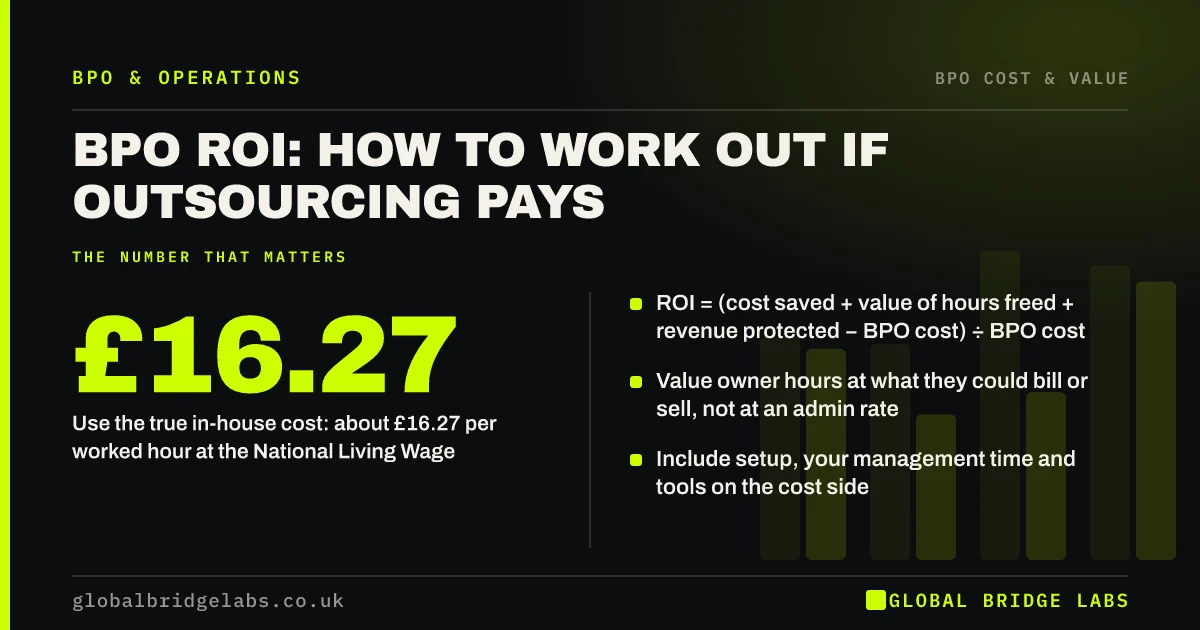
- ROI = (cost saved + value of hours freed + revenue protected − BPO cost) ÷ BPO cost.
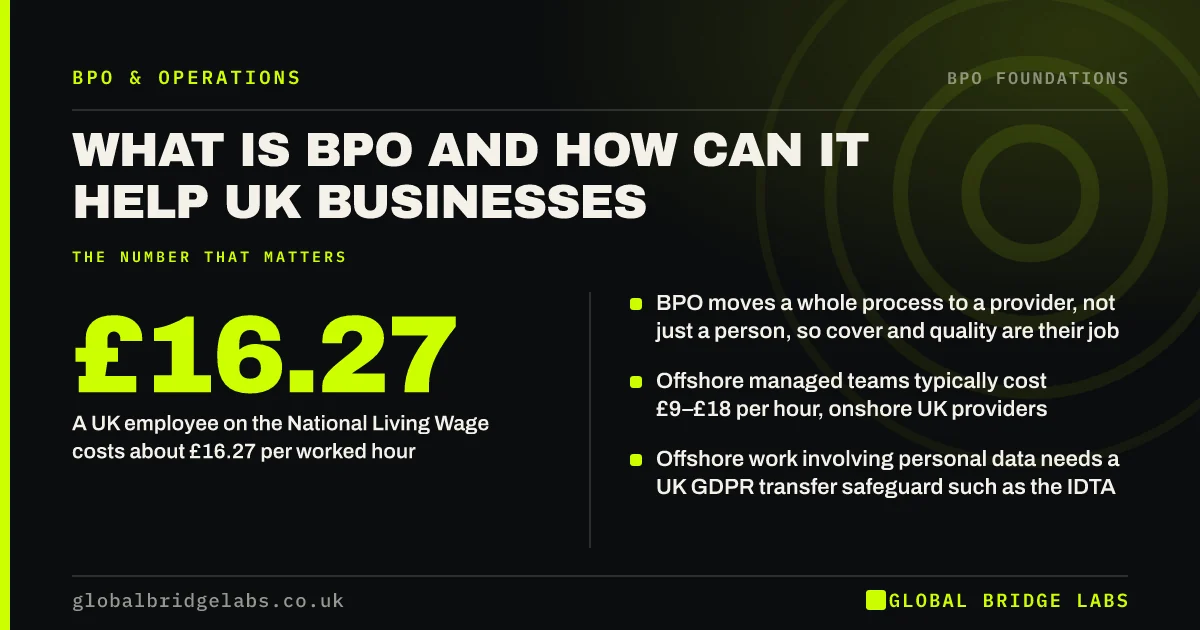
- Use the true in-house cost: about £16.27 per worked hour at the National Living Wage.
- Value owner hours at what they could bill or sell, not at an admin rate.
- Include setup, your management time and tools on the cost side.
- Measure at 90 days against a baseline taken before go-live.
Want your BPO ROI worked out on real numbers? Message us on WhatsApp with the process and hours.
Chat on WhatsApp →What is BPO ROI?
BPO ROI (return on investment) is the net benefit of outsourcing a business process divided by its cost, expressed as a percentage or a ratio. A positive ROI means the process now costs less, earns more, or both, than it did in-house.
The benefit side is where most calculations go wrong. Business process outsourcing rarely pays off only through a lower hourly rate. It pays off because owners stop doing admin, enquiries are answered faster and work no longer stalls when someone is away.
How do you calculate the cost side?
Include everything you will pay, not only the provider's rate. Underestimating costs is the quickest way to an ROI that looks good on paper and disappoints in practice.
- Provider fees for the year at expected volume.
- Setup or onboarding fees.
- Your internal owner's time: 2–4 hours a week for 3 months, then about 1.
- Extra software licences for the team.
- Rework during the first weeks of training.
How do you calculate the benefit side?
Count three benefits separately. First, direct cost saved: what the same hours cost in-house. A UK employee on the April 2026 National Living Wage costs about £16.27 per worked hour after employer National Insurance, pension and holiday, and about £17.09 on a £26,000 salary, before overheads.
Second, the value of hours freed: owner or senior staff time moved from admin to revenue-earning work. Value it at a conservative estimate of what that hour earns. Third, revenue protected: enquiries that were previously missed or answered too late, multiplied by your conversion rate and average order value.
What does a worked example look like?
Take a UK trades business. The owner spends 12 hours a week on calls, quotes admin and invoicing, and misses about 10 calls a week. An offshore managed seat at an indicative £12 per hour for 30 hours a week costs about £18,700 a year. Add £2,000 for setup, tools and the owner's time in the first months: £20,700 in total.
Benefits: 12 owner hours a week, valued conservatively at £40 an hour over 46 working weeks, is £22,080. If half of 10 missed calls a week were real jobs, and a quarter of those convert at an average of £400, that is about £23,000 a year of revenue protected. Even counting only the owner's time, the return is positive; with revenue protected, it is more than double the cost.
Want this worked example rebuilt with your own numbers? Send us your hours, missed calls and average job value on WhatsApp and we will discuss your requirements.
Chat on WhatsApp →What baseline do you need before starting?
You need a baseline to prove the ROI afterwards. Measure these for two to four weeks before go-live, then compare at 30, 60 and 90 days.
- Hours spent on the process each week, by person.
- Average response time to enquiries.
- Missed calls and unanswered messages.
- Error or rework rate on the process.
- Enquiry-to-sale conversion rate.
- Debtor days, if finance admin is included.
When does BPO fail to pay back?
BPO fails to pay back when volumes are too small to justify setup, when freed hours are not used for anything valuable, when the process is broken and simply moves elsewhere, or when a long minimum term locks you into a poor service. The second is the most common and the least discussed: freed time only has value if it is spent on something that earns.
What does this look like in practice?
Across our client work, owners have got 31 hours a week back, response time to enquiries has fallen by 71% and back-office cost per task by 42%. Those three numbers map directly onto the three benefits in the formula: hours freed, revenue protected and cost saved.
Checklist: build your ROI case
Work through these in a spreadsheet.
- Record the baseline for two to four weeks.
- Calculate the true in-house cost of the hours involved.
- Value owner hours conservatively.
- Estimate revenue protected from missed or slow enquiries.
- Add all costs: fees, setup, tools and your time.
- Calculate ROI at expected, low and high benefit.
- Review actual results at 90 days.
Next step
Send us your numbers and we will build the ROI case with you, including the costs most calculations leave out. 30 minutes, no pitch.
Message us on WhatsApp for an ROI calculation, or book a 30-minute consultation.
Chat on WhatsApp →Sources and further reading
- National Minimum Wage and National Living Wage rates · GOV.UK
- Rates and thresholds for employers 2026 to 2027 · HM Revenue & Customs
- Holiday entitlement · GOV.UK
Frequently asked questions
How do you calculate ROI on outsourcing?
Add the direct cost saved, the value of hours freed and the revenue protected, subtract the total cost of outsourcing including setup and your management time, and divide by that total cost. Measure the benefits against a baseline taken before go-live, and review at 90 days.
Is outsourcing worth it for a small business?
Often, when the work is repeatable and currently done by the owner or senior staff. The biggest returns usually come from hours freed and enquiries no longer missed, rather than the hourly saving. It is less worthwhile for very small volumes or broken processes.
How long does it take for outsourcing to pay back?
Response-time and hours-freed benefits can appear within weeks of go-live. Full payback, including setup and training costs, commonly takes two to four months for a well-scoped process. A staged go-live and a clear baseline make it easier to see when that point is reached.
What costs do people forget in outsourcing ROI?
The most commonly forgotten costs are the internal owner's time during setup, rework while the team learns, extra software licences, and exit costs if the provider does not work out. Include them all and the ROI will be realistic rather than flattering.
Written by

Global Bridge Labs (GBL) is a UK–Sri Lanka partner for social media, websites and BPO. Everything here comes from client delivery, not theory.