
On this page
- 01Key takeaways
- 02What are operational costs?
- 03What are the main types of operating cost?
- 04How do operating costs differ from capital costs?
- 05Which operating costs are fixed and which vary?
- 06How do you work out your own operating costs?
- 07Which operating costs are easiest to reduce?
- 08When is a high operating cost not a problem?
- 09What does this look like in practice?
- 10Operating costs checklist
- 11Next step
- 12Sources and further reading
- 13Frequently asked questions
Key takeaways
Operational costs are the day-to-day costs of running a business: wages, premises, software, customer service, administration and marketing. They recur every month whether or not you make a sale. For most UK service businesses, people are the largest share, which is why lowering the cost of routine work has the biggest effect.
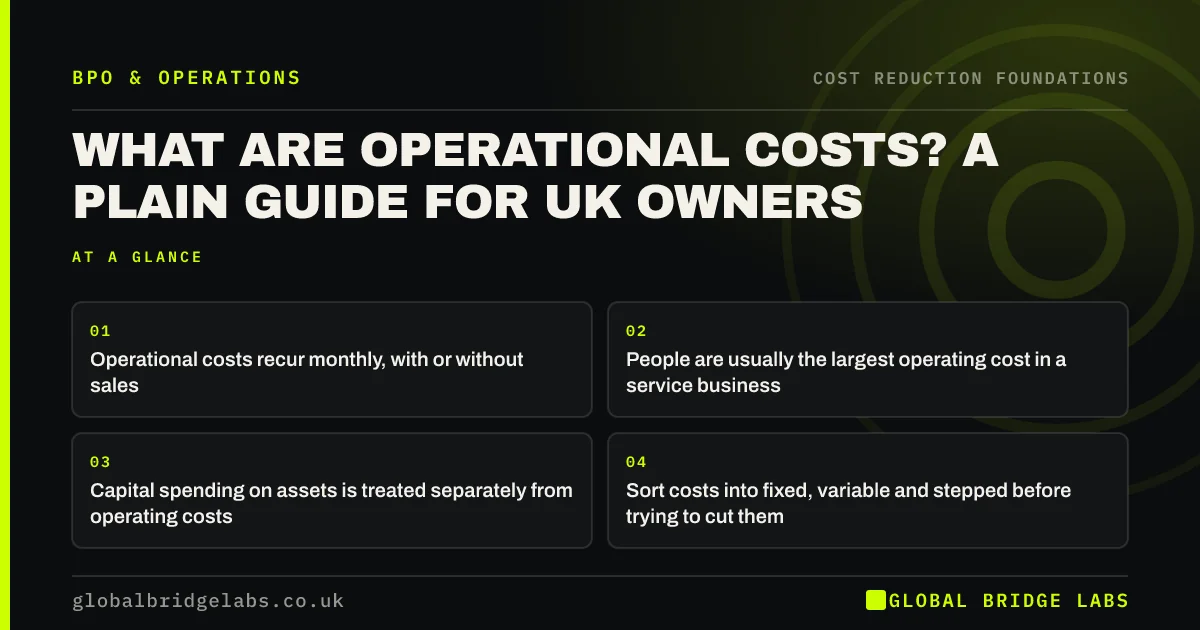
- Operational costs recur monthly, with or without sales.
- People are usually the largest operating cost in a service business.
- Capital spending on assets is treated separately from operating costs.
- Sort costs into fixed, variable and stepped before trying to cut them.
Not sure where your operating costs really sit? Message us on WhatsApp with your team size and sector.
Chat on WhatsApp →What are operational costs?
Operational costs, also called operating costs or operating expenses (opex), are the ongoing costs a business pays to keep trading. In everyday use the term covers everything needed to run the business. In a set of accounts, operating expenses usually sit below gross profit and exclude the direct cost of sales, interest and tax.
Both uses are valid. What matters is that you use one definition consistently, so this year's figure can be compared with last year's.
What are the main types of operating cost?
The main types are people, premises, technology, sales and marketing, professional and finance costs, and general administration. A small business can usually fit every line of its profit and loss account into one of these six groups, which makes the total easier to read and to challenge.
- People: salaries, employer National Insurance, pensions, recruitment and training.
- Premises: rent, rates, utilities, cleaning and insurance.
- Technology: software subscriptions, hardware, hosting and telephony.
- Sales and marketing: advertising, agency fees and website costs.
- Professional and finance: accountancy, legal fees and bank charges.
- Administration: postage, supplies, travel and outsourced services.
How do operating costs differ from capital costs?
Operating costs are used up in the period they are paid for, while capital costs (capex) buy assets that last several years, such as vehicles, machinery or a fit-out. The monthly software subscription is an operating cost. The van is a capital cost, although its fuel, insurance and servicing are operating costs.
The distinction matters for cost reduction because operating costs repeat. A saving of £500 a month is worth £6,000 every year, while a cheaper van is saved once.
Which operating costs are fixed and which vary?
Fixed operating costs stay the same whatever the workload, such as rent and salaried staff. Variable costs move with volume, such as card fees, packaging or hours bought from a provider. Stepped costs are fixed until a limit is reached and then jump, which is how most small businesses experience hiring.
A business with mostly fixed costs is profitable in busy months and exposed in quiet ones. Moving routine work from salaried roles to a managed service turns part of a fixed cost into a variable one.
How do you work out your own operating costs?
Add up twelve months of expenses from your accounting software, leaving out stock purchases, loan repayments, tax and one-off asset purchases. Group the lines into the six types above. Then divide the total by revenue to see what share of each pound of sales is spent on running the business.
In an illustrative firm with £600,000 revenue, operating costs of £180,000 mean 30p of every pound goes on running the business. The trend over three years tells you more than any single figure.
- 1. Export twelve months of expenses by category.
- 2. Remove stock, tax, loan repayments and asset purchases.
- 3. Group what remains into six types.
- 4. Divide the total by revenue for the same period.
- Operating expense ratio: how to calculate and read yours
- Cost baseline: measure today's cost before you change it
Want a second opinion on your cost breakdown? Send us the six totals on WhatsApp.
Chat on WhatsApp →Which operating costs are easiest to reduce?
The easiest operating costs to reduce are the ones tied to repeatable work: customer replies, bookings, invoicing, data entry and reporting. They can be measured per task, done to a written process and run by a managed team at a lower cost per hour. Rent and insurance are harder, because they are contractual and change only at renewal.
Small subscriptions and supplies are simple to trim but rarely add up to much. People costs are where the meaningful savings are, and where careless cuts do the most harm.
When is a high operating cost not a problem?
A high operating cost is not a problem when it buys something customers pay for. A firm that spends more on experienced staff and fast replies may charge more and keep clients longer. The test is whether a cost produces revenue, protects it, or neither. Cut the third kind first.
What does this look like in practice?
A pattern we see in UK small businesses: the owner knows the rent and the wage bill to the pound, but cannot say what answering customers or raising invoices costs, because those costs are spread across several people's days. Once the work is logged and priced per task, the largest saving is usually in a place nobody was looking.
Operating costs checklist
Use these checks the next time you review your accounts.
- Agree one definition of operating costs and keep to it.
- Group twelve months of spend into six types.
- Mark each line fixed, variable or stepped.
- Calculate operating costs as a share of revenue.
- Compare the share with the last two years.
- Price your three most common routine tasks per task.
Next step
Send us your six cost totals and your headcount. We will tell you which lines are likely to respond to better processes or a managed team, and which are best left alone.
Message us on WhatsApp to review your operating costs, or book a 30-minute consultation.
Chat on WhatsApp →Sources and further reading
- Running a limited company: company and accounting records · GOV.UK
- Rates and thresholds for employers 2026 to 2027 · HM Revenue & Customs
- Business population estimates for the UK and regions 2025 · Department for Business and Trade
Frequently asked questions
What is included in operational costs?
Operational costs include wages and employer costs, rent and utilities, software and telephony, marketing, professional fees, insurance and general administration. They are the recurring costs of keeping a business running. Purchases of long-life assets, loan repayments and tax are normally treated separately.
Are salaries an operating cost?
Yes. Salaries, employer National Insurance, pension contributions and holiday pay are operating costs, and in most service businesses they are the largest. Wages of staff who directly make or deliver the product are sometimes shown as cost of sales, but they are still part of what it costs to operate.
What is the difference between opex and capex?
Opex is operating expenditure: recurring costs used up in the period, such as wages, rent and subscriptions. Capex is capital expenditure: money spent on assets that last several years, such as vehicles, equipment or a building fit-out. Opex repeats every month, so savings on it repeat too.
What is a good level of operating costs?
There is no single good level, because it depends on the sector and business model. A useful test is your own trend. If operating costs are growing faster than revenue over two or three years, each sale is becoming more expensive to deliver and the cause is worth finding.
Written by

Global Bridge Labs (GBL) is a UK–Sri Lanka partner for social media, websites and BPO. Everything here comes from client delivery, not theory.


