
On this page
- 01Key takeaways
- 02What makes the best answering service for tradesmen?
- 03Why do tradespeople and builders need an answering service at all?
- 04What types of answering service can a trades business use?
- 05Which type fits which trades business?
- 06How do you test an answering service before you sign?
- 07How do you score the five-call test?
- 08What should a trades answering service be able to do?
- 09How much does an answering service cost for trades in the UK?
- 10How should an answering service handle emergencies?
- 11What matters more for construction firms than for sole traders?
- 12How do you keep customer data safe with an answering service?
- 13When is an answering service the wrong choice?
- 14What does this look like in practice?
- 15Best answering service checklist
- 16Guides on answering service basics
- 17Guides on answering service costs
- 18Guides on answering service features
- 19Guides on emergency and out-of-hours calls
- 20Guides on answering services by trade
- 21Guides on answering services for construction
- 22Guides on choosing an answering service
- 23Guides on setting up an answering service
- 24Guides on measuring an answering service
- 25Guides on answering services in practice
- 26Next step
- 27Sources and further reading
- 28Frequently asked questions
Key takeaways
The best answering service for a tradesman or UK construction business is the one that answers within about 20 seconds, asks your trade's questions, books or escalates the job on the first call and sends you clear notes within minutes. No single provider is best for everyone, so test each shortlisted service with five real-world calls before you sign.
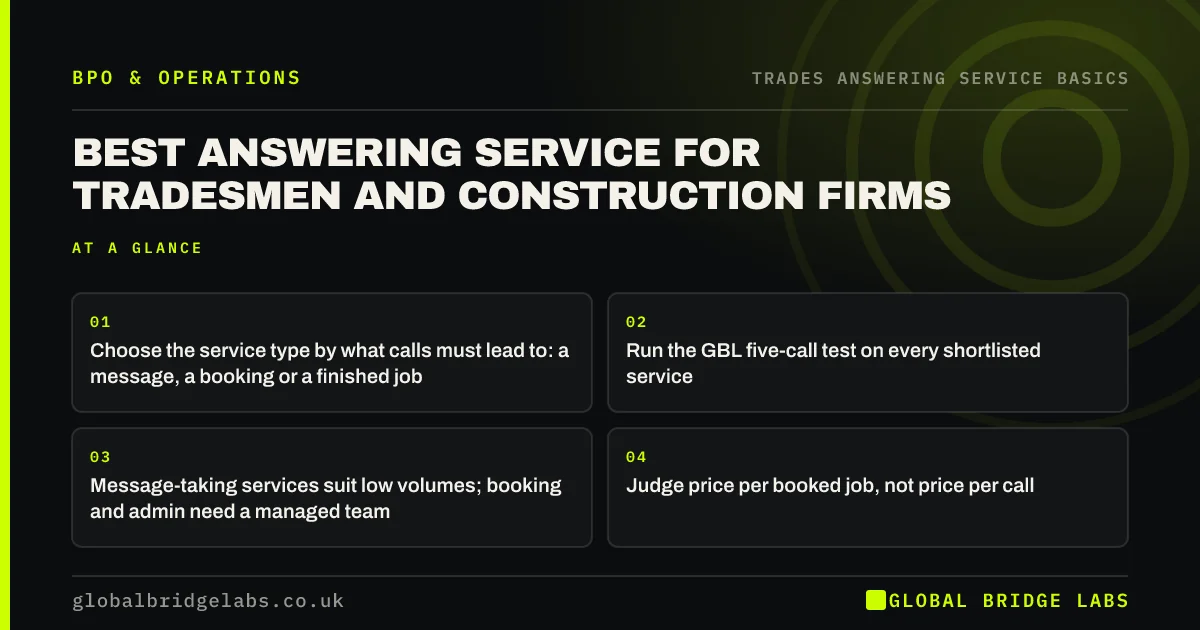
- Choose the service type by what calls must lead to: a message, a booking or a finished job.
- Run the GBL five-call test on every shortlisted service.
- Message-taking services suit low volumes; booking and admin need a managed team.
- Judge price per booked job, not price per call.
Missing calls while you are on site? Message us on WhatsApp with roughly how many calls you get a day.
Chat on WhatsApp →What makes the best answering service for tradesmen?
A trades answering service is a team, or sometimes software, that picks up your business line when you cannot, answers in your business name and turns the call into something useful: a message, a booked visit, a transferred emergency or a chased quote. The best one for you is the one whose output matches what your calls need to become.
Most comparison lists rank providers on price per call or on how friendly the receptionists sound. Those matter, but they are not what wins jobs. For trades and construction firms, five things decide whether an answering service pays for itself: speed of answer, the right questions for your trade, the power to act on the call, a safe emergency route and notes you can use without calling the customer back.
- Speed: answered within about five rings, including at 8am and in a cold snap.
- Questions: job type, postcode, urgency, access and photos captured every time.
- Action: visits booked into your diary, not just messages left.
- Safety: a written emergency rule that is followed on every call.
- Notes: a short summary sent within minutes, in a format you can act on from the van.
Why do tradespeople and builders need an answering service at all?
Tradespeople need an answering service because the people who could answer the phone are usually doing the work. Calls arrive while you are on a roof, under a floor or driving, and customers looking for a trade rarely leave voicemail. They ring the next name on the search results, and the job goes with them.
The cost of a missed call depends on your job values. As an illustrative example, if one missed call a day would have become a £250 job one time in four, that is about £62 of lost work a day, or roughly £15,000 a year across a working year. Even a fraction of that covers most answering services several times over. The less visible cost is your evenings: returning calls, chasing quotes and writing up jobs after a full day on site.
What types of answering service can a trades business use?
There are five main types, and they differ more in what they can do than in what they cost. Pick the type first, then compare providers within it.
- Voicemail and call forwarding: free or cheap, but most callers will not wait or leave a message.
- Message-taking answering service: a receptionist takes details and sends them to you, usually priced per call or per minute.
- Virtual receptionist with diary access: takes details and books visits or quotes into your calendar.
- Managed outsourced team: answers calls and messages, books jobs and also chases quotes, raises invoices and updates your job system, usually priced per hour or per seat.
- AI voice answering: software that answers, asks set questions and sends a summary; useful for simple out-of-hours capture with a human route behind it.
Which type fits which trades business?
A sole trader getting a handful of calls a day often needs no more than a good message-taking service with clear notes. A firm with several engineers needs bookings made into the right diary, so a virtual receptionist or managed team fits better. A construction business with subcontractors, suppliers and site queries usually needs a managed team that knows who to route each call to.
How do you test an answering service before you sign?
Use the GBL five-call test. Before you sign, make or arrange five realistic calls to each shortlisted service during its trial or onboarding period, then score each call out of five. A service that scores well on paper but badly on these calls will cost you jobs.
- Call 1, a new job: someone wanting a quote for a common job in your area.
- Call 2, an emergency: a leak, gas smell or no power, depending on your trade.
- Call 3, an existing customer: someone chasing when the engineer is arriving.
- Call 4, out of hours: the same new job, called at 7.30pm or on a Saturday.
- Call 5, an awkward call: a complaint or a caller pushing for a price.
How do you score the five-call test?
Score each call one point for each of these: answered within about 20 seconds; the right details captured; the right action taken, such as booked, escalated or callback set; notes received within five minutes; and the caller would think they had reached your business. That gives a total out of 25. A score of 20 or more is a strong fit, 15 to 19 means fix the gaps in writing before you commit, and under 15 means keep looking.
Want a hand running the five-call test on your shortlist? Message us on WhatsApp and we will discuss your requirements.
Chat on WhatsApp →What should a trades answering service be able to do?
At a minimum it should answer in your business name, follow a script written for your trade, capture the job properly and get the details to you fast. Beyond that, the features worth paying for depend on how your business runs. Each extra feature should save you a callback or win you a job; if it does neither, do not pay for it.
- Diary booking, with your job lengths, travel time and engineer skills built into the rules.
- Access to your job management software, so each call becomes a job record.
- WhatsApp and text handling, since many customers now message rather than ring.
- Requests for photos before a site visit, so you can quote or bring the right parts.
- Live transfer for emergencies and for the callers you always want to speak to.
- Quote chasing and callback lists, so enquiries do not go cold.
- Call recordings and a monthly report showing calls, bookings and missed calls.
How much does an answering service cost for trades in the UK?
As indicative market ranges, message-taking services are usually priced per call or per minute, often around £1 to £2 a call at small volumes, with monthly bundles. Managed teams that book jobs and handle admin are usually priced per hour or per seat, around £9 to £18 an hour offshore and £20 to £35 onshore, including training, supervision and cover.
Compare that with employing someone. At the April 2026 National Living Wage of £12.71 an hour, a full-time office employee costs about £28,300 a year once employer National Insurance and pension are added, or about £16.27 per worked hour after holiday. One person also cannot answer two calls at once, cover their own lunch or work every evening.
The fairest comparison is cost per booked job. Divide the monthly cost of each option by the jobs it books, and set that against your average profit per job. A cheaper service that only takes messages can cost more per job than a dearer one that books visits.
- Message-taking: low monthly cost, but you still return every call.
- Booking service: higher cost, but the job is in the diary before you finish the one you are on.
- Managed team: highest monthly cost, but it can also remove quote chasing and invoicing from your evenings.
How should an answering service handle emergencies?
It should follow a written emergency rule every time and never improvise technical or safety advice. You define what counts as an emergency for your trade and what happens next: transfer to the on-call engineer, a callback within a set time, or directing the caller to the right emergency service using approved wording.
For gas, the approved wording sends callers who smell gas to the National Gas Emergency Service on 0800 111 999 and tells them not to use switches or naked flames. Only Gas Safe registered engineers can work on gas appliances, so the service should never suggest a caller try a fix. For water, electrics and structures, write your own short triage questions and the action for each answer.
What matters more for construction firms than for sole traders?
Construction firms take more types of call, so routing matters more than raw answer speed. A builder or contractor hears from homeowners, subcontractors, suppliers, delivery drivers, neighbours and site staff, and each needs a different route. A good service learns that routing and keeps customer enquiries apart from trade calls.
Construction firms also need a clean record. Complaints during a build, neighbour concerns and site incidents all need to be logged accurately and passed to the right person quickly. Sole traders, by contrast, mainly need fast capture and a good booking rule, because they are the only person who can do the work.
How do you keep customer data safe with an answering service?
An answering service handles your customers' names, addresses, phone numbers and sometimes access codes, so it acts as your data processor under UK GDPR. You need a written contract that sets out what it may do with the data, how it keeps it secure and what happens when the contract ends. Ask where the team works, who can see call recordings and how long they are kept.
When is an answering service the wrong choice?
It is the wrong choice when your diary is already full for weeks. Answering more calls into a full diary only frustrates customers; manage a waiting list or fix capacity first. It is also wrong when every enquiry needs your own technical judgement before anything can happen, in which case the service should simply capture details and book a callback slot with you.
A service is also a poor fit if you cannot spare an hour or two to set it up properly. Without your job types, prices, service area and emergency rules, even a good receptionist will sound vague, and vague answers lose jobs.
What does this look like in practice?
A pattern we see in trades firms: the owner chooses the cheapest per-call service, then still spends every evening ringing people back because the notes say only "call back about a job". Switching to a service that books visits into the diary, using the same job questions every time, usually means fewer calls returned and more jobs booked from the same number of rings.
The construction and maintenance client on our projects page shows the back-office side of the same idea: clear routines, tidy job records and numbers the owners trust.
Best answering service checklist
Use this list to compare providers side by side before you sign.
- Count your calls by hour and your current missed-call rate.
- Decide what each call should become: a message, a booking or a finished job.
- Shortlist services of that type only.
- Run the GBL five-call test on each one.
- Check emergency wording and the on-call route in writing.
- Ask for the price per month at your real call volume, including extras.
- Divide each quote by the jobs it should book.
- Confirm notice period, setup fees and who keeps your number.
- Sign a data processing contract before go-live.
- Review calls, bookings and missed calls monthly for the first quarter.
Guides on answering service basics
These guides explain the main service types, how a call is handled and what missed calls cost a trades business.
- Types of answering service for trades firms compared
- The five-call test: try an answering service first
- How a trades answering service handles a call
- What missed calls really cost a trades business
- Answering service vs voicemail for tradesmen
- Call forwarding to your mobile vs an answering service
- AI answering services for trades: where they help and fail
- UK-based vs offshore answering service for trades
- Does a sole trader need an answering service?
Guides on answering service costs
These guides cover pricing models, extra charges, out-of-hours costs, contracts and how to work out whether a service pays for itself.
- How much does an answering service cost for trades?
- Pay per call vs monthly bundles: answering service pricing
- Answering service hidden charges trades firms miss
- What 24/7 and out-of-hours call answering costs
- Answering service break-even: how many jobs it needs
- Answering service vs an office manager for trades
- Partner answering the phone vs an answering service
- Answering service contracts: minimum terms and notice
- Answering service setup fees and onboarding costs
- Is an answering service tax deductible for tradesmen?
Guides on answering service features
These guides explain the features that matter for trades, from diary booking and job software to call notes, WhatsApp and reports.
- Answering services that book jobs into your diary
- Answering services and job management software
- Answering service call notes: what good looks like
- Answering services that handle WhatsApp and texts
- Call recordings from your answering service
- Getting customer photos before a site visit
- Quote chasing by your answering service
- Live call transfer: when callers should be put through
- Answering in your business name: greetings and tone
- Answering service reports trades owners should read
Guides on emergency and out-of-hours calls
These guides cover emergency routes, triage scripts, on-call rotas and the calls that arrive at night and on bank holidays.
- Emergency call-out answering for trades businesses
- On-call rotas: how the service reaches your engineer
- Gas smell calls: what your answering service must say
- Burst pipe and leak calls: a triage script
- Electrical emergency calls: triage rules for electricians
- Vulnerable callers and a trades answering service
- Quoting out-of-hours call-out charges by phone
- Bank holiday and Christmas call cover for trades
- Night calls that are not emergencies: handle them well
- Urgent repair calls from landlords and letting agents
Guides on answering services by trade
These guides cover what each trade should look for, from plumbers and electricians to roofers, locksmiths and drainage engineers.
- Answering service for plumbers: what to look for
- Answering service for electricians: what to look for
- Answering service for building and extension firms
- Answering service for roofers: storms and quotes
- Answering service for heating and boiler engineers
- Answering service for locksmiths: speed and trust
- Answering service for landscapers and gardeners
- Answering service for painters and decorators
- Answering service for kitchen and bathroom fitters
- Answering service for drainage engineers
Guides on answering services for construction
These guides cover the extra calls construction firms receive: subcontractors, suppliers, site deliveries, complaints, neighbours and incidents.
- Site office phone cover for construction contractors
- Subcontractor and supplier calls: route them right
- Commercial and tender enquiries by phone
- Delivery and site access calls when you are on site
- Complaint calls during a build: what the service does
- Neighbour complaint calls about building work
- Snagging and aftercare calls for builders
- Site incident calls: the route your service follows
- Multi-trade firms: routing calls to the right trade
- Reactive maintenance and FM contract calls
Guides on choosing an answering service
These guides help you compare providers: questions to ask, reviews, trade knowledge, capacity, data protection, service levels and red flags.
- Questions to ask an answering service before signing
- Reading answering service reviews as a tradesman
- Does your answering service understand the trade?
- Can the service cope when the weather turns?
- Answering services and customer data: UK GDPR basics
- Dedicated vs shared receptionists for trades calls
- Answering service SLAs: the promises to get in writing
- Switching answering service without losing calls
- Diverting your business number to an answering service
- Answering service red flags for trades businesses
Guides on setting up an answering service
These guides cover onboarding, call scripts, qualifying questions, booking rules, price questions, holidays and web enquiries.
- Onboarding an answering service: the first two weeks
- A call script template for trades businesses
- Qualifying questions for trade enquiries
- Filtering time-wasters without losing good jobs
- Postcode and service-area rules for your answering service
- Booking rules: job lengths, travel and slots
- When callers ask how much: price answers by phone
- Giving your answering service feedback that sticks
- Using an answering service to take a real holiday
- Answering services for web forms and live chat
Guides on measuring an answering service
These guides explain the numbers to track, from answer speed and calls to booked jobs to cost per job and the yearly value review.
- Answering service KPIs for trades businesses
- Calls to booked jobs: the conversion rate that matters
- How fast should a trades business answer calls?
- When trades calls peak: hours, days and seasons
- Calling back the callers who hung up
- Scoring answering service calls: a monthly sample
- What customers think of your answering service
- Cost per booked job: compare answering services fairly
- Is your answering service still worth it? A yearly review
- When you outgrow your answering service
Guides on answering services in practice
These tools turn the advice into action: a scorecard, a comparison worksheet, worked examples, a glossary, myths, mistakes and a 90-day plan.
- Trades answering service scorecard: 20 checks
- Answering service comparison worksheet: three quotes
- Answering service set-ups for five trades firms
- Answering service terms explained for trades
- Answering service myths that cost tradesmen jobs
- Mistakes tradesmen make choosing an answering service
- Do you need an answering service? A decision path
- An answering service brief for trades businesses
- Your first 90 days with an answering service
- A one-page phone plan for a growing trades business
Next step
Tell us how many calls you get, how many you miss and what an average job is worth. We will show you which type of service fits, what it should cost and what a team could book for you. 30 minutes, no pitch.
Message us on WhatsApp for a trades answering service plan, or book a 30-minute consultation.
Chat on WhatsApp →Sources and further reading
- National Minimum Wage and National Living Wage rates · GOV.UK
- Rates and thresholds for employers 2026 to 2027 · HM Revenue & Customs
- Gas Safe Register · Gas Safe Register
- Contracts and liabilities between controllers and processors · Information Commissioner's Office
Frequently asked questions
What is the best answering service for a tradesman?
The best answering service for a tradesman is one that answers within about 20 seconds, asks the right questions for your trade, books or escalates jobs on the first call and sends clear notes quickly. Test shortlisted services with realistic calls, including an emergency and an out-of-hours call, before signing any contract.
How much does an answering service cost for a small trades business?
As indicative UK ranges, message-taking services often cost around £1 to £2 a call at small volumes, with monthly bundles. Managed teams that book jobs and handle admin cost around £9 to £18 an hour offshore and £20 to £35 onshore. Compare options by cost per booked job, not cost per call.
Can an answering service book jobs into my diary?
Yes, if it has access to your calendar or job management software and clear booking rules for job types, durations, travel time and engineer skills. Basic message-taking services usually cannot, which is why trades businesses with several engineers often choose a virtual receptionist or managed team instead.
Will customers know they are speaking to an answering service?
Usually not, if the service answers in your business name, uses your script and knows your services, area and prices. Customers mainly notice vague answers or being told someone will call back with no time given. A good service sounds like your office and gives a clear next step on every call.
Is an AI answering service good enough for trades?
AI answering can capture simple details out of hours and send a summary, which beats voicemail. It struggles with accents, noisy lines, distressed callers and judgement calls such as emergencies. For most trades firms it works best as a backstop behind a human service, with a clear route to a person for anything urgent.
Written by

Global Bridge Labs (GBL) is a UK–Sri Lanka partner for social media, websites and BPO. Everything here comes from client delivery, not theory.


