On this page
- 01Key takeaways
- 02Why separate trade calls from customer calls?
- 03How should subcontractor calls be routed?
- 04How should supplier calls be routed?
- 05What should be logged?
- 06What about payment chasers?
- 07When should trade calls reach you directly?
- 08What does this look like in practice?
- 09Trade call routing checklist
- 10Next step
- 11Sources and further reading
- 12Frequently asked questions
Key takeaways
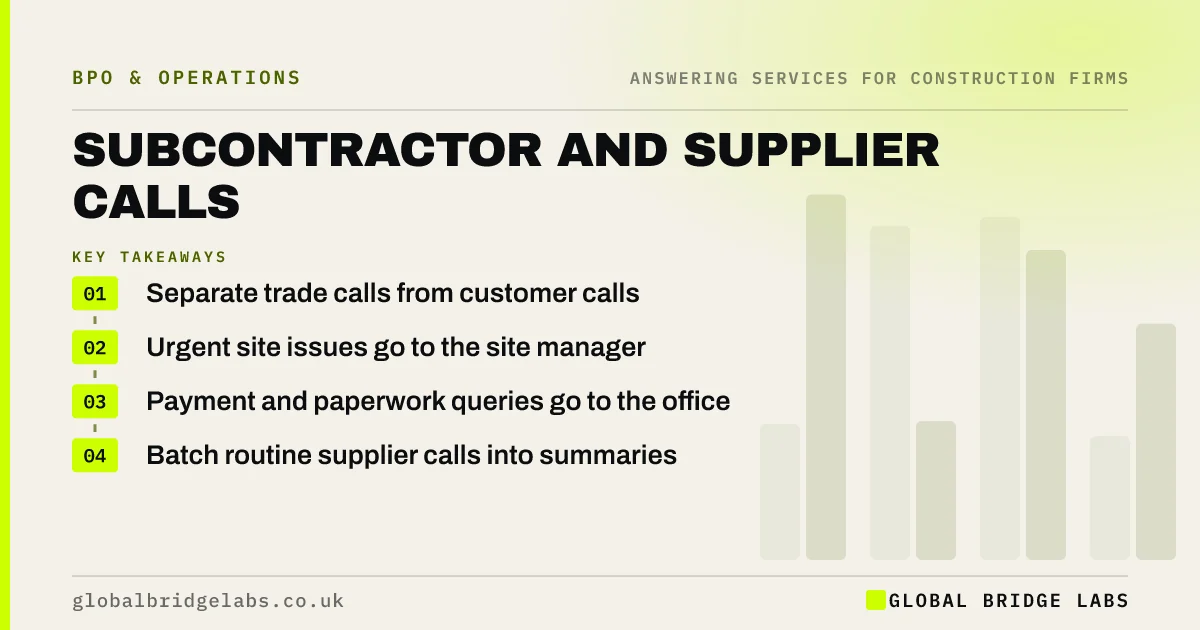
Subcontractor and supplier calls should never compete with customer enquiries for attention. Give your answering service a separate route for trade calls: urgent site issues to the site manager, payment and paperwork queries to the office, and routine supplier calls batched into a daily or weekly summary. Clear routes keep site managers working and customers answered.
- Separate trade calls from customer calls.
- Urgent site issues go to the site manager.
- Payment and paperwork queries go to the office.
- Batch routine supplier calls into summaries.
Want trade calls routed away from customers? Message us on WhatsApp.
Chat on WhatsApp →Why separate trade calls from customer calls?
Trade calls are frequent and often routine: confirming deliveries, chasing payment, checking start dates. If they are treated like customer calls, site managers are interrupted all day and real customer enquiries wait. Separating them gives each the right level of attention.
How should subcontractor calls be routed?
Ask the service to identify the subcontractor, the site and the reason. Urgent site matters, such as access, safety or materials missing, go to the site manager. Payment, CIS and paperwork queries go to the office. Start date and programme questions go to whoever plans the work.
How should supplier calls be routed?
Delivery confirmations and site access go to the site. Order changes and stock issues go to whoever placed the order. Account and invoice queries go to the office. New sales offers go into a weekly summary.
- Delivery and site access calls when you are on site
- Multi-trade firms: routing calls to the right trade
Want a routing list for your trade calls? Message us on WhatsApp and we will discuss your requirements.
Chat on WhatsApp →What should be logged?
Log the company, contact, site, reason and who it was passed to. A clear log helps you spot repeat problems, such as late deliveries from one supplier or payment chasers you have missed.
What about payment chasers?
Subcontractors chasing payment should get a clear, polite answer and a route to the office. Late payment damages relationships and can carry statutory interest in business to business deals. Logging every chase helps you see where payment is slipping.
When should trade calls reach you directly?
When a key subcontractor or supplier has a problem that could stop a job, it should reach the decision maker fast. Give the service a short list of names who can always be transferred.
What does this look like in practice?
A pattern we see: once supplier sales calls are batched weekly and payment queries go to the office, site managers report far fewer interruptions, and customer enquiries are answered faster.
Trade call routing checklist
- List subcontractors and suppliers.
- Set routes by reason.
- Name who can always be transferred.
- Batch sales calls weekly.
- Log every trade call.
- Review the log monthly.
Next step
Write three routes for trade calls, site, office and summary, and give them to your service.
Message us on WhatsApp for a trade call routing plan, or book a 30-minute consultation.
Chat on WhatsApp →Sources and further reading
- What you must do as a Construction Industry Scheme (CIS) contractor · GOV.UK
- Late commercial payments: charging interest and debt recovery · GOV.UK
- Construction (Design and Management) Regulations 2015 · Health and Safety Executive
Frequently asked questions
Should subcontractors use the same number as customers?
They often do, which is why routing matters. Some firms give subcontractors a separate line or extension, but many simply ask the answering service to identify trade callers and route them differently. Either works, as long as trade calls do not delay customer enquiries.
How should an answering service handle a subcontractor chasing payment?
Take the company, invoice reference and amount, then pass it to the office with a promised response time. The service should be polite and clear but should never promise payment dates itself. A log of payment chases helps you spot and fix cash flow problems early.
Can an answering service confirm deliveries to site?
It can pass delivery calls to the site manager or confirm details from a delivery schedule you share. It should not authorise changes to orders or accept deliveries on your behalf. Clear site access instructions in the script help drivers reach the right gate at the right time.
Written by

Global Bridge Labs (GBL) is a UK–Sri Lanka partner for social media, websites and BPO. Everything here comes from client delivery, not theory.