On this page
Key takeaways
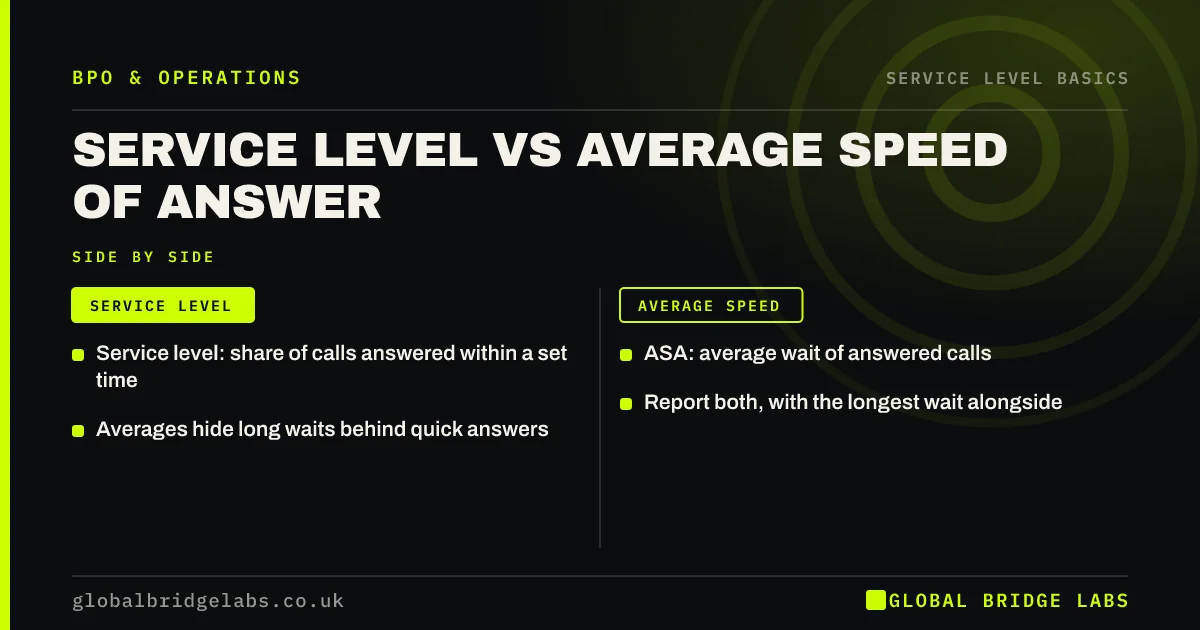
Service level counts the share of calls answered within a threshold, such as 80% within 20 seconds. Average speed of answer, or ASA, is the mean wait across all answered calls. ASA is easy to read but hides long waits behind many quick answers. Report service level as the target and use ASA as a supporting figure, never on its own.
- Service level: share of calls answered within a set time.
- ASA: average wait of answered calls.
- Averages hide long waits behind quick answers.
- Report both, with the longest wait alongside.
Not sure which call figures to report? Message us on WhatsApp.
Chat on WhatsApp →What is average speed of answer?
Average speed of answer is the total time answered callers spent waiting, divided by the number of answered calls. If ten callers waited a total of 300 seconds, ASA is 30 seconds. Most phone systems show it, and many owners find it easier to understand than a percentage.
How is it different from service level?
Service level answers a yes or no question for each call: was it answered within the threshold? ASA blends every wait into one number. Two days can have the same ASA of 30 seconds, one where everyone waited about 30 seconds and one where most callers waited five seconds and a few waited several minutes. Callers experience those days very differently.
Why can ASA mislead?
Because it only counts answered calls. A caller who gave up after four minutes does not appear in ASA at all, so a bad half hour with many abandoned calls can make ASA look better, not worse. It is also pulled around by a few extreme waits, which makes week-to-week comparisons noisy for small teams.
- Abandoned calls are left out.
- A few long waits distort the figure.
- It hides which half hours were poor.
Want a second opinion on your call report? Send it to us on WhatsApp.
Chat on WhatsApp →Which should a small business report?
Use service level as the headline target, because it is easy to plan staffing against. Add ASA as a supporting figure, plus the longest wait and the abandonment rate. Together those four numbers show speed, spread, worst case and lost callers, which is enough for most small teams.
What does this look like in practice?
A pattern we see: an owner is pleased with an ASA of 18 seconds, but the abandonment rate is 9% and the longest waits are over five minutes at lunchtime. Once service level and the longest wait are reported by half hour, the lunchtime gap is obvious and easy to staff.
ASA and service level checklist
- Report service level as the headline.
- Show ASA as a supporting figure.
- Add the longest wait each day.
- Read both with the abandonment rate.
- Split all figures by half hour.
Next step
Pull last week's figures from your phone system and put service level, ASA, abandonment and longest wait side by side. The gaps will show where to start.
Message us on WhatsApp to review your call figures, or book a 30-minute consultation.
Chat on WhatsApp →Sources and further reading
- Measuring success · GOV.UK Service Manual
- UK Customer Satisfaction Index · Institute of Customer Service
Frequently asked questions
What is a good average speed of answer?
There is no single benchmark. Many teams that work to 80/20 see ASA well under 20 seconds, because most calls are answered quickly. Rather than chase a number, check ASA alongside abandonment and the longest wait, and look for the half hours where all three get worse together.
Does ASA include abandoned calls?
Usually not. ASA is normally calculated on answered calls only, so callers who hung up are left out. That is why ASA can look healthy on a day when many people gave up. Always read it with the abandonment rate, and ask any provider exactly how their ASA is calculated.
Should I use ASA or service level in a contract?
Use service level as the main measure, because it sets a clear threshold for each call. ASA can be a secondary measure. Make sure the contract also defines how abandoned calls are treated and requires reports by half hour, so a good monthly average cannot hide poor peaks.
Written by

Global Bridge Labs (GBL) is a UK–Sri Lanka partner for social media, websites and BPO. Everything here comes from client delivery, not theory.