On this page
- 01Key takeaways
- 02What is the five-call test?
- 03Which five calls should you make?
- 04How do you score each call?
- 05When should you run the test?
- 06What do the scores mean?
- 07When is the test less useful?
- 08What does this look like in practice?
- 09Five-call test checklist
- 10Next step
- 11Sources and further reading
- 12Frequently asked questions
Key takeaways
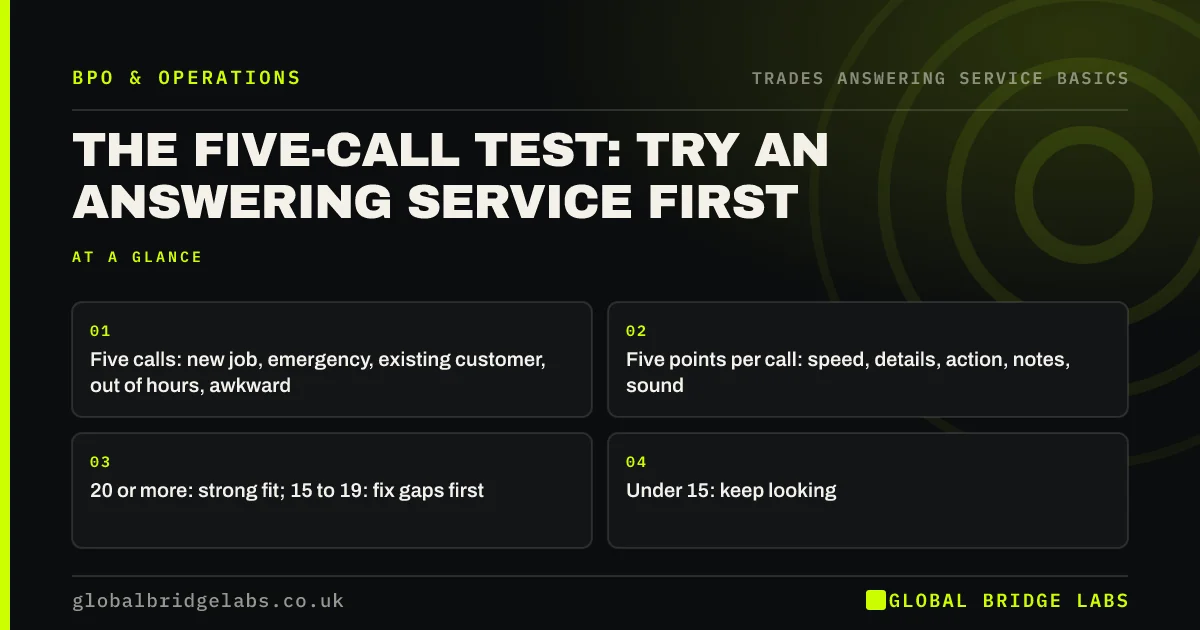
The GBL five-call test is a way to try an answering service before you commit. You make five realistic calls: a new job, an emergency, an existing customer, an out-of-hours call and an awkward call. Score each out of five for speed, details, action, notes and how it sounds. A total of 20 or more out of 25 is a strong fit.
- Five calls: new job, emergency, existing customer, out of hours, awkward.
- Five points per call: speed, details, action, notes, sound.
- 20 or more: strong fit; 15 to 19: fix gaps first.
- Under 15: keep looking.
Want us to help design your five test calls? Message us on WhatsApp.
Chat on WhatsApp →What is the five-call test?
The five-call test checks whether an answering service can handle the calls that actually win or lose trades jobs, rather than how polished its sales pitch sounds. It uses five short scenarios that every trades business receives, each scored the same way, so you can compare providers fairly.
Which five calls should you make?
Each call tests a different weakness. Keep the scenarios realistic for your trade and your area.
- New job: a homeowner wanting a quote for a common job in your patch.
- Emergency: a leak, gas smell, no power or lockout, depending on your trade.
- Existing customer: someone asking when the engineer will arrive.
- Out of hours: the new job again, at 7.30pm or on a Saturday morning.
- Awkward: a complaint, or a caller pushing hard for a price.
How do you score each call?
Give one point for each of five things on every call, for a total out of 25. Be strict: half-right is a zero.
- Answered within about 20 seconds, roughly five rings.
- The right details captured: name, number, postcode, job, urgency.
- The right action: booked, escalated or callback set with a time.
- Notes received within five minutes, in a usable format.
- Sounded like your business, with your name and a clear next step.
Need a scoring sheet for the five calls? Message us on WhatsApp and we will discuss your requirements.
Chat on WhatsApp →When should you run the test?
Run it during a free trial, the onboarding period or a short paid pilot, after the service has your script. Testing before they have your details only tests the default script. Spread the calls across a week, including a busy morning, so you see real conditions rather than a quiet afternoon.
What do the scores mean?
A score of 20 to 25 means the service is a strong fit. 15 to 19 means it can work, but write the fixes into the agreement before you sign. Under 15 means the gaps are too large to fix with a few notes, so keep looking. A zero on the emergency call should rule a service out on its own.
When is the test less useful?
It is less useful for very low volumes, where one bad call may be bad luck. It also cannot show how a service copes in a cold snap or a storm, so ask separately about peak capacity.
What does this look like in practice?
A pattern we see: two services score the same on price and reviews, but one books the out-of-hours call while the other only takes a message. The five-call test makes that difference visible before a contract is signed.
Five-call test checklist
- Write five scenarios for your trade.
- Ask a friend or colleague to make the calls.
- Use a number the service will not recognise.
- Score each call straight away.
- Keep the notes each service sends.
- Compare totals and the emergency score.
Next step
Write your five scenarios this week, then run them on every shortlisted service before you compare prices.
Message us on WhatsApp to run the five-call test with us, or book a 30-minute consultation.
Chat on WhatsApp →Sources and further reading
- Contracts and liabilities between controllers and processors · Information Commissioner's Office
- Gas Safe Register · Gas Safe Register
- Consumer Contracts (Information, Cancellation and Additional Charges) Regulations 2013 · legislation.gov.uk
Frequently asked questions
Is it fair to test an answering service with fake calls?
Yes, if you tell the provider you will be testing during a trial or pilot and do not waste large amounts of their time. Most good providers expect it. Keep the calls realistic and short, and do not include real customer data. The aim is to see normal service, not to trick anyone.
How long does the five-call test take?
About an hour of your time in total: twenty minutes to write the scenarios, five short calls spread across a week, and a few minutes scoring each call and reviewing the notes. That hour can save months on the wrong contract, which is why it is worth doing for every shortlisted provider.
What if two services score the same?
Look at the emergency call and the out-of-hours call first, because those decide urgent jobs. If they still tie, compare cost per booked job and the notice period. A service with a shorter commitment lets you switch more easily if the quality slips after the first month.
Written by

Global Bridge Labs (GBL) is a UK–Sri Lanka partner for social media, websites and BPO. Everything here comes from client delivery, not theory.