On this page
- 01Key takeaways
- 02How does pay-per-call pricing work?
- 03How do monthly bundles work?
- 04How does hourly or seat pricing work?
- 05Which model suits seasonal trades?
- 06What catches people out?
- 07What does this look like in practice?
- 08Pricing model checklist
- 09Next step
- 10Sources and further reading
- 11Frequently asked questions
Key takeaways
Answering services price in three main ways: per call or per minute, monthly bundles of calls, and per hour or seat for a dedicated team. Per call suits low, unpredictable volumes. Bundles suit steady volumes. Hourly suits busy lines with booking and admin. Pick the model that matches your call pattern, then check what happens when you go over.
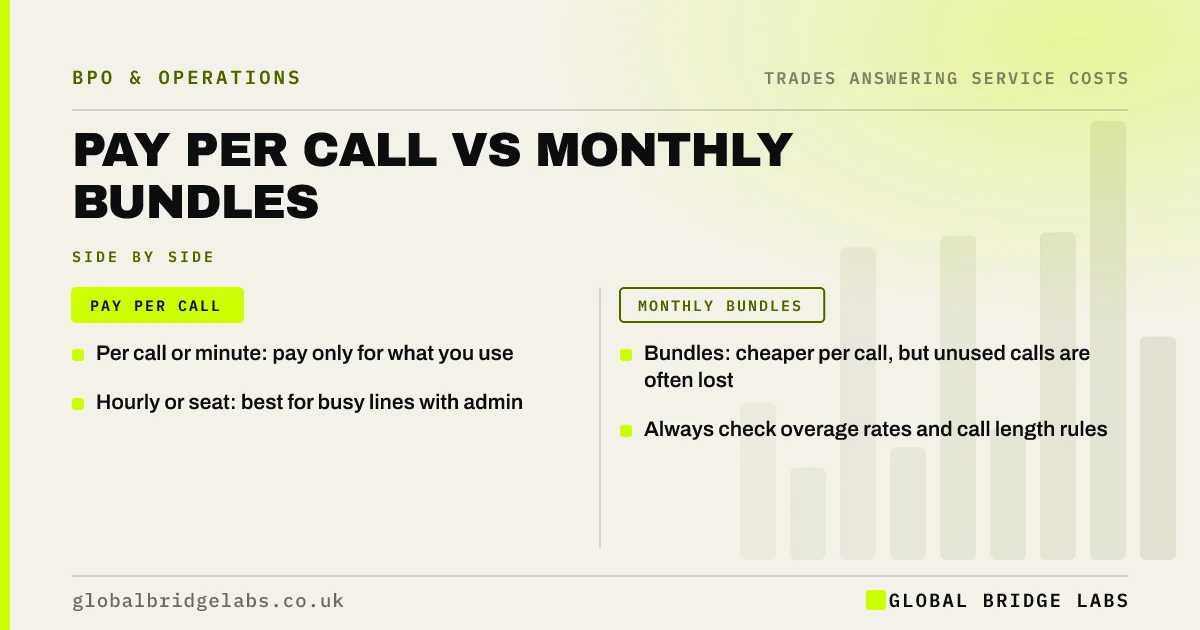
- Per call or minute: pay only for what you use.
- Bundles: cheaper per call, but unused calls are often lost.
- Hourly or seat: best for busy lines with admin.
- Always check overage rates and call length rules.
Not sure which pricing model fits? Message us on WhatsApp.
Chat on WhatsApp →How does pay-per-call pricing work?
You pay a fixed amount for each call, sometimes with a monthly minimum. Some providers charge per minute instead, which costs more for long calls with many questions. Per call is simple and fair for low volumes, but busy months can cost more than expected.
How do monthly bundles work?
You buy a set number of calls or minutes each month for a fixed price. The unit cost is lower, but unused calls usually do not roll over, and calls above the bundle are charged at a higher overage rate. Bundles suit steady volumes you can forecast.
How does hourly or seat pricing work?
You pay for a person or team for set hours, whatever the call count. It suits busy lines and work beyond calls, such as quote chasing and job records. As indicative ranges, managed teams cost about £9 to £18 an hour offshore and £20 to £35 onshore.
Want each model priced against your last three months? Message us on WhatsApp and we will discuss your requirements.
Chat on WhatsApp →Which model suits seasonal trades?
Seasonal trades, such as roofers, heating engineers and landscapers, have sharp peaks. Per call or a flexible bundle avoids paying for quiet months. Check whether the provider can scale quickly in a cold snap or storm, and what overage costs at those times.
What catches people out?
The common surprises are minimum monthly charges, rounding call time up to the next minute, charging for wrong numbers and spam, overage rates, and paying extra for booking or transfers. Ask for an example invoice at your volume.
What does this look like in practice?
A pattern we see: a heating firm on a small bundle pays heavy overage every winter. A per-call plan with no minimum or a seasonal bundle often costs less across the year.
Pricing model checklist
- Pull 12 months of call volumes.
- Note peaks and quiet months.
- Ask for per call, bundle and hourly prices.
- Check overage, rounding and minimums.
- Ask how spam calls are charged.
- Compare yearly totals.
Next step
Price your last 12 months on each model and pick the lowest yearly cost that still covers your peaks.
Message us on WhatsApp to compare pricing models, or book a 30-minute consultation.
Chat on WhatsApp →Sources and further reading
- Consumer Contracts (Information, Cancellation and Additional Charges) Regulations 2013 · legislation.gov.uk
- VAT rates · GOV.UK
Frequently asked questions
Is it better to pay per call or per minute?
Per call is usually easier to predict, especially if your calls involve several qualifying questions. Per minute can be cheaper for very short calls such as simple messages. Check how each provider rounds time, because rounding every call up to a full minute can noticeably raise the bill on busy months.
Do unused bundle calls roll over?
Often they do not, so a bundle that is too large wastes money in quiet months. Some providers allow rollover or flexible bundles. Ask before you sign, and size the bundle to your typical month rather than your busiest, accepting some overage in peak weeks.
Am I charged for spam and wrong-number calls?
Some providers charge for every answered call, including spam, sales calls and wrong numbers. Others filter or refund them. Ask how these calls are counted and whether you can block known spam numbers, because they can make up a noticeable share of calls on a public business number.
Written by

Global Bridge Labs (GBL) is a UK–Sri Lanka partner for social media, websites and BPO. Everything here comes from client delivery, not theory.