
On this page
- 01Key takeaways
- 02What are the five parts of a trades call script?
- 03What does an example script look like?
- 04How long should calls take?
- 05How should the script handle unusual calls?
- 06How often should the script change?
- 07Should each job type have its own script?
- 08What does this look like in practice?
- 09Call script checklist
- 10Next step
- 11Sources and further reading
- 12Frequently asked questions
Key takeaways
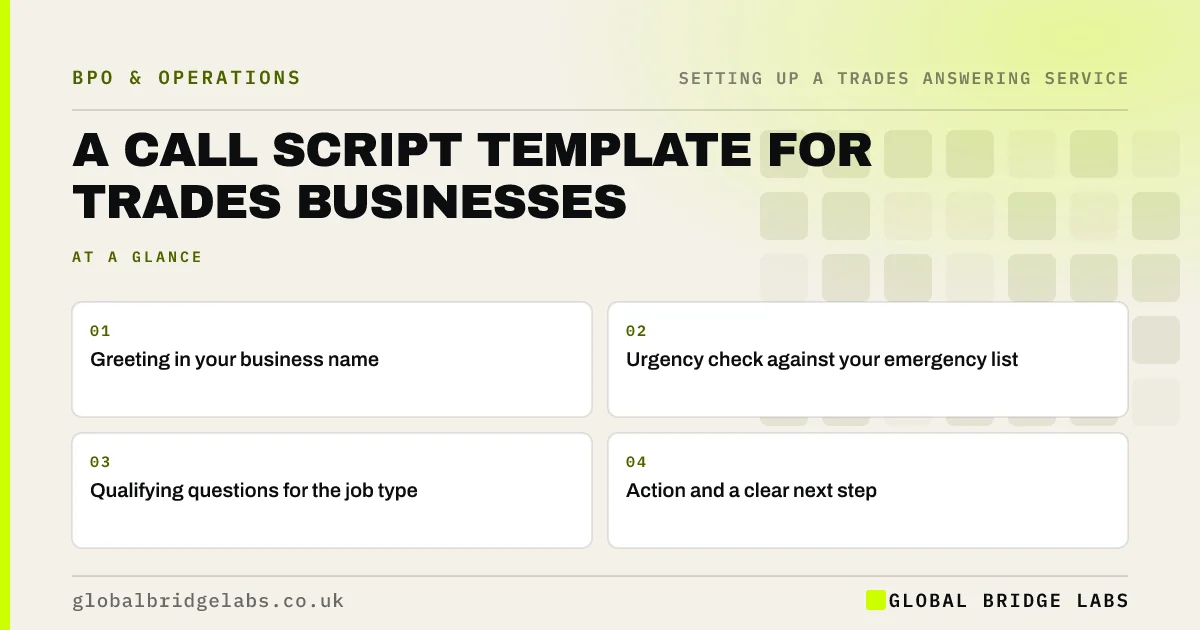
A good trades call script has five parts: a short greeting, an urgency check, qualifying questions for the job type, the action, such as booking, transfer or callback, and a clear close stating what happens next. Keep it short enough to finish most calls in a few minutes. Give your answering service the script, and review it after the first 20 calls.
- Greeting in your business name.
- Urgency check against your emergency list.
- Qualifying questions for the job type.
- Action and a clear next step.
Want a call script written for your trade? Message us on WhatsApp.
Chat on WhatsApp →What are the five parts of a trades call script?
Each part has one job. Together they make sure every call ends with useful information and a clear promise.
- Greet: business name and an offer to help.
- Check: is this urgent under our emergency list?
- Qualify: the questions for this job type.
- Act: book, transfer, callback or message.
- Close: confirm details and the next step.
What does an example script look like?
An illustrative plumbing example. Greet: Good morning, Taylor Plumbing, how can I help? Check: Is water leaking now, or near any electrics? Qualify: What is the problem, where in the property, your postcode, best number and can you send a photo? Act: I can book a visit on Thursday at 10am. Close: I will text you the confirmation now.
How long should calls take?
Most routine trades calls can be handled in two to four minutes. Long scripts make callers impatient and cost more on per-minute plans. Cut any question you never use.
Want your script reviewed for length? Message us on WhatsApp and we will discuss your requirements.
Chat on WhatsApp →How should the script handle unusual calls?
Add a fallback: if the call does not fit any job type, take full details and book a callback with you. Never let the receptionist guess.
How often should the script change?
Review it after the first 20 calls, then whenever prices, services or staff change, and before busy seasons.
Should each job type have its own script?
Use one shared greeting, urgency check and close, with a short block of questions for each common job type. That keeps receptionists consistent while still capturing what each job needs. Five or six job blocks cover most trades businesses.
What does this look like in practice?
A pattern we see: a firm's first script has 18 questions and calls take seven minutes. Cutting it to the questions that change a decision halves call length and improves notes.
Call script checklist
- Write a short greeting.
- Add the urgency check.
- Write questions per job type.
- Set actions and fallbacks.
- Write a clear close.
- Review after 20 calls.
Next step
Draft your five-part script on one page, then time a practice call with a friend.
Message us on WhatsApp for a call script, or book a 30-minute consultation.
Chat on WhatsApp →Sources and further reading
- Health and safety basics for your business · Health and Safety Executive
- Consumer Contracts (Information, Cancellation and Additional Charges) Regulations 2013 · legislation.gov.uk
Frequently asked questions
What should a tradesman's phone script include?
A short greeting with your business name, an urgency check, qualifying questions for the job type, the action such as booking or callback, and a clear close that confirms details and the next step. Keep it short enough that most calls finish in a few minutes.
How long should an answering service call take?
For routine trades enquiries, two to four minutes is a sensible aim. Emergencies may take longer because of safety wording and transfers. If routine calls regularly run longer, your script probably has questions that do not change any decision, and cutting them improves both cost and caller experience.
Should my answering service use the same script as me?
Use the same questions and promises, but write them down clearly for the service. Owners often answer from memory and skip steps receptionists need. A written script makes every call consistent, whoever answers, and gives you a basis for feedback when something goes wrong.
Written by

Global Bridge Labs (GBL) is a UK–Sri Lanka partner for social media, websites and BPO. Everything here comes from client delivery, not theory.


