On this page
- 01Key takeaways
- 02Example 1: a sole-trader electrician
- 03Example 2: a three-van plumbing firm
- 04Example 3: a roofing company
- 05Example 4: a building firm
- 06Example 5: a maintenance contractor
- 07What do the examples have in common?
- 08What does this look like in practice?
- 09Examples checklist
- 10Next step
- 11Sources and further reading
- 12Frequently asked questions
Key takeaways
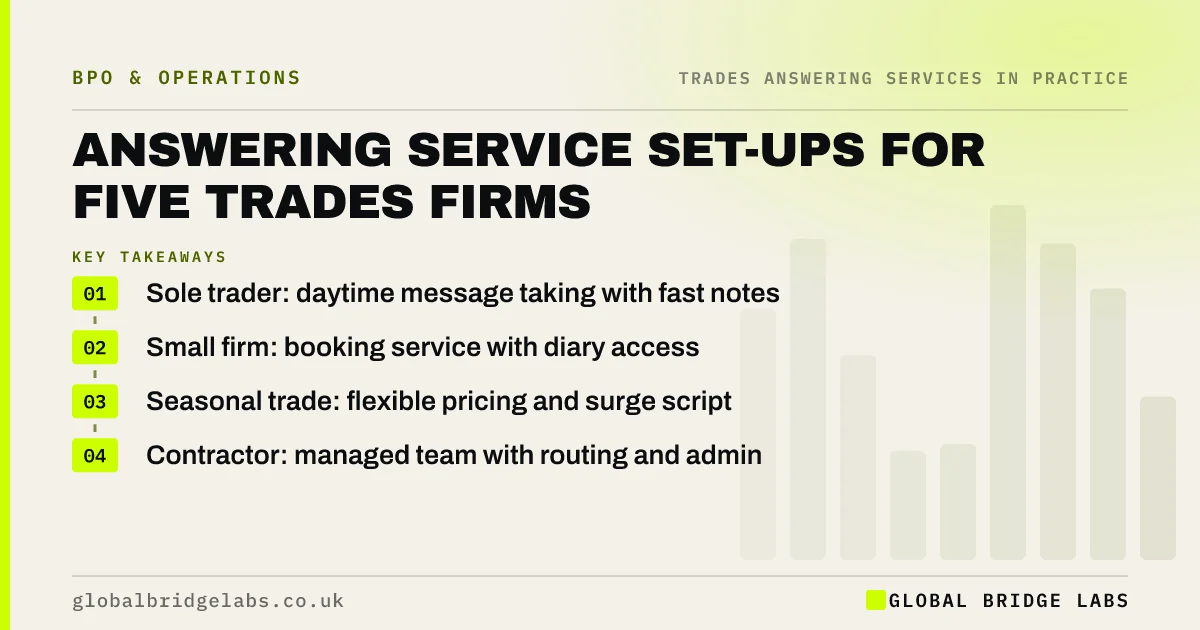
These five illustrative examples show how different trades businesses might set up an answering service: a sole-trader electrician, a three-van plumbing firm, a roofing company with storm peaks, a building firm qualifying projects and a maintenance contractor running a helpdesk. Each picks the service type, hours and rules that match its calls, not the cheapest option.
- Sole trader: daytime message taking with fast notes.
- Small firm: booking service with diary access.
- Seasonal trade: flexible pricing and surge script.
- Contractor: managed team with routing and admin.
Want a set-up designed for your firm? Message us on WhatsApp.
Chat on WhatsApp →Example 1: a sole-trader electrician
Illustrative, not client data. A one-person electrician misses morning calls while on jobs. Set-up: message taking from 8am to 6pm, text notes within five minutes, strict electrical emergency wording, two fixed quote slots a day. Result to look for: fewer hang-ups and evening callbacks.
Example 2: a three-van plumbing firm
Illustrative. Three engineers, many leak calls. Set-up: a service with diary access, leak triage, three priority levels, photo requests and evening cover until 10pm. Result to look for: a higher calls to bookings rate and on-call engineers reached only for real emergencies.
Example 3: a roofing company
Illustrative. Calls quiet most months, then spike after storms. Set-up: per-call pricing with no minimum, a storm script, honest waiting list and photo requests from the ground. Result to look for: every storm caller gets a time without paying for quiet months.
Want your set-up sketched like these? Message us on WhatsApp and we will discuss your requirements.
Chat on WhatsApp →Example 4: a building firm
Illustrative. Surveys wasted on projects without budgets. Set-up: qualifying questions on scope, drawings, budget and timing, survey slots only for qualified enquiries, trade calls routed separately. Result to look for: fewer wasted surveys and faster quotes.
Example 5: a maintenance contractor
Illustrative. FM contracts with response times. Set-up: a managed team as helpdesk, logging jobs against contracts, applying priorities and producing monthly response reports. Result to look for: response times proven at contract review.
What do the examples have in common?
Each starts from what calls need to become, then picks the simplest service that delivers it. None chose on price per call alone, and each kept emergency handling and pricing decisions under the owner's control.
What does this look like in practice?
GBL works with UK trades and construction businesses on calls and the admin around them. The pattern across all five examples is the same: start with the calls you miss, then add booking, routing or admin only where it wins work.
Examples checklist
- Pick the example closest to you.
- Note its service type and hours.
- Adapt its rules to your trade.
- Run the five-call test.
- Track the result to look for.
- Review after three months.
Next step
Choose the example closest to your firm and adapt its set-up as your starting brief.
Message us on WhatsApp for a set-up review, or book a 30-minute consultation.
Chat on WhatsApp →Sources and further reading
- National Minimum Wage and National Living Wage rates · GOV.UK
- Gas Safe Register · Gas Safe Register
Frequently asked questions
Which answering service set-up suits a small trades firm?
For a firm with a few engineers, a service that books into a shared diary, follows a triage script and sends notes quickly usually fits. Add evening cover if call logs show evening demand. A managed team becomes worthwhile when quote chasing and admin also need taking off the owner.
Are these answering service examples real clients?
No. They are illustrative examples based on common patterns in trades businesses, not client data. They show how service type, hours and rules can be matched to different call patterns. Use them as a starting point and adapt them to your own calls and trade.
How do I choose between these set-ups?
Start with what your calls need to become: a message, a booking, a routed call or completed admin. Then check your call log for when calls arrive and when you miss them. Pick the simplest set-up that covers both, and review it after three months.
Written by

Global Bridge Labs (GBL) is a UK–Sri Lanka partner for social media, websites and BPO. Everything here comes from client delivery, not theory.