
On this page
- 01Key takeaways
- 02Which electrical calls are emergencies?
- 03What wording should the service use?
- 04How should calls be escalated?
- 05What should the service never do?
- 06What about landlord and tenant calls?
- 07What does this look like in practice?
- 08Electrical triage checklist
- 09Next step
- 10Sources and further reading
- 11Frequently asked questions
Key takeaways
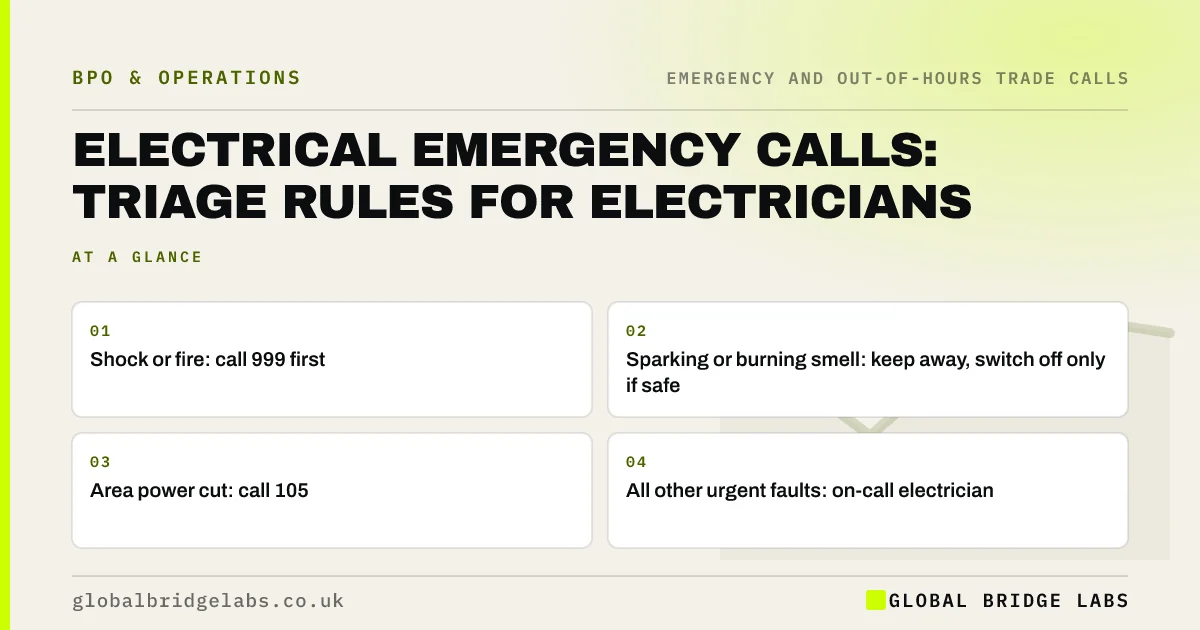
For electrical emergencies, the answering service needs short triage rules: if anyone has had a shock or there is fire, call 999; if there is sparking or a burning smell, keep away and switch off at the consumer unit only if safe; if there is a power cut, check whether neighbours are affected and call 105. Everything else follows your on-call route.
- Shock or fire: call 999 first.
- Sparking or burning smell: keep away, switch off only if safe.
- Area power cut: call 105.
- All other urgent faults: on-call electrician.
Want electrical triage wording for your service? Message us on WhatsApp.
Chat on WhatsApp →Which electrical calls are emergencies?
Electrical emergencies are calls where people or property are at immediate risk, or where a vulnerable person has no power. Typical examples are sparking, burning smells, scorch marks, water near electrics, a tripped supply that will not reset in a vulnerable home and damaged cables.
What wording should the service use?
Fixed, short wording for each situation, nothing more.
- Someone had a shock or there is fire: call 999 now.
- Sparking or burning smell: keep away and switch off at the consumer unit only if it is safe.
- Water near electrics: do not touch switches, keep away.
- Power cut in the street: call 105 for the network operator.
How should calls be escalated?
Danger to life goes to 999 first, then your on-call electrician is alerted. Sparking, smells and water near electrics go straight to on call. A tripped circuit with no danger can usually be booked for the next slot.
- On-call rotas: how the service reaches your engineer
- Live call transfer: when callers should be put through
Want your escalation order written? Message us on WhatsApp and we will discuss your requirements.
Chat on WhatsApp →What should the service never do?
Never tell a caller to remove covers, reset a device repeatedly or touch anything damaged. Never say a fault is safe. The receptionist captures details, gives the approved wording and alerts the engineer.
What about landlord and tenant calls?
Tenants often call about electrical faults in rented homes. Landlords must keep electrical installations safe and inspected. The service should note who the landlord or agent is and follow your rule for who authorises work.
What does this look like in practice?
A pattern we see: a receptionist without a script tells a caller to try resetting the trip switch again. A fixed script with clear limits removes the guesswork and keeps advice where it belongs.
Electrical triage checklist
- List electrical emergencies.
- Write fixed wording for each.
- Add 999 and 105 routes.
- Set the on-call escalation.
- Add a landlord and agent rule.
- Test quarterly.
Next step
Write fixed wording for your four most common emergencies and send it to your answering service.
Message us on WhatsApp for an electrical triage script, or book a 30-minute consultation.
Chat on WhatsApp →Sources and further reading
- Health and safety basics for your business · Health and Safety Executive
- Electrical safety standards in the private rented sector · Ministry of Housing, Communities and Local Government
- Competent person schemes: current schemes and how they are authorised · Ministry of Housing, Communities and Local Government
Frequently asked questions
What number do you call for a power cut in the UK?
In Great Britain, you can call 105 to reach your local electricity network operator about a power cut, free of charge. Your answering service can give this number when a caller reports that neighbours are also without power, while noting the call in case an electrician is needed afterwards.
Should an answering service tell a caller to reset a trip switch?
It should not guide repairs or repeated resetting. If the caller has already tried and the circuit will not reset, the service should note it and book or escalate according to your rules. Any sign of burning, sparking or damage should be treated as urgent and routed to your on-call electrician.
When should a receptionist tell a caller to dial 999?
When someone has had an electric shock, is injured, or there is fire or smoke. The receptionist should say this immediately, before taking other details. Your engineer can follow up afterwards. Making this the first line of the electrical script avoids any delay in a life-threatening situation.
Written by

Global Bridge Labs (GBL) is a UK–Sri Lanka partner for social media, websites and BPO. Everything here comes from client delivery, not theory.


