
On this page
- 01Key takeaways
- 02What red flags appear in sales calls?
- 03What red flags appear in contracts?
- 04What red flags appear in test calls?
- 05What red flags appear after you start?
- 06What should you do when you see one?
- 07Are low prices a red flag?
- 08What does this look like in practice?
- 09Red flags checklist
- 10Next step
- 11Sources and further reading
- 12Frequently asked questions
Key takeaways
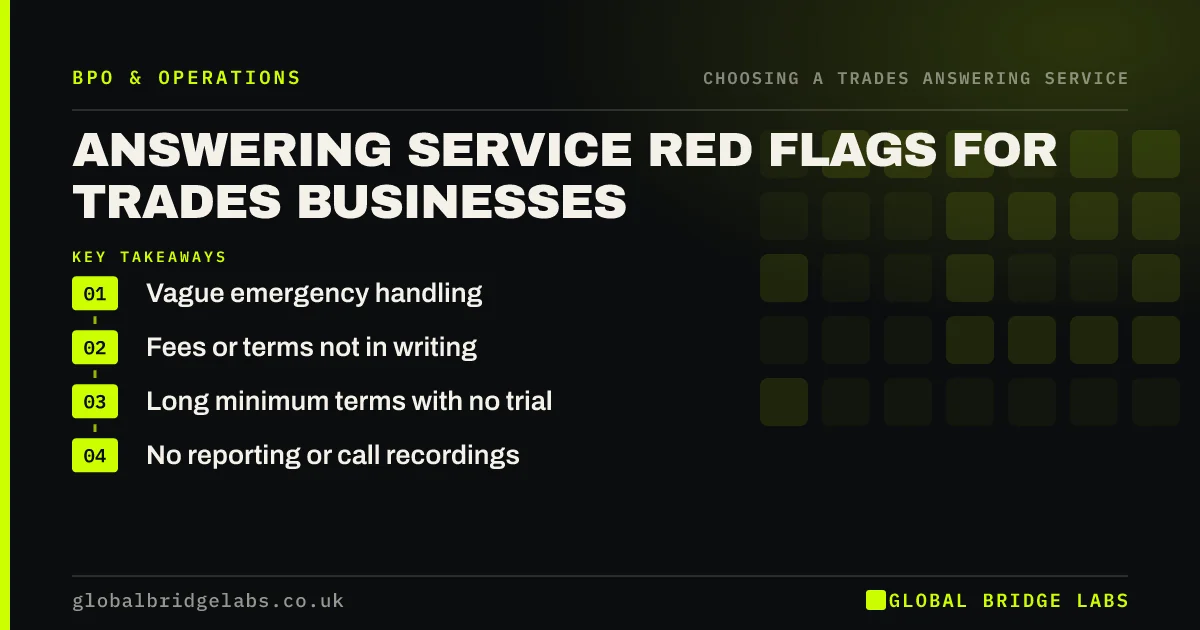
Red flags in an answering service include vague answers about emergencies, fees that will not go in writing, long contracts with no trial, no reports, owning your number, poor data answers and test calls that end with no next step. One red flag is a question to ask; several together mean look elsewhere. Spotting them before signing saves months of lost calls.
- Vague emergency handling.
- Fees or terms not in writing.
- Long minimum terms with no trial.
- No reporting or call recordings.
Want a provider checked for red flags? Message us on WhatsApp.
Chat on WhatsApp →What red flags appear in sales calls?
Watch for answers that avoid specifics. If the salesperson cannot explain how emergencies are handled, how your calls are answered at peak times or what you will pay at your volume, the service may not deliver either.
- Cannot explain the emergency route.
- Will not give a price at your volume.
- Pushes a long contract on the first call.
- Avoids questions about data and location.
What red flags appear in contracts?
Long minimum terms with automatic renewal, heavy exit fees, the provider owning your number, no processor contract and price rises at its discretion are all warning signs.
What red flags appear in test calls?
Slow answers, generic greetings, missing questions, no next step for the caller, notes that arrive late or vague, and poor handling of the emergency call.
- The five-call test: try an answering service first
- Answering service call notes: what good looks like
Want help judging test call results? Message us on WhatsApp and we will discuss your requirements.
Chat on WhatsApp →What red flags appear after you start?
Notes getting worse after the first month, rising abandoned calls, script changes ignored, slow replies to complaints and reports that stop arriving.
What should you do when you see one?
Ask about it directly and in writing. A good provider explains and fixes it. If several red flags appear together, keep looking or plan to switch.
Are low prices a red flag?
Not on their own. Some providers keep prices low through efficient systems. Low prices become a warning when paired with vague answers, long contracts or extra fees that only appear later. Judge the full package, not the headline rate.
What does this look like in practice?
A pattern we see: a cheap provider will not put its emergency route in writing and insists on a 12-month term. A second provider answers clearly and offers a monthly contract. The second costs more per call but less per booked job.
Red flags checklist
- Note vague sales answers.
- Check contract length and exit fees.
- Check number ownership.
- Check data terms.
- Score test calls strictly.
- Watch the first three months closely.
Next step
Use this list during sales calls and test calls, and ask about every red flag you spot in writing.
Message us on WhatsApp for a provider review, or book a 30-minute consultation.
Chat on WhatsApp →Sources and further reading
- Consumer Contracts (Information, Cancellation and Additional Charges) Regulations 2013 · legislation.gov.uk
- Unfair commercial practices guidance (CMA207) · Competition and Markets Authority
- Contracts and liabilities between controllers and processors · Information Commissioner's Office
Frequently asked questions
What are the warning signs of a bad answering service?
Vague emergency handling, fees not in writing, long contracts with no trial, the provider owning your number, poor data answers, no reports and test calls that end without a clear next step. Once you start, watch for worsening notes, rising abandoned calls and ignored feedback.
Is a long contract a red flag for an answering service?
Not always, but a long minimum term without a trial or exit right is a risk, because you cannot leave if quality is poor. Prefer a monthly rolling contract or a short first term. Commit to longer terms only once the service has proved itself on your real calls.
What should I do if my answering service gets worse?
Raise specific examples in writing, ask for a fix plan and check the next month's results. Give feedback on notes and scripts, because some issues are fixable. If quality keeps slipping despite feedback, plan a switch, check your notice period and set up the new provider first.
Written by

Global Bridge Labs (GBL) is a UK–Sri Lanka partner for social media, websites and BPO. Everything here comes from client delivery, not theory.


