On this page
- 01Key takeaways
- 02Why does feedback matter so much?
- 03What makes feedback useful?
- 04How often should you give feedback?
- 05Who should receive feedback?
- 06What if feedback is ignored?
- 07How do you keep feedback manageable?
- 08What does this look like in practice?
- 09Feedback checklist
- 10Next step
- 11Sources and further reading
- 12Frequently asked questions
Key takeaways
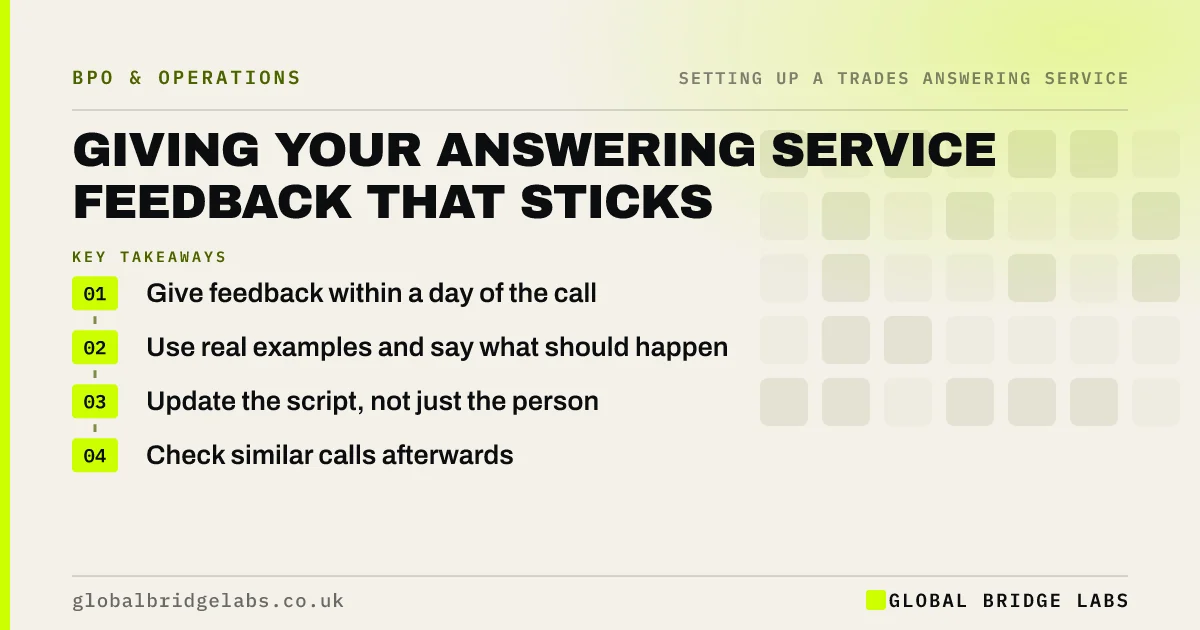
Feedback that sticks is specific, quick and linked to the script. When a note is wrong or a call goes badly, send the provider the example, what should have happened and the script change, within a day. Then check the next few similar calls. Regular, small corrections improve quality far more than an occasional complaint.
- Give feedback within a day of the call.
- Use real examples and say what should happen.
- Update the script, not just the person.
- Check similar calls afterwards.
Want a feedback routine set up? Message us on WhatsApp.
Chat on WhatsApp →Why does feedback matter so much?
Receptionists only know what your script and feedback tell them. Without feedback, small errors repeat. With quick, clear feedback, they stop. Most quality problems in answering services are fixable this way.
What makes feedback useful?
Use a simple format so the provider can act quickly.
- The call: date, time and caller.
- What happened.
- What should have happened.
- The script change needed.
How often should you give feedback?
Daily in the first two weeks, weekly for the next two months, then monthly. Praise good calls too, so receptionists know what to repeat.
Want help writing feedback your service can use? Message us on WhatsApp and we will discuss your requirements.
Chat on WhatsApp →Who should receive feedback?
Your account manager or team lead at the provider, not individual receptionists. They update the script and brief the whole team, so a fix reaches everyone who answers your line, including night and weekend staff you may never speak to directly.
What if feedback is ignored?
Raise it formally, with dates and examples, and ask for a written fix plan with a date for review. If the same issue repeats after clear feedback, it is a service problem, not a script problem, and you may need to switch.
How do you keep feedback manageable?
Keep a simple running log: date, issue, change requested and whether it was fixed. Review it each month with the provider. The log stops the same issue being raised several times and shows whether quality is improving.
What does this look like in practice?
A pattern we see: an owner complains vaguely that notes are poor. Switching to specific examples with script changes fixes most issues within two weeks.
Feedback checklist
- Review notes daily at first.
- Use the four-part format.
- Send to the account lead.
- Update the script.
- Praise good calls.
- Check similar calls afterwards.
Next step
Pick the worst note from last week and send it to your provider using the four-part format.
Message us on WhatsApp for a feedback routine, or book a 30-minute consultation.
Chat on WhatsApp →Sources and further reading
- Principle (d): Accuracy · Information Commissioner's Office
- Contracts and liabilities between controllers and processors · Information Commissioner's Office
Frequently asked questions
How do I give feedback to my answering service?
Send specific examples to your account manager: the call, what happened, what should have happened and the script change needed. Do it within a day so it is fresh. Praise good calls too. Then check similar calls over the next week to confirm the change has worked.
How often should I review my answering service's calls?
Daily for the first two weeks, weekly for the next two months, then monthly once quality is steady. Look at a sample of notes and recordings, including busy periods and at least one emergency or awkward call each month. Increase checks again after any script or staff change.
What if my answering service keeps making the same mistake?
Check the script first, because repeated mistakes often come from unclear instructions. If the script is clear and the mistake continues after specific feedback, raise it formally with dates and examples. Persistent errors after clear feedback suggest a training or staffing issue at the provider.
Written by

Global Bridge Labs (GBL) is a UK–Sri Lanka partner for social media, websites and BPO. Everything here comes from client delivery, not theory.