
On this page
- 01Key takeaways
- 02What is a shared receptionist model?
- 03What is a dedicated model?
- 04How do quality and cost compare?
- 05What questions reveal the model?
- 06When should you move to dedicated?
- 07Can you mix the two?
- 08What does this look like in practice?
- 09Model choice checklist
- 10Next step
- 11Sources and further reading
- 12Frequently asked questions
Key takeaways
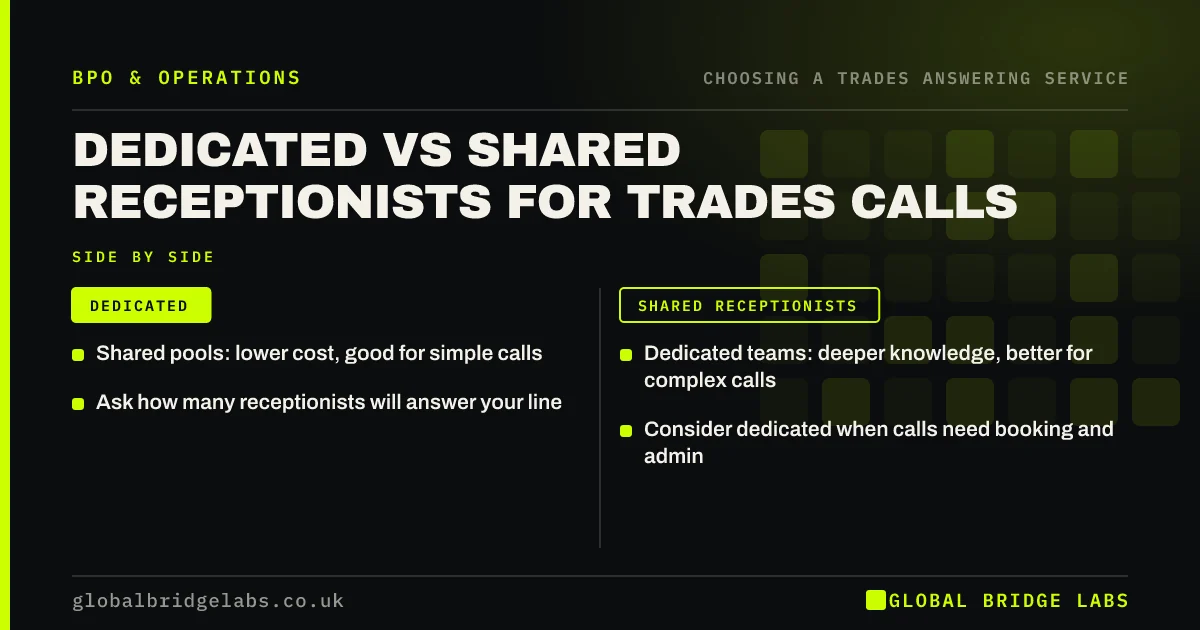
A shared receptionist model means a large pool answers many businesses' calls; a dedicated model means a small team learns your business and answers mostly your calls. Shared pools are cheaper and handle volume spikes well. Dedicated teams sound more like your office and handle complex routing and admin better. Many trades firms start shared and move to dedicated as they grow.
- Shared pools: lower cost, good for simple calls.
- Dedicated teams: deeper knowledge, better for complex calls.
- Ask how many receptionists will answer your line.
- Consider dedicated when calls need booking and admin.
Weighing shared and dedicated models? Message us on WhatsApp.
Chat on WhatsApp →What is a shared receptionist model?
In a shared model, many receptionists answer calls for many businesses. When your call arrives, any free receptionist answers using your script on screen. It is efficient and handles spikes, but receptionists may know little about your business beyond the script.
What is a dedicated model?
In a dedicated model, a small team answers your calls, often alongside your admin. They learn your customers, engineers, job types and quirks. Callers often notice the familiarity.
How do quality and cost compare?
Shared models usually cost less per call. Dedicated teams usually cost more per hour but handle booking, routing and admin better. For simple message taking, shared is often enough. For complex trades calls, dedicated often wins on cost per booked job.
- Cost per booked job: compare answering services fairly
- How much does an answering service cost for trades?
Want both models costed for your calls? Message us on WhatsApp and we will discuss your requirements.
Chat on WhatsApp →What questions reveal the model?
Ask how many receptionists will answer your line, whether the same people answer each day, how new staff are trained on your business and who you speak to about quality.
When should you move to dedicated?
Move when calls need booking into complex diaries, routing across trades or sites, quote chasing or admin, or when consistent voices matter to your customers.
Can you mix the two?
Yes. A common set-up uses a dedicated team during working hours for booking and admin, with a shared pool for overnight and overflow calls. Both follow the same script and emergency rule, and notes go to the same place.
What does this look like in practice?
A pattern we see: a growing firm on a shared service gets accurate messages but few bookings. Moving to a small dedicated team that books jobs and chases quotes raises bookings from the same calls.
Model choice checklist
- Count calls and complexity.
- Ask how many receptionists answer.
- Check training on your business.
- Compare cost per booked job.
- Consider dedicated for admin.
- Review as you grow.
Next step
Ask each provider how many people will answer your line, then decide which model fits your calls.
Message us on WhatsApp for help choosing a model, or book a 30-minute consultation.
Chat on WhatsApp →Sources and further reading
- Contracts and liabilities between controllers and processors · Information Commissioner's Office
- National Minimum Wage and National Living Wage rates · GOV.UK
Frequently asked questions
Is a dedicated receptionist better than a shared answering service?
It depends on your calls. For simple message taking, a shared service is usually cheaper and good enough. For calls that need booking, routing or admin, a dedicated team that learns your business tends to perform better and can cost less per booked job, despite a higher monthly price.
Will the same person answer my calls every time?
With a shared service, usually not; any free receptionist answers. With a dedicated team, a small group answers most of your calls, so callers often hear familiar voices. Ask each provider how many people will handle your line and how they are trained on your business.
Can a shared service handle emergencies well?
It can, if the script and emergency route are clear and receptionists follow them. The risk is that someone unfamiliar with your trade hesitates on an unusual call. Test emergency scenarios during a trial and check the route is followed exactly, whichever model you choose.
Written by

Global Bridge Labs (GBL) is a UK–Sri Lanka partner for social media, websites and BPO. Everything here comes from client delivery, not theory.


