On this page
Key takeaways
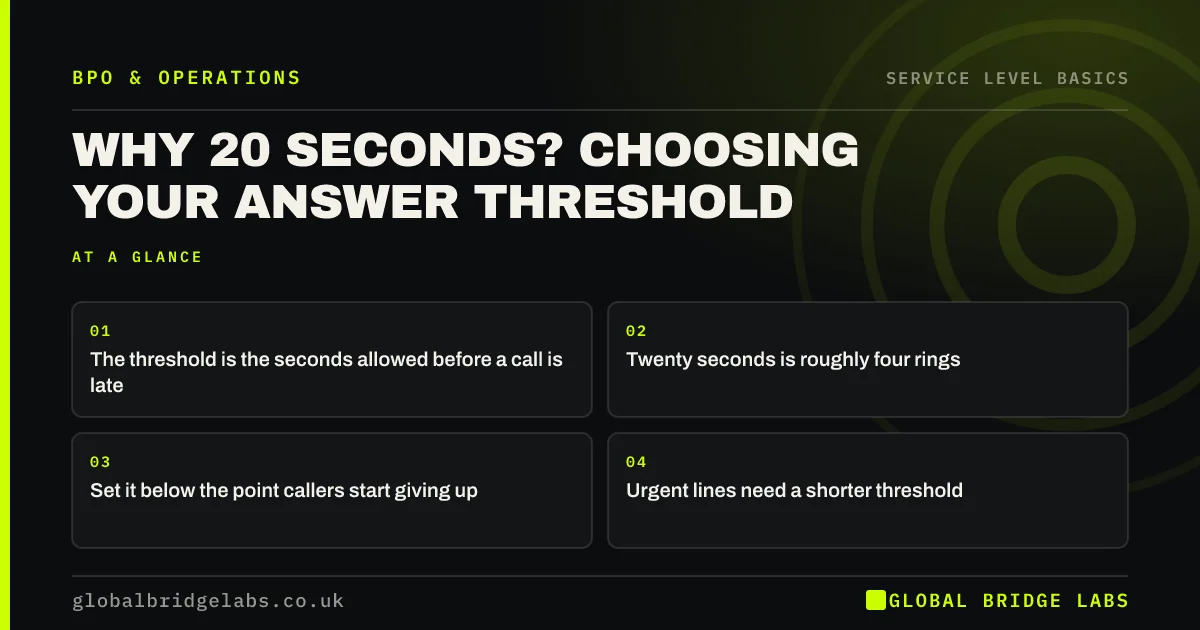
The threshold is the second number in a service level, the seconds a caller can wait and still count as answered on time. Twenty seconds, about four rings, is the common choice because most callers tolerate that wait. Choose yours by measuring when your callers start hanging up, then set the threshold comfortably below that point.
- The threshold is the seconds allowed before a call is late.
- Twenty seconds is roughly four rings.
- Set it below the point callers start giving up.
- Urgent lines need a shorter threshold.
Not sure what threshold suits your callers? Message us on WhatsApp.
Chat on WhatsApp →Why 20 seconds?
Twenty seconds is long enough to absorb small bursts of calls without a big team, and short enough that most callers do not notice a wait. It has become a habit across contact centres rather than a researched optimum for every business. Treat it as a starting point you test, not a rule.
How do you find your callers' limit?
Look at when abandoned calls hang up. Most phone systems record how long each abandoned caller waited. If few callers give up before 30 seconds and many give up after 60, your threshold should sit well inside that window. Check by time of day, because callers ringing on a lunch break are often less patient.
What changes with 10 or 30 seconds?
A ten-second threshold means answering on the first or second ring, which needs more people per busy half hour. A 30-second threshold gives the team more slack and suits lines where callers expect to queue. Changing the threshold changes the staffing maths, so recalculate rather than just editing the target.
- Ten seconds: urgent lines, more staff.
- Twenty seconds: general default.
- Thirty seconds: account or advice lines.
Want to see how a shorter threshold changes your staffing? Send us your call volumes on WhatsApp.
Chat on WhatsApp →Does the queue message count?
Decide this up front. Some teams start the clock when the call reaches the queue, after any menu, and others start it when the call first connects. If callers listen to a 30-second menu before queuing, a 20-second threshold measured from the queue understates their real wait. Write down where the clock starts.
What does this look like in practice?
A pattern we see: a business measures 80/20 from the queue but has a 40-second menu in front of it. Callers actually wait about a minute. Shortening the menu to two options cut abandonment more than any staffing change.
Answer threshold checklist
- Check when abandoned callers hang up.
- Note where the clock starts.
- Include menu time in the caller's real wait.
- Set a shorter threshold for urgent lines.
- Recalculate staffing after any change.
Next step
Export a month of abandoned calls with wait times, find when callers start giving up, and set a threshold that sits well before that point.
Message us on WhatsApp to set an answer threshold, or book a 30-minute consultation.
Chat on WhatsApp →Sources and further reading
- UK Customer Satisfaction Index · Institute of Customer Service
- Measuring success · GOV.UK Service Manual
Frequently asked questions
How many rings is 20 seconds?
In the UK a ring cycle is roughly five seconds, so 20 seconds is about four rings. It varies a little by phone system. Many callers start to wonder whether anyone will answer after four to six rings, which is one reason 20 seconds is such a common threshold.
Should the threshold include time in the phone menu?
For an honest picture of the caller's wait, yes, or at least report menu time separately. Many systems start the service level clock only when the call reaches the queue. If your menu is long, callers have already waited before that clock starts, so shorten the menu or measure from connection.
Can I change my threshold later?
Yes, but treat it as a new target. Recalculate the staffing needed, tell anyone who reports against it, and do not compare old and new figures as if they were the same measure. Keep a note of the date and reason for the change in your reporting.
Written by

Global Bridge Labs (GBL) is a UK–Sri Lanka partner for social media, websites and BPO. Everything here comes from client delivery, not theory.