On this page
- 01Key takeaways
- 02Why does trade knowledge matter?
- 03How do you test trade knowledge?
- 04What should you give the service?
- 05Can trade knowledge be trained?
- 06When does trade knowledge matter most?
- 07What should you do when gaps appear?
- 08What does this look like in practice?
- 09Trade knowledge checklist
- 10Next step
- 11Sources and further reading
- 12Frequently asked questions
Key takeaways
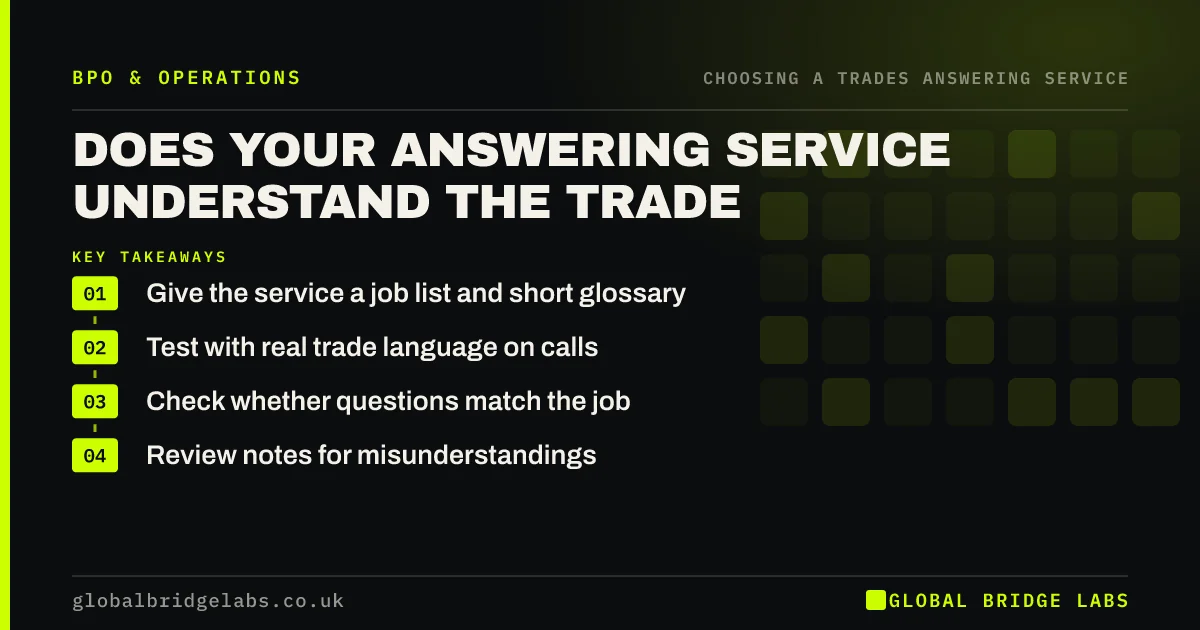
An answering service does not need to be full of former tradespeople, but receptionists must understand your job types, common terms and when something sounds urgent. Check this with test calls using real trade language, give the service a short glossary and job list, and review the first notes closely. Trade knowledge shows most in the quality of questions asked.
- Give the service a job list and short glossary.
- Test with real trade language on calls.
- Check whether questions match the job.
- Review notes for misunderstandings.
Want a trade glossary written for your service? Message us on WhatsApp.
Chat on WhatsApp →Why does trade knowledge matter?
Callers describe problems in their own words, and receptionists must turn those into useful notes. A receptionist who does not know a combi boiler from a system boiler, or a consumer unit from a meter, may ask the wrong questions and send the wrong engineer.
How do you test trade knowledge?
Make test calls using trade terms and common customer descriptions. Ask about a specific job, such as a bathroom extractor fan or a flat roof leak. Check the questions asked and the notes sent.
What should you give the service?
A one-page job list with the questions for each job, a short glossary of terms customers use and what they usually mean, your service area and your prices for common jobs. Update it when you add services.
Want a job list and glossary prepared? Message us on WhatsApp and we will discuss your requirements.
Chat on WhatsApp →Can trade knowledge be trained?
Yes. Most receptionists learn quickly with good material and feedback. A dedicated team that handles your calls every day learns faster than a large shared pool.
When does trade knowledge matter most?
In emergencies, when describing symptoms to decide urgency, and for high-value enquiries, where a confident first call wins trust.
What should you do when gaps appear?
When a note shows a misunderstanding, correct it the same day, add the example to the glossary and ask the service to brief its team. Small, quick corrections in the first month build trade knowledge faster than any training session.
What does this look like in practice?
A pattern we see: in the first week, notes mix up radiator valves and boiler faults. After a short glossary and two rounds of feedback, the notes become accurate and engineers stop calling customers to clarify.
Trade knowledge checklist
- Write a job list with questions.
- Write a short glossary.
- Test with trade language.
- Review the first 20 notes.
- Give feedback fast.
- Update the material as services change.
Next step
Write a one-page glossary of the ten terms your customers use most and send it to your service.
Message us on WhatsApp for a trade knowledge pack, or book a 30-minute consultation.
Chat on WhatsApp →Sources and further reading
- Contracts and liabilities between controllers and processors · Information Commissioner's Office
- Health and safety basics for your business · Health and Safety Executive
Frequently asked questions
Do answering services understand trades jargon?
Some specialise in trades and know common terms, but most need training on your specific services. A short glossary, job list and question set, plus feedback on early notes, usually brings receptionists up to speed quickly. Test with real trade language before you sign.
Should I choose an answering service that specialises in trades?
It can help, because receptionists will already know common trade terms and call types. But specialism alone is not enough. Test how the service handles your own job types and emergencies, and check whether the same small team will answer your calls every day.
How long does it take an answering service to learn my business?
With a good onboarding pack, most services handle routine calls well within one to two weeks. Less common job types and complex routing can take a month or so. Regular feedback on notes in the first weeks speeds this up more than anything else.
Written by

Global Bridge Labs (GBL) is a UK–Sri Lanka partner for social media, websites and BPO. Everything here comes from client delivery, not theory.