
On this page
- 01Key takeaways
- 02What do answering service reviews tell you?
- 03Which reviews should you trust most?
- 04What patterns should worry you?
- 05Can reviews be fake?
- 06Should you ask for references?
- 07How much weight should reviews carry?
- 08What does this look like in practice?
- 09Reviews checklist
- 10Next step
- 11Sources and further reading
- 12Frequently asked questions
Key takeaways
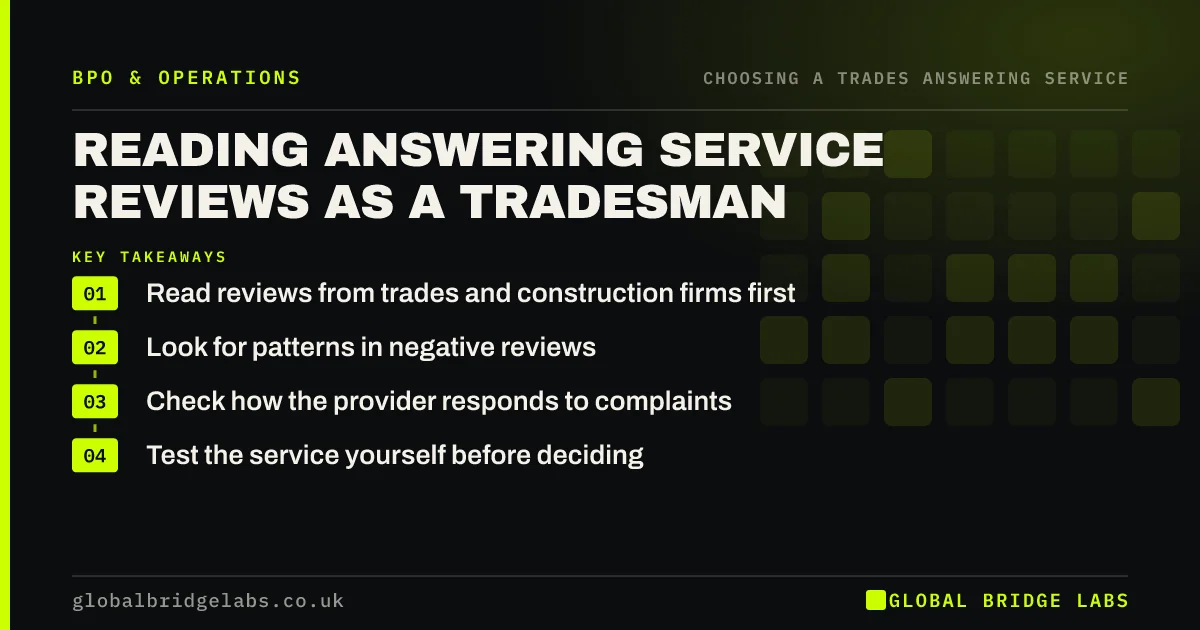
Answering service reviews help you spot serious problems, such as billing disputes or poor emergency handling, but they rarely tell you how a service will handle trades calls. Look for reviews from businesses like yours, read the negative ones for patterns, check dates, and then test the service yourself. Your own five test calls beat a hundred general reviews.
- Read reviews from trades and construction firms first.
- Look for patterns in negative reviews.
- Check how the provider responds to complaints.
- Test the service yourself before deciding.
Want help reading reviews of a shortlisted service? Message us on WhatsApp.
Chat on WhatsApp →What do answering service reviews tell you?
Reviews show how businesses felt about the service overall: friendliness, billing, support and reliability. They can warn you about recurring issues. They rarely show how receptionists handle your specific call types or emergencies.
Which reviews should you trust most?
Trust detailed reviews from businesses similar to yours, written recently, describing specific events. Short five-star reviews with no detail tell you little. Reviews from very different businesses, such as a solicitor's office, may not reflect how trades calls are handled.
What patterns should worry you?
Repeated complaints about surprise charges, difficulty cancelling, messages not delivered, receptionists not following scripts or poor out-of-hours handling are warning signs, especially if the provider's responses are defensive or missing.
Want a second opinion on a provider's reviews? Message us on WhatsApp and we will discuss your requirements.
Chat on WhatsApp →Can reviews be fake?
Fake and incentivised reviews are illegal in the UK under consumer law, but they still appear. Be wary of bursts of similar reviews, vague praise and reviewers with no history. Balance reviews with references and your own tests.
Should you ask for references?
Yes. Ask for one or two trades or construction clients you can call. Ask them about emergencies, notes, billing and how problems were fixed.
How much weight should reviews carry?
Treat reviews as a filter, not a decision. Use them to rule out providers with clear patterns of problems, then let your test calls, references and cost per booked job decide between the rest.
What does this look like in practice?
A pattern we see: a provider with excellent general reviews performs poorly on trades emergency test calls, while a less-reviewed provider handles them well. Testing reveals what reviews cannot.
Reviews checklist
- Filter for trades reviews.
- Read negative reviews for patterns.
- Check dates.
- Check provider responses.
- Ask for references.
- Run your own test calls.
Next step
Use reviews to cut your list to three, then let test calls and references decide.
Message us on WhatsApp for help choosing a provider, or book a 30-minute consultation.
Chat on WhatsApp →Sources and further reading
- Publishing consumer reviews and complying with consumer protection law · Competition and Markets Authority
- Digital Markets, Competition and Consumers Act 2024, Schedule 20 (banned practices, including fake reviews) · legislation.gov.uk
- TrustMark: the government endorsed quality scheme for work in and around the home · TrustMark
Frequently asked questions
Are answering service reviews reliable?
They are useful for spotting recurring problems such as billing disputes or missed messages, but they rarely show how a service handles trades calls specifically. Read detailed recent reviews from similar businesses, watch for patterns, and confirm what you read with references and your own test calls before deciding.
Where can I find answering service reviews?
Common places include review platforms, Google reviews, trade forums and Facebook groups for tradespeople. Forums and groups can be especially useful because members describe real experiences with trades calls. Ask other tradespeople you trust which services they use and why.
How can I tell if answering service reviews are fake?
Watch for bursts of short, similar reviews, vague praise with no details, reviewers with no other activity and reviews that read like adverts. Fake reviews are illegal in the UK but still appear. Detailed reviews describing specific events, including some criticism, are usually more trustworthy.
Written by

Global Bridge Labs (GBL) is a UK–Sri Lanka partner for social media, websites and BPO. Everything here comes from client delivery, not theory.


