
On this page
- 01Key takeaways
- 02What do the call handling terms mean?
- 03What do the pricing terms mean?
- 04What do the performance terms mean?
- 05What do the data terms mean?
- 06What do the service type terms mean?
- 07Which terms matter most when signing?
- 08What does this look like in practice?
- 09Glossary checklist
- 10Next step
- 11Sources and further reading
- 12Frequently asked questions
Key takeaways
Answering service providers use terms that can confuse a busy tradesperson comparing quotes. This glossary explains the common ones in plain English, from divert and warm transfer to overage, SLA, abandoned calls and processor contract, so you can read proposals and contracts with confidence and ask the right questions.
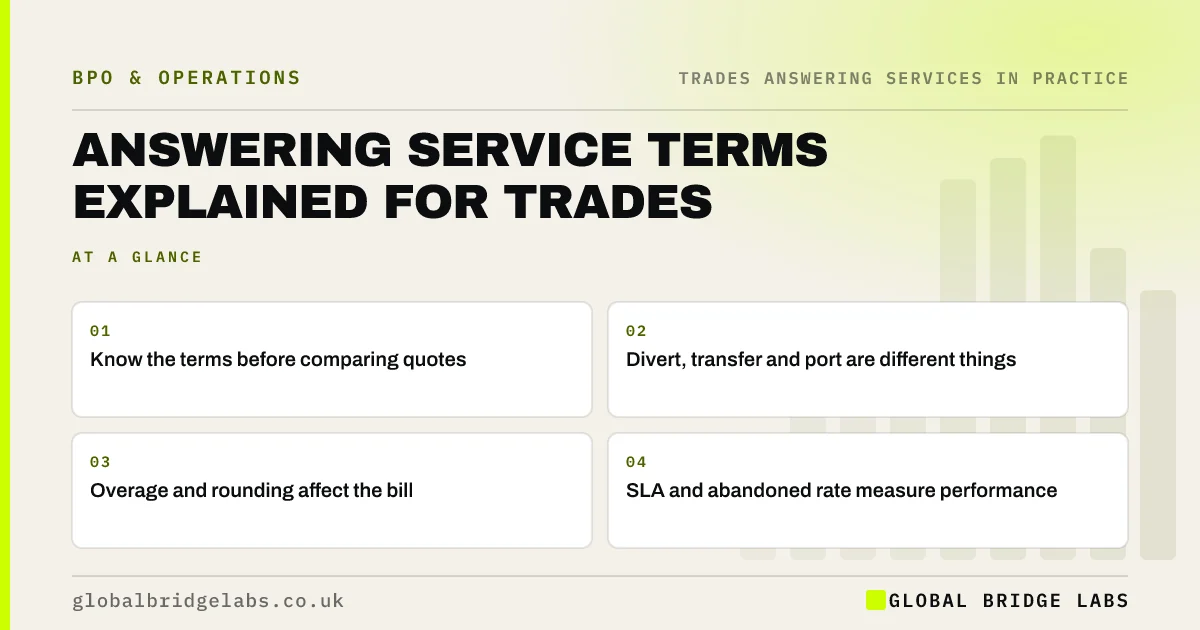
- Know the terms before comparing quotes.
- Divert, transfer and port are different things.
- Overage and rounding affect the bill.
- SLA and abandoned rate measure performance.
Confused by a provider's proposal? Message us on WhatsApp.
Chat on WhatsApp →What do the call handling terms mean?
These describe what happens to a call.
- Divert: your number forwards calls to the service.
- Port: your number moves to another provider.
- Warm transfer: the receptionist briefs you before connecting the caller.
- Cold transfer: the caller is put straight through.
- Overflow: calls go to the service only when you are busy.
- Triage: questions that decide how urgent a call is.
What do the pricing terms mean?
These decide what you pay.
- Per call: a fixed price for each answered call.
- Per minute: price by call length.
- Bundle: a set number of calls or minutes each month.
- Overage: the price for calls above your bundle.
- Rounding: how call time is rounded up.
- Seat: a dedicated person or time slot.
What do the performance terms mean?
These show how well the service works.
- SLA: the service levels promised in writing.
- Answer speed: time from first ring to answer.
- Abandoned call: the caller hangs up before an answer.
- Calls to bookings rate: share of enquiries booked.
- Cost per booked job: monthly cost divided by bookings.
Want a provider's proposal explained in plain English? Message us on WhatsApp and we will discuss your requirements.
Chat on WhatsApp →What do the data terms mean?
- Controller: you, deciding how customer data is used.
- Processor: the service, handling data for you.
- Processor contract: the written agreement UK GDPR requires.
- Retention period: how long recordings and notes are kept.
What do the service type terms mean?
Message taking passes details on. A virtual receptionist books and transfers. A managed team also handles admin. AI answering uses software to capture details.
Which terms matter most when signing?
Overage, rounding, minimum term, notice period, number ownership and the processor contract. These decide your real bill and how easily you can leave. Ask the provider to explain any of them in writing if the contract is unclear.
What does this look like in practice?
A pattern we see: an owner signs a bundle without knowing about overage and rounding, then gets a surprise bill in winter. Knowing the terms first avoids it.
Glossary checklist
- Learn divert vs port.
- Learn warm vs cold transfer.
- Check overage and rounding.
- Ask for the SLA.
- Track abandoned calls.
- Sign a processor contract.
Next step
Read your shortlisted proposals with this glossary and mark any term you need explained.
Message us on WhatsApp for help reading a proposal, or book a 30-minute consultation.
Chat on WhatsApp →Sources and further reading
- Online Nation: how the UK uses online services · Ofcom
- Controllers and processors · Information Commissioner's Office
Frequently asked questions
What is the difference between divert and port?
Divert forwards calls from your number to the answering service, while the number stays with your phone provider and under your control. Port moves the number itself to another provider. For answering services, diverting is usually simpler and keeps you free to switch provider easily.
What does overage mean on an answering service bill?
Overage is the charge for calls or minutes above the amount included in your monthly bundle, usually at a higher rate. Seasonal trades can be caught out in busy months. Check the overage rate before signing and size your bundle to a typical month.
What is an abandoned call?
An abandoned call is one where the caller hangs up before anyone answers. A high abandoned call rate suggests the service is too slow or understaffed at certain times. Ask for abandoned calls by hour, because they often cluster at the busiest times of day.
Written by

Global Bridge Labs (GBL) is a UK–Sri Lanka partner for social media, websites and BPO. Everything here comes from client delivery, not theory.


