
On this page
- 01Key takeaways
- 02Why do postcode rules matter?
- 03How should you define your area?
- 04How should the service check postcodes?
- 05What should out-of-area callers hear?
- 06Should your area change by season or demand?
- 07Should travel time affect booking as well as area?
- 08What does this look like in practice?
- 09Service area checklist
- 10Next step
- 11Sources and further reading
- 12Frequently asked questions
Key takeaways
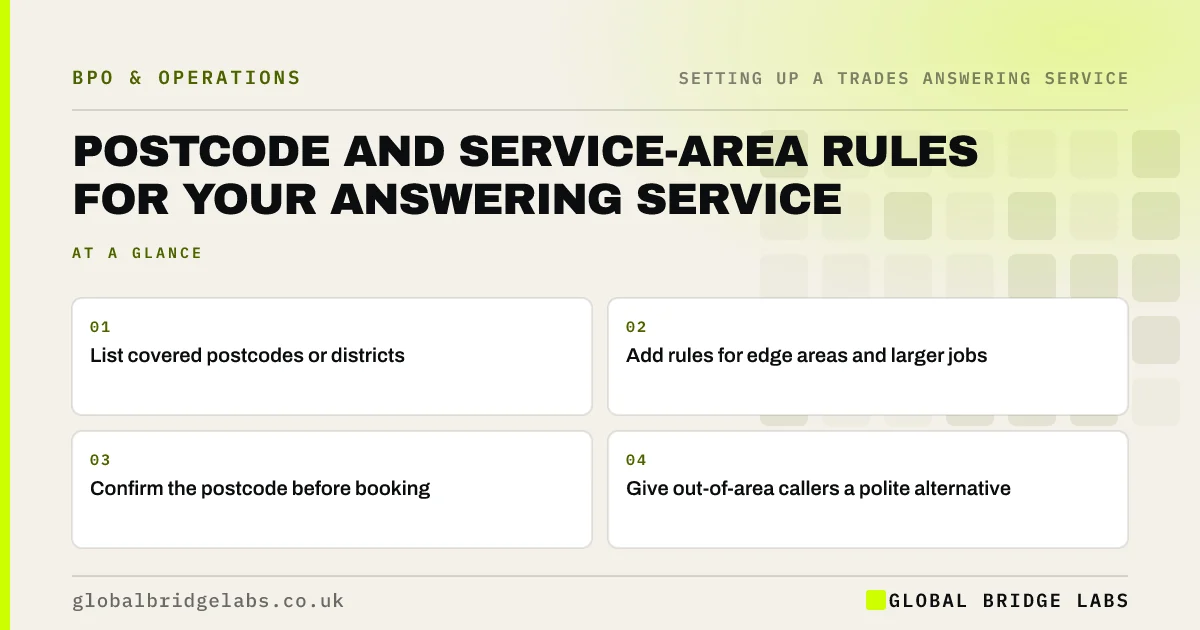
Your answering service needs clear service-area rules so it never books a job you cannot reach profitably. List the postcodes or districts you cover, any areas covered only for larger jobs or emergencies, and what to say to callers outside the area. Ask the service to confirm the postcode on every call before anything else is booked.
- List covered postcodes or districts.
- Add rules for edge areas and larger jobs.
- Confirm the postcode before booking.
- Give out-of-area callers a polite alternative.
Want your service area set up properly? Message us on WhatsApp.
Chat on WhatsApp →Why do postcode rules matter?
Without them, receptionists guess from place names and may book jobs an hour away. Travel eats profit and time, and cancelling a booked job annoys the customer. Clear rules prevent both.
How should you define your area?
Use postcode districts, such as LS1 to LS29, rather than place names, because they are easier to check. Group them into core, edge and outside. Core gets every job, edge gets larger or emergency jobs, outside gets a polite referral.
- Core: all jobs.
- Edge: larger jobs or emergencies only.
- Outside: polite referral.
How should the service check postcodes?
Ask for the postcode early in the call and check it against the list. Read it back to the caller. For new-build streets or unclear addresses, note a landmark.
- Answering service call notes: what good looks like
- Delivery and site access calls when you are on site
Want your postcode list built for the service? Message us on WhatsApp and we will discuss your requirements.
Chat on WhatsApp →What should out-of-area callers hear?
Something like: thanks for calling, we do not cover your area, so we would not be able to help quickly. You may find a local firm through a trusted trade directory. Polite refusals protect your reputation.
Should your area change by season or demand?
Some firms shrink their area when busy and widen it when quiet. If you do, update the list and tell the service the date it changes.
Should travel time affect booking as well as area?
Yes. Even within your area, a job at the far edge needs more travel time. Group postcodes into zones and add travel buffers by zone in your booking rules, so the service does not book two distant jobs back to back.
What does this look like in practice?
A pattern we see: a service books a job in a town with the same name as a local village. Switching to postcode checks ends the mix-ups.
Service area checklist
- List postcode districts.
- Group into core, edge and outside.
- Ask for the postcode early.
- Read it back.
- Write out-of-area wording.
- Update when your area changes.
Next step
Write your core, edge and outside postcode lists and give them to your service today.
Message us on WhatsApp for a service area set-up, or book a 30-minute consultation.
Chat on WhatsApp →Sources and further reading
- Google Business Profile Help · Google
- Consumer Contracts (Information, Cancellation and Additional Charges) Regulations 2013 · legislation.gov.uk
Frequently asked questions
How should an answering service check if a job is in my area?
By asking for the postcode early in the call and checking it against a list of postcode districts you provide, then reading it back. Postcodes are more reliable than place names, which can be duplicated or vague. Edge areas can have their own rules for larger jobs only.
What should callers outside my area be told?
A polite explanation that you do not cover their area and could not help quickly, with a suggestion such as checking a trusted trade directory. Being helpful even when saying no protects your reputation and sometimes leads to referrals from callers who remember the courtesy.
Should my service area be the same as my Google Business Profile?
It should be consistent. If your Google Business Profile shows a wider area than you actually cover, you will attract calls you have to turn away. Matching your profile, website and answering service rules keeps expectations clear for customers and saves wasted calls.
Written by

Global Bridge Labs (GBL) is a UK–Sri Lanka partner for social media, websites and BPO. Everything here comes from client delivery, not theory.


