
On this page
- 01Key takeaways
- 02What makes an enquiry a time-waster?
- 03What filter rules work?
- 04How should the service say no?
- 05Can filters break discrimination law?
- 06How do you check filters are working?
- 07What about price shoppers?
- 08What does this look like in practice?
- 09Filter checklist
- 10Next step
- 11Sources and further reading
- 12Frequently asked questions
Key takeaways
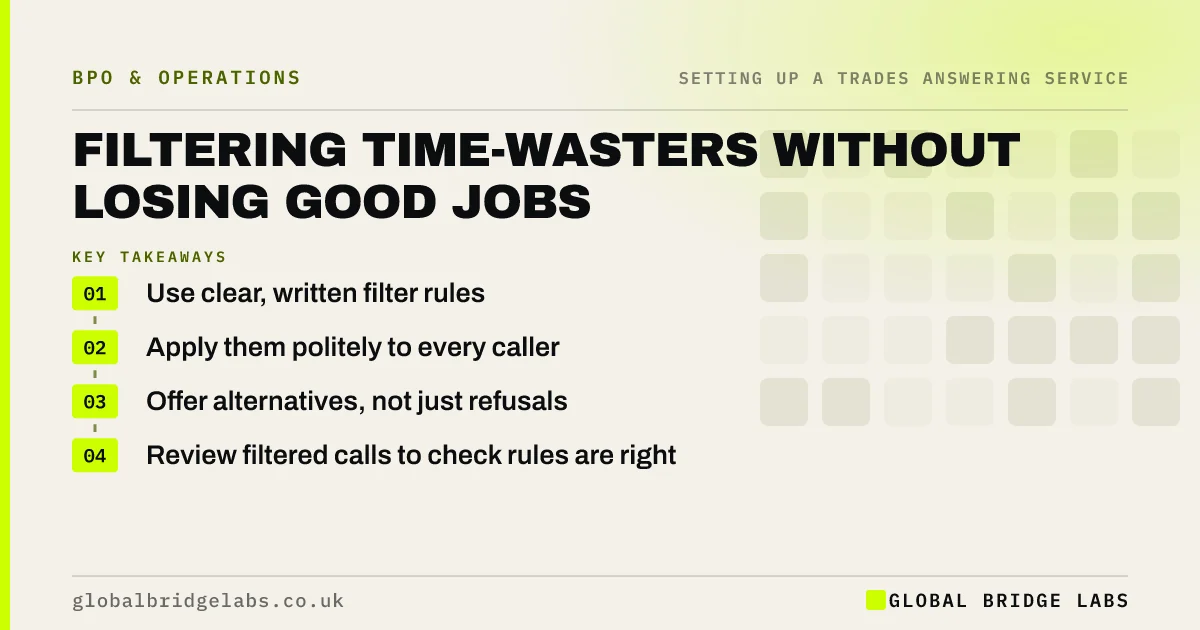
Not every enquiry is worth a visit, but harsh filtering loses good customers. A fair filter uses clear rules: your service area, minimum job size, job types you do, realistic timing and, for projects, a budget. The answering service applies the rules politely and offers an alternative, such as a later slot or a referral, rather than just saying no.
- Use clear, written filter rules.
- Apply them politely to every caller.
- Offer alternatives, not just refusals.
- Review filtered calls to check rules are right.
Want fair filter rules written? Message us on WhatsApp.
Chat on WhatsApp →What makes an enquiry a time-waster?
Usually not the caller, but a mismatch: a job outside your area, too small, not something you do, or a project without budget or timing. Price shoppers who want a figure without a visit are another common case.
What filter rules work?
Write rules the service can apply without judgement.
- Postcodes you cover.
- Minimum job size or charge.
- Job types you do and do not do.
- Earliest start date you can offer.
- Budget threshold for projects.
How should the service say no?
Politely, with a reason and an alternative: we do not cover that area, but you could try a local directory; or our minimum charge is this, would that suit? Callers who feel respected may come back or recommend you.
- When callers ask how much: price answers by phone
- Answering in your business name: greetings and tone
Want filter wording written for your service? Message us on WhatsApp and we will discuss your requirements.
Chat on WhatsApp →Can filters break discrimination law?
Filters based on location, job size or budget are normal. Filters must not treat people less favourably because of protected characteristics, such as age or disability. Keep rules about the job, not the person.
How do you check filters are working?
Review a sample of filtered calls monthly. If good jobs are being turned away, loosen the rule. If wasted visits continue, tighten it.
What about price shoppers?
Callers who only want a price can be offered your published prices or call-out charge, a photo-based guide price, or a visit. Some will book once they hear you are clear and reasonable. Treat them as customers still deciding rather than as time-wasters.
What does this look like in practice?
A pattern we see: a builder's service turns away small jobs bluntly, and reviews mention rudeness. Changing the wording to offer a referral list keeps the same filter without the bad feeling.
Filter checklist
- Write postcode rules.
- Set a minimum job size.
- List job types you do not do.
- Write polite refusal wording.
- Offer alternatives.
- Review filtered calls monthly.
Next step
Write your filter rules and polite refusal wording, then share both with your service.
Message us on WhatsApp for filter rules, or book a 30-minute consultation.
Chat on WhatsApp →Sources and further reading
- Consumer Contracts (Information, Cancellation and Additional Charges) Regulations 2013 · legislation.gov.uk
- Equality Act 2010 · legislation.gov.uk
Frequently asked questions
How can a tradesman avoid wasted quote visits?
Use clear qualifying questions, a service area, a minimum job size and photo requests before visits. An answering service can apply these rules on every call. For larger projects, ask about budget and timing. Review wasted visits regularly to see which rule would have caught them.
Should an answering service turn away small jobs?
It can, if you set a clear minimum and the service explains it politely, ideally offering an alternative such as a later slot, a minimum charge or a referral. Turning callers away bluntly can harm your reputation, so wording matters as much as the rule itself.
Is it fair to screen callers by budget?
Yes, for larger projects. Asking whether a budget is set and roughly what it is helps both sides avoid wasted time. Keep the question polite and focused on the job. Never screen callers based on personal characteristics such as age or disability, which could breach equality law.
Written by

Global Bridge Labs (GBL) is a UK–Sri Lanka partner for social media, websites and BPO. Everything here comes from client delivery, not theory.


