
On this page
- 01Key takeaways
- 02How does a call reach the answering service?
- 03What happens in the first 30 seconds?
- 04What questions does the service ask?
- 05What action does the service take?
- 06How do you get the details?
- 07When does the process break down?
- 08What does this look like in practice?
- 09Call flow checklist
- 10Next step
- 11Sources and further reading
- 12Frequently asked questions
Key takeaways
A trades answering service handles each call in five steps: it answers in your business name, identifies the caller and reason, asks your qualifying questions, takes the agreed action, such as booking or escalating, and then sends you a short summary. Each step depends on rules you provide, so setup decides quality more than the receptionist does.
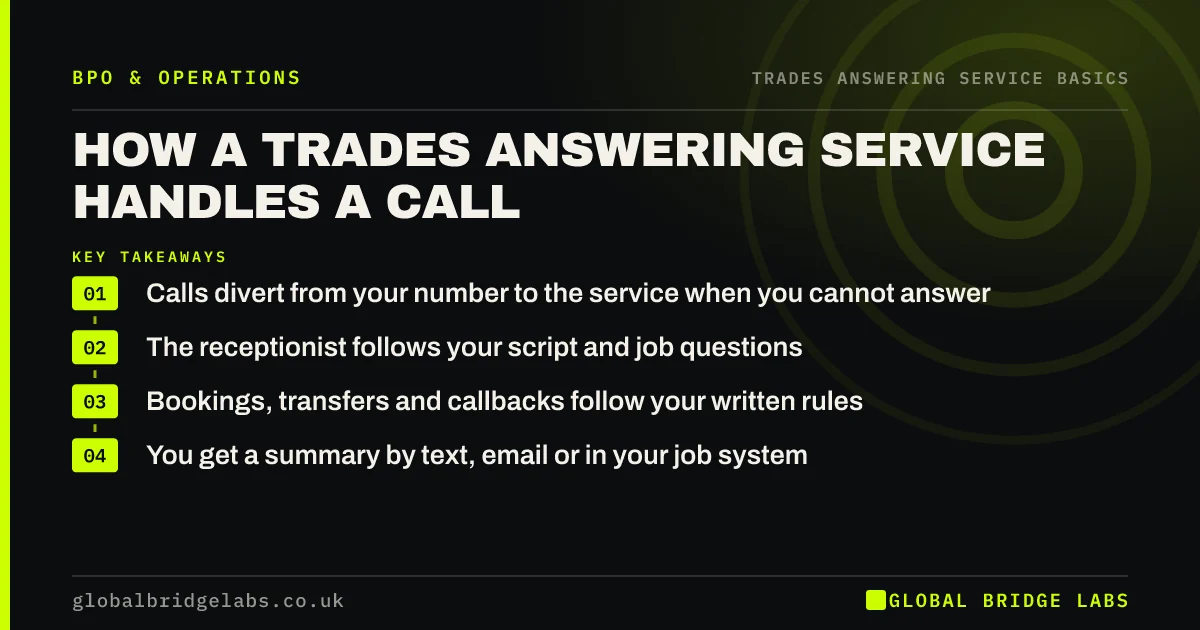
- Calls divert from your number to the service when you cannot answer.
- The receptionist follows your script and job questions.
- Bookings, transfers and callbacks follow your written rules.
- You get a summary by text, email or in your job system.
Want to see how calls would flow for your business? Message us on WhatsApp.
Chat on WhatsApp →How does a call reach the answering service?
Your business number diverts to the service, either always, when busy, after a set number of rings or outside set hours. The caller does not see the divert. The receptionist's screen shows which client the call is for, so they can answer in your business name with your script in front of them.
What happens in the first 30 seconds?
The receptionist greets the caller in your business name, finds out whether they are a new customer, an existing customer or someone else, and checks for urgency. Urgent calls follow your emergency rule straight away. Other calls move on to the qualifying questions for that job type.
What questions does the service ask?
The service asks the questions you set for each job type. For most trades that means name, number, address and postcode, the job, how urgent it is, access, and whether photos can be sent. Good scripts are short; every extra question makes the call longer and the caller more likely to give up.
What action does the service take?
The action depends on your rules and the service type. It might book a quote visit into a free slot, transfer an emergency to the on-call engineer, set a callback for a time you agreed, or take a message. Each call should end with the caller knowing exactly what happens next and when.
- Book: the slot goes into your diary with the job notes.
- Transfer: the call goes to the person on call.
- Callback: a time is set and logged.
- Message: the details go to you to decide.
- Answering services that book jobs into your diary
- Live call transfer: when callers should be put through
Want your rules written as a call flow? Message us on WhatsApp and we will discuss your requirements.
Chat on WhatsApp →How do you get the details?
You get a summary within minutes by text, email, WhatsApp or straight into your job management system. Good notes are short and laid out the same way every time, so you can read them in the van and act without calling the customer.
When does the process break down?
It breaks down when the rules are missing or out of date: new prices not shared, an engineer on holiday still in the diary, or no emergency rule. The receptionist can only follow what you give them, so keep the script and diary current.
What does this look like in practice?
A pattern we see: the first week of a new service produces vague notes because the script was generic. Once the job types and questions are written down, the same receptionists produce bookings rather than messages.
Call flow checklist
- Decide when calls divert: always, busy or after hours.
- Write a greeting in your business name.
- List the questions for each job type.
- Set booking, transfer and callback rules.
- Choose how notes reach you.
- Review the first 20 calls together.
Next step
Sketch the five steps for your own calls on one page, then share it with any service you are comparing.
Message us on WhatsApp for a call flow review, or book a 30-minute consultation.
Chat on WhatsApp →Sources and further reading
- Contracts and liabilities between controllers and processors · Information Commissioner's Office
- Lawful basis for processing personal data · Information Commissioner's Office
- Gas Safe Register · Gas Safe Register
Frequently asked questions
Does the answering service use my phone number?
Usually your number stays yours and simply diverts to the service. Callers dial your normal number and are answered in your business name. Some services offer a new number instead, but keeping your own number avoids reprinting vans and cards and keeps you free to change provider later.
How quickly do I get the message after a call?
A good service sends the summary within a few minutes of the call ending, by text, email or into your job system. Urgent calls should be transferred or escalated straight away rather than waiting for a message. Ask each provider for its usual timing and include it in the agreement.
Can the answering service see my diary?
It can if you give it access, usually through a shared calendar or a limited login to your job management software. Give only the permissions needed to view slots and add bookings. Without diary access, the service can take details and offer a callback, but it cannot confirm a visit time.
Written by

Global Bridge Labs (GBL) is a UK–Sri Lanka partner for social media, websites and BPO. Everything here comes from client delivery, not theory.


