
On this page
- 01Key takeaways
- 02What should happen in month one?
- 03What should happen in month two?
- 04What should happen in month three?
- 05What commonly goes wrong in the first 90 days?
- 06What should you do at day 90?
- 07How involved do you need to be?
- 08What does this look like in practice?
- 09First 90 days checklist
- 10Next step
- 11Sources and further reading
- 12Frequently asked questions
Key takeaways
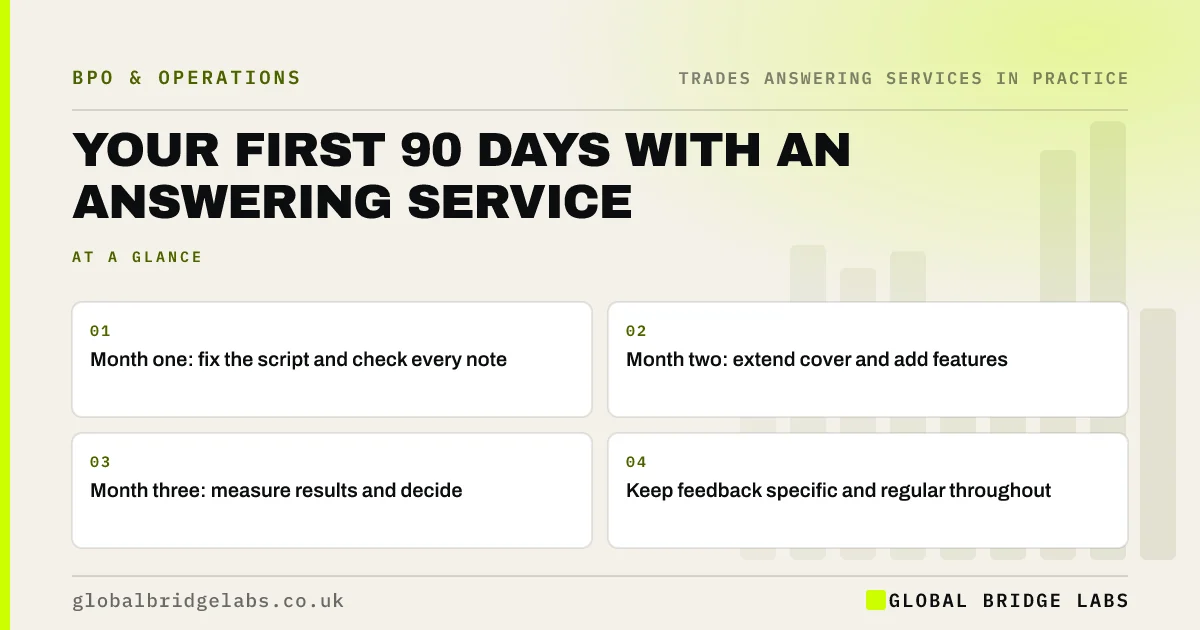
The first 90 days decide whether an answering service works for you. Month one is about fixing the script and checking every note. Month two is about extending cover and adding features such as booking or quote chasing. Month three is about measuring results and deciding whether to keep, adjust or switch.
- Month one: fix the script and check every note.
- Month two: extend cover and add features.
- Month three: measure results and decide.
- Keep feedback specific and regular throughout.
Starting with a new answering service? Message us on WhatsApp.
Chat on WhatsApp →What should happen in month one?
Go live gradually, review every note, listen to recordings, send daily feedback and fix the script. Test the emergency route. Expect early errors and correct them quickly.
What should happen in month two?
Once notes are reliable, extend cover to more hours or full cover, add booking for more job types, start quote chasing and move feedback to weekly. Run the five test calls again to check standards have held.
What should happen in month three?
Measure: answer speed, abandoned calls, calls to bookings, callbacks needed and cost per booked job. Compare with your missed-call cost before the service. Decide whether to keep, adjust or switch.
Want a 90-day review with us? Message us on WhatsApp and we will discuss your requirements.
Chat on WhatsApp →What commonly goes wrong in the first 90 days?
Owners stop reviewing notes too early, scripts are not updated when prices change, and nobody tests the emergency route after the first week. Each is easily avoided.
What should you do at day 90?
Write a short review: what improved, what still needs work, and the numbers. Share it with the provider and agree priorities for the next quarter.
How involved do you need to be?
Most involved in month one, when daily review and feedback make the biggest difference. By month three, a monthly check of KPIs and a sample of calls is usually enough. Name one person on your side to own the relationship throughout.
What does this look like in practice?
A pattern we see: a firm that reviews notes daily in month one has a service sounding like its own office by month two. A firm that skips reviews is still correcting the same errors at month three.
First 90 days checklist
- Review every note in month one.
- Test the emergency route.
- Extend cover in month two.
- Add booking and quote chasing.
- Measure KPIs in month three.
- Write a day-90 review.
Next step
Put three dates in your diary now: end of month one, two and three, each with its review task.
Message us on WhatsApp for a 90-day plan, or book a 30-minute consultation.
Chat on WhatsApp →Sources and further reading
- Contracts and liabilities between controllers and processors · Information Commissioner's Office
- Consumer Contracts (Information, Cancellation and Additional Charges) Regulations 2013 · legislation.gov.uk
Frequently asked questions
How long does it take for an answering service to settle in?
Most trades businesses see notes and bookings settle within four to six weeks if they review calls closely and give specific feedback. By the end of three months, you should have enough data on bookings, speed and cost per booked job to decide whether the service is working.
What should I check after one month with an answering service?
Check that notes are complete and on time, emergencies follow your route, bookings are right first time and you rarely need to call customers to clarify. Listen to a few recordings, including busy and awkward calls. Fix anything that still fails before extending cover.
When should I decide whether to keep my answering service?
Around the three-month mark, once you have reliable numbers for bookings, answer speed, callbacks needed and cost per booked job. Compare them with your missed-call cost before the service. If the service is paying for itself and quality is steady, keep it.
Written by

Global Bridge Labs (GBL) is a UK–Sri Lanka partner for social media, websites and BPO. Everything here comes from client delivery, not theory.


