On this page
- 01Key takeaways
- 02What counts as an emergency for a trades business?
- 03What route should an emergency call follow?
- 04What should the service tell an emergency caller?
- 05What must the service never do?
- 06How do you test the emergency route?
- 07What does this look like in practice?
- 08Emergency route checklist
- 09Next step
- 10Sources and further reading
- 11Frequently asked questions
Key takeaways
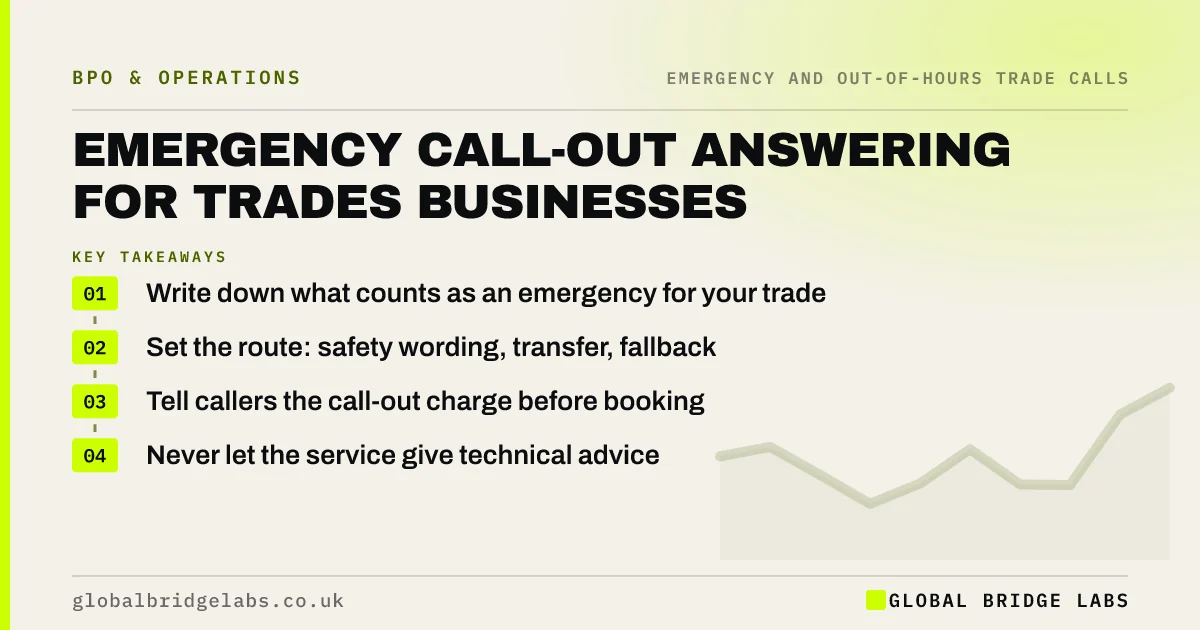
Emergency call-out answering means every urgent call is recognised fast and follows the same written route: approved safety wording where needed, then a transfer or alert to whoever is on call, and a clear promise to the caller. You decide what counts as an emergency for your trade. The service follows the rule every time and never improvises technical or safety advice.
- Write down what counts as an emergency for your trade.
- Set the route: safety wording, transfer, fallback.
- Tell callers the call-out charge before booking.
- Never let the service give technical advice.
Want an emergency route written for your trade? Message us on WhatsApp.
Chat on WhatsApp →What counts as an emergency for a trades business?
An emergency is anything that puts people or property at immediate risk, or leaves a vulnerable person without essentials. Each trade has its own list. Write it down so the service does not have to guess.
- Plumbing: burst pipes, uncontrolled leaks, no water.
- Heating: no heating or hot water for a vulnerable person.
- Gas: any smell of gas.
- Electrical: sparking, burning smells, no power.
- Locks: locked out, or a door that will not secure.
- Building: unsafe structures, storm damage, roof leaks.
What route should an emergency call follow?
The route is the same every time. First, any approved safety wording. Second, the call is transferred or the on-call engineer is alerted. Third, if nobody answers within a set time, the next person on the rota is tried. Finally, the caller is told what happens next and roughly when.
What should the service tell an emergency caller?
It should give approved safety wording only, take the address and a contact number first in case the line drops, explain the call-out charge if you have one, and give a realistic arrival window. It should never promise a time the engineer has not confirmed.
Want your emergency wording reviewed? Message us on WhatsApp and we will discuss your requirements.
Chat on WhatsApp →What must the service never do?
It must never diagnose faults, tell callers to carry out repairs, or tell them a situation is safe. Those judgements belong to qualified engineers and, where life is at risk, to the emergency services. Scripted safety wording is the limit.
How do you test the emergency route?
Run a test emergency call during your trial and repeat it every few months. Check the timing of the transfer, the wording used, the fallback when nobody answers and the note sent afterwards.
What does this look like in practice?
A pattern we see: a firm's emergency rule is clear in the day but nobody updated the out-of-hours rota. A quarterly test call catches the gap before a real customer does.
Emergency route checklist
- List emergencies for your trade.
- Write approved safety wording.
- Set the transfer order.
- Set the fallback time.
- Agree how charges are explained.
- Test the route every quarter.
Next step
Write your emergency list and route on one page and send it to your answering service this week.
Message us on WhatsApp for an emergency route review, or book a 30-minute consultation.
Chat on WhatsApp →Sources and further reading
- Gas Safe Register · Gas Safe Register
- Health and safety basics for your business · Health and Safety Executive
- Consumer Contracts (Information, Cancellation and Additional Charges) Regulations 2013 · legislation.gov.uk
Frequently asked questions
What is an emergency call-out for a tradesman?
It is an urgent job that cannot wait for a normal booking, such as a burst pipe, a gas smell, an electrical fault, a lockout or storm damage. Each business defines its own list and charges. Writing it down lets your answering service recognise emergencies quickly and follow the right route.
Should an answering service give safety advice?
Only approved, scripted wording, such as telling a caller who smells gas to call the gas emergency number and not to use switches. It should never diagnose faults or tell callers to attempt repairs. Anything beyond the script should go to a qualified engineer or the emergency services.
What if the on-call engineer does not answer?
The service should try the next person on the rota after a set time, such as five minutes, and keep the caller informed. If nobody can attend, it should say so honestly and, where there is danger, point the caller to the relevant emergency service rather than leaving them waiting.
Written by

Global Bridge Labs (GBL) is a UK–Sri Lanka partner for social media, websites and BPO. Everything here comes from client delivery, not theory.