
On this page
- 01Key takeaways
- 02Why write a brief?
- 03What should the brief include?
- 04How do you separate must-haves from nice-to-haves?
- 05What should you ask providers to send back?
- 06How does the brief help onboarding?
- 07How often should the brief be updated?
- 08What does this look like in practice?
- 09Brief checklist
- 10Next step
- 11Sources and further reading
- 12Frequently asked questions
Key takeaways
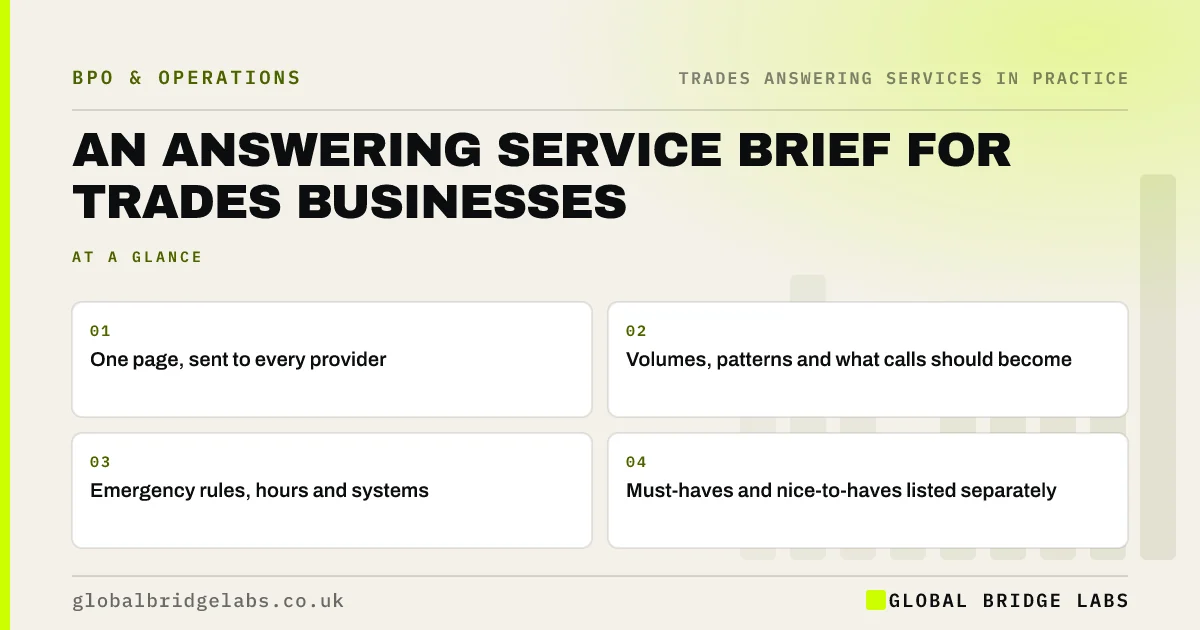
An answering service brief is a one-page summary of your business and calls that you send to providers before they quote. It covers who you are, call volumes and patterns, what calls should become, job types, emergency rules, hours, systems and must-haves. A good brief gets comparable quotes and speeds up onboarding with whichever provider you choose.
- One page, sent to every provider.
- Volumes, patterns and what calls should become.
- Emergency rules, hours and systems.
- Must-haves and nice-to-haves listed separately.
Want an answering service brief written? Message us on WhatsApp.
Chat on WhatsApp →Why write a brief?
Without one, each provider quotes for what it assumes you need, and quotes cannot be compared. A brief puts every provider on the same footing and shows you are organised, which often gets you better attention.
What should the brief include?
Keep it to one page under clear headings.
- Business: trade, area, team size.
- Calls: volume a month, busiest hours, missed calls.
- Outcome: message, booking, routing or admin.
- Job types and qualifying questions.
- Emergencies: what counts and the route.
- Hours: daytime, evenings, weekends, holidays.
- Systems: diary or job software.
- Must-haves and nice-to-haves.
How do you separate must-haves from nice-to-haves?
Must-haves are things that would rule a provider out, such as following your emergency wording or booking into your job software. Nice-to-haves are extras such as WhatsApp handling. Keep the must-have list short.
Want your must-haves checked? Message us on WhatsApp and we will discuss your requirements.
Chat on WhatsApp →What should you ask providers to send back?
A price at your volume with all extras, contract terms, a sample report, a sample note and their emergency handling process in writing.
How does the brief help onboarding?
It becomes the start of your onboarding pack. The chosen provider already knows your calls, so setup is faster.
How often should the brief be updated?
Update it whenever your business changes: new services, new areas, more engineers or new hours. Keep it with your onboarding pack so you can resend it quickly if you ever need to switch provider.
What does this look like in practice?
A pattern we see: an owner sends the same one-page brief to three providers and gets three comparable quotes within days, instead of weeks of back and forth.
Brief checklist
- Describe the business.
- Add call volumes and patterns.
- State what calls should become.
- Add emergency rules.
- List hours and systems.
- Split must-haves from nice-to-haves.
Next step
Write your one-page brief this week and send it to every provider on your shortlist.
Message us on WhatsApp for a brief template, or book a 30-minute consultation.
Chat on WhatsApp →Sources and further reading
- Contracts and liabilities between controllers and processors · Information Commissioner's Office
- Consumer Contracts (Information, Cancellation and Additional Charges) Regulations 2013 · legislation.gov.uk
Frequently asked questions
What should I tell an answering service before getting a quote?
Your trade, area and team size, monthly call volume and busiest hours, what calls should become, job types, emergency rules, hours of cover, the systems you use and your must-haves. A one-page brief with this information gets accurate, comparable quotes from every provider you contact.
How long should an answering service brief be?
One page is usually enough for a trades business. Use short headings and bullet points so providers can read it quickly. Put detailed scripts and job lists in your onboarding pack later, once you have chosen a provider, rather than in the brief.
Should I share my prices in the brief?
Share the prices you want the service to give callers, such as call-out charges and fixed prices, because they affect script length and call handling. You do not need to share margins or internal costs. The brief is about how calls should be handled, not your business finances.
Written by

Global Bridge Labs (GBL) is a UK–Sri Lanka partner for social media, websites and BPO. Everything here comes from client delivery, not theory.


