On this page
- 01Key takeaways
- 02Why does data protection matter for answering services?
- 03What should the processor contract include?
- 04What about offshore teams?
- 05What access controls should you expect?
- 06What about key safe codes and access details?
- 07What if there is a data breach?
- 08What does this look like in practice?
- 09Data protection checklist
- 10Next step
- 11Sources and further reading
- 12Frequently asked questions
Key takeaways
An answering service handles your customers' names, addresses, numbers and sometimes access codes, so under UK GDPR it is usually your processor and you are the controller. You need a written contract covering what it does with the data, security, staff confidentiality, sub-processors, international transfers and deletion at the end. Ask to see it before you sign.
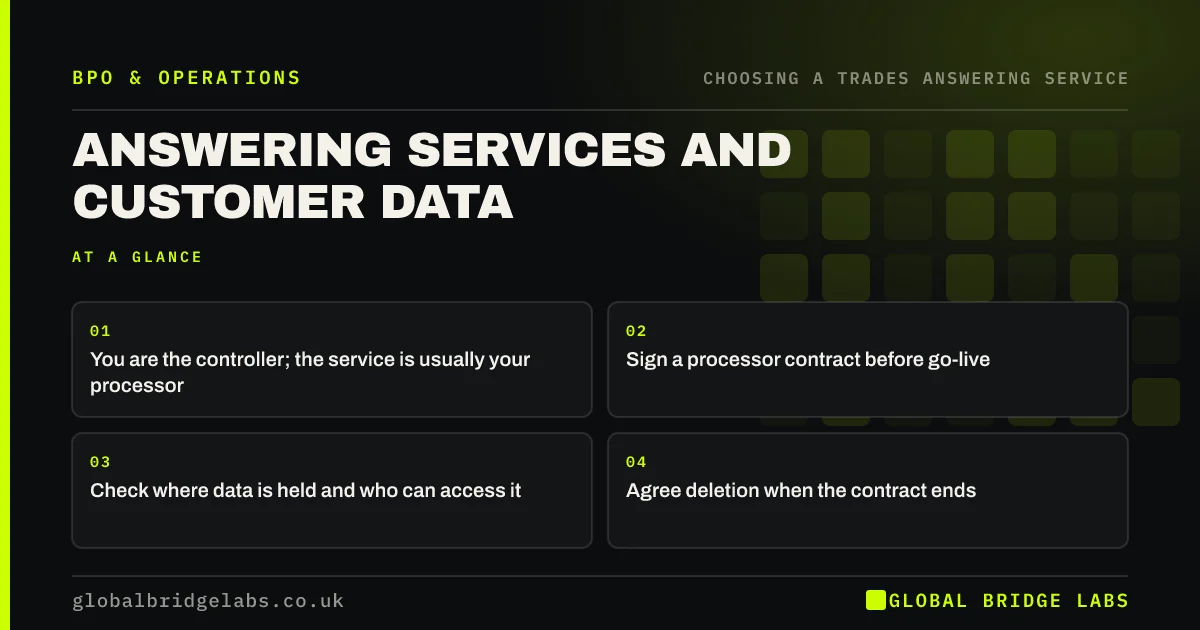
- You are the controller; the service is usually your processor.
- Sign a processor contract before go-live.
- Check where data is held and who can access it.
- Agree deletion when the contract ends.
Want help checking a provider's data terms? Message us on WhatsApp.
Chat on WhatsApp →Why does data protection matter for answering services?
Call notes contain personal data, and some contain sensitive details such as health conditions or key safe codes. A leak could harm customers and your reputation. UK GDPR makes you responsible for choosing a provider that protects the data properly.
What should the processor contract include?
The ICO sets out what a controller and processor contract must cover. In practice, check these points.
- Only acting on your instructions.
- Confidentiality for staff.
- Security measures.
- Use of sub-processors.
- Help with data requests.
- Deletion or return at the end.
What about offshore teams?
If data is accessed from outside the UK, there must be a lawful transfer mechanism and suitable safeguards. Ask the provider to explain how it meets the rules and to put it in writing.
- GDPR and offshore outsourcing: what UK firms must do
- UK-based vs offshore answering service for trades
Want a data checklist for your shortlist? Message us on WhatsApp and we will discuss your requirements.
Chat on WhatsApp →What access controls should you expect?
Receptionists should see only what they need for your calls. Logins should be individual, protected with strong passwords and two-factor sign-in where possible, and removed when staff leave.
What about key safe codes and access details?
Avoid storing key safe codes in call notes. If engineers need them, share them through a secure route in your job system with limited access.
What if there is a data breach?
Your contract should require the provider to tell you quickly about any breach. You then decide whether it must be reported to the ICO, usually within 72 hours of becoming aware, and whether customers must be told.
What does this look like in practice?
A pattern we see: a firm's old service emails notes with full addresses and key codes to a shared inbox. Moving notes into the job system with limited access fixes the risk without slowing the work.
Data protection checklist
- Sign a processor contract.
- Check where data is held.
- Check transfer safeguards.
- Limit access.
- Avoid key codes in notes.
- Agree breach reporting and deletion.
Next step
Ask each shortlisted provider for its standard processor contract and read it before comparing prices.
Message us on WhatsApp for a data protection check, or book a 30-minute consultation.
Chat on WhatsApp →Sources and further reading
- Contracts and liabilities between controllers and processors · Information Commissioner's Office
- Controllers and processors · Information Commissioner's Office
- International transfers of personal data · Information Commissioner's Office
Frequently asked questions
Is an answering service a data processor?
Usually, yes. It handles personal data on your behalf and under your instructions, which makes it a processor while you remain the controller. UK GDPR requires a written contract between you covering security, confidentiality, sub-processors and deletion. Most reputable providers have a standard agreement ready.
Can an offshore answering service handle UK customer data?
Yes, if the transfer meets UK GDPR rules, such as an approved transfer mechanism and suitable safeguards, and you have a processor contract. Ask the provider to explain where data is accessed, how it is protected and how it meets the transfer rules, and keep that in writing.
Should call notes include key safe codes?
It is better not to. Key safe codes and alarm codes are sensitive security details. If engineers need them, share them through a secure, access-controlled route in your job system rather than in emailed or texted notes, and remove them once the job is done.
Written by

Global Bridge Labs (GBL) is a UK–Sri Lanka partner for social media, websites and BPO. Everything here comes from client delivery, not theory.