On this page
- 01Key takeaways
- 02Who might be a vulnerable caller?
- 03How should the service respond?
- 04How do you record vulnerability fairly?
- 05How do you avoid pressure selling?
- 06When should other services be involved?
- 07What does this look like in practice?
- 08Vulnerable caller checklist
- 09Next step
- 10Sources and further reading
- 11Frequently asked questions
Key takeaways
Some callers are more at risk if a job waits: older people without heating, disabled customers, people with young children, or anyone who sounds confused or distressed. Your answering service should know how to spot this, ask a gentle question, raise the priority under your rules and record only what is needed. A short written rule keeps decisions fair and consistent.
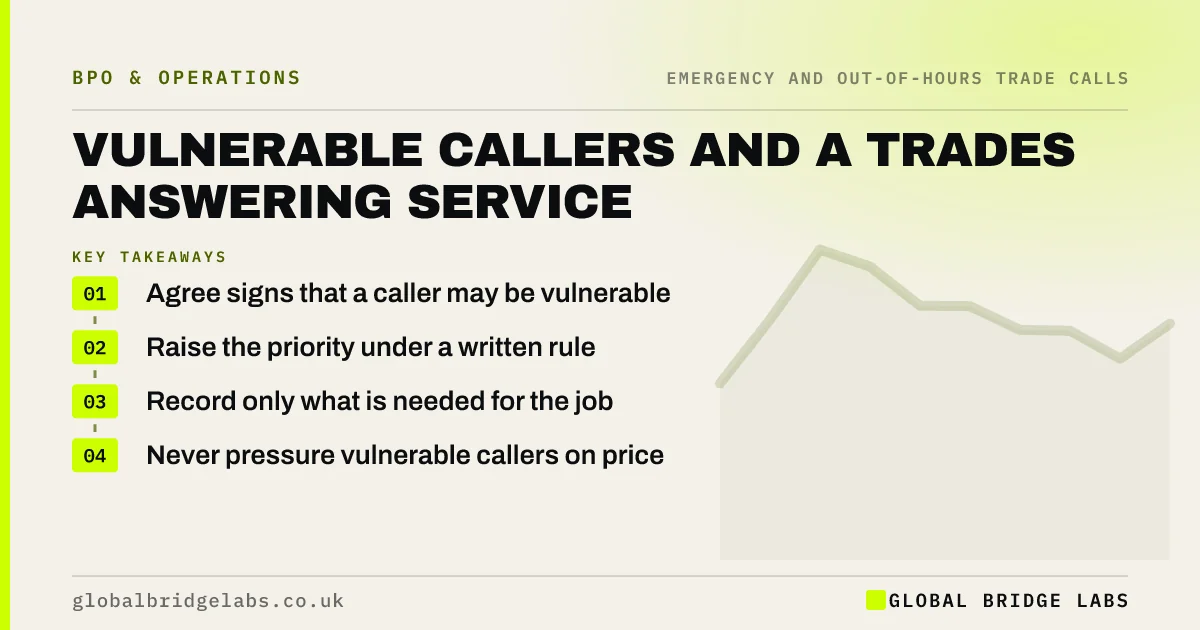
- Agree signs that a caller may be vulnerable.
- Raise the priority under a written rule.
- Record only what is needed for the job.
- Never pressure vulnerable callers on price.
Want a vulnerable caller rule for your service? Message us on WhatsApp.
Chat on WhatsApp →Who might be a vulnerable caller?
Vulnerability depends on the person and the situation. An older person with no heating in winter, someone who relies on electricity for medical equipment, a parent with a baby and no hot water, or a caller who is confused, upset or struggling to understand are all examples.
How should the service respond?
Slow down, use plain language and check the caller has understood. Ask a gentle question, such as is there anyone in the home who might be affected more than usual. If the answer shows higher risk, follow your rule for raising the priority.
How do you record vulnerability fairly?
Record only what is needed to do the job safely, such as elderly occupant, no heating. Health details are sensitive personal data under UK GDPR, so avoid recording more than necessary and limit who can see it.
- Answering services and customer data: UK GDPR basics
- Answering service call notes: what good looks like
Want help writing a fair priority rule? Message us on WhatsApp and we will discuss your requirements.
Chat on WhatsApp →How do you avoid pressure selling?
Vulnerable customers can feel pressured into decisions. The service should never push upgrades or quick decisions on price. If a large job is likely, suggest the customer has a friend or relative present when you visit.
When should other services be involved?
If a caller seems at risk beyond the job, such as no heat in freezing weather and no one to help, the service can suggest contacting family, the council or, in an emergency, 999. Write this into the rule.
What does this look like in practice?
A pattern we see: during a cold spell, a heating firm's service flags older callers without heating as priority. The on-call engineer reaches them first, and routine calls are booked for the next day.
Vulnerable caller checklist
- Agree signs of vulnerability.
- Write a gentle question.
- Set the priority rule.
- Record only what is needed.
- Ban pressure on price.
- Add routes to other help.
Next step
Write a one-paragraph vulnerable caller rule and add it to your answering service script.
Message us on WhatsApp for a vulnerable caller rule, or book a 30-minute consultation.
Chat on WhatsApp →Sources and further reading
- Equality Act 2010 · legislation.gov.uk
- Special category data · Information Commissioner's Office
- Consumer Contracts (Information, Cancellation and Additional Charges) Regulations 2013 · legislation.gov.uk
Frequently asked questions
Should elderly customers get priority for emergency repairs?
Many trades firms give priority to older or vulnerable customers in situations such as no heating in winter, because the risk to them is higher. Write a clear rule so the answering service applies it fairly. Priority should depend on risk, not on who complains most or sounds most insistent.
Can the answering service record health information?
Only what is needed to do the job safely, such as a note that an occupant is elderly or relies on medical equipment. Health information is special category data under UK GDPR and needs extra care. Limit who can see it and remove it when it is no longer needed.
How should a receptionist handle a confused caller?
Slow down, use short questions, repeat back key details and check understanding. If the caller is struggling, offer to speak to a relative or call back at an agreed time. Note any concern for your engineer, and never rush a confused caller into agreeing a price or decision.
Written by

Global Bridge Labs (GBL) is a UK–Sri Lanka partner for social media, websites and BPO. Everything here comes from client delivery, not theory.