On this page
- 01Key takeaways
- 02What is the difference between diverting and porting?
- 03What types of divert are there?
- 04Does diverting cost anything?
- 05How do you test diverts?
- 06What about mobile business numbers?
- 07What happens to the divert if you switch provider?
- 08What does this look like in practice?
- 09Divert checklist
- 10Next step
- 11Sources and further reading
- 12Frequently asked questions
Key takeaways
Most trades businesses connect an answering service by diverting their own number to a number the service provides. You keep ownership, can change the divert at any time and can switch provider easily. Porting moves the number to the provider instead, which is rarely necessary. Choose divert types to suit your day: always, when busy, on no answer or at set times.
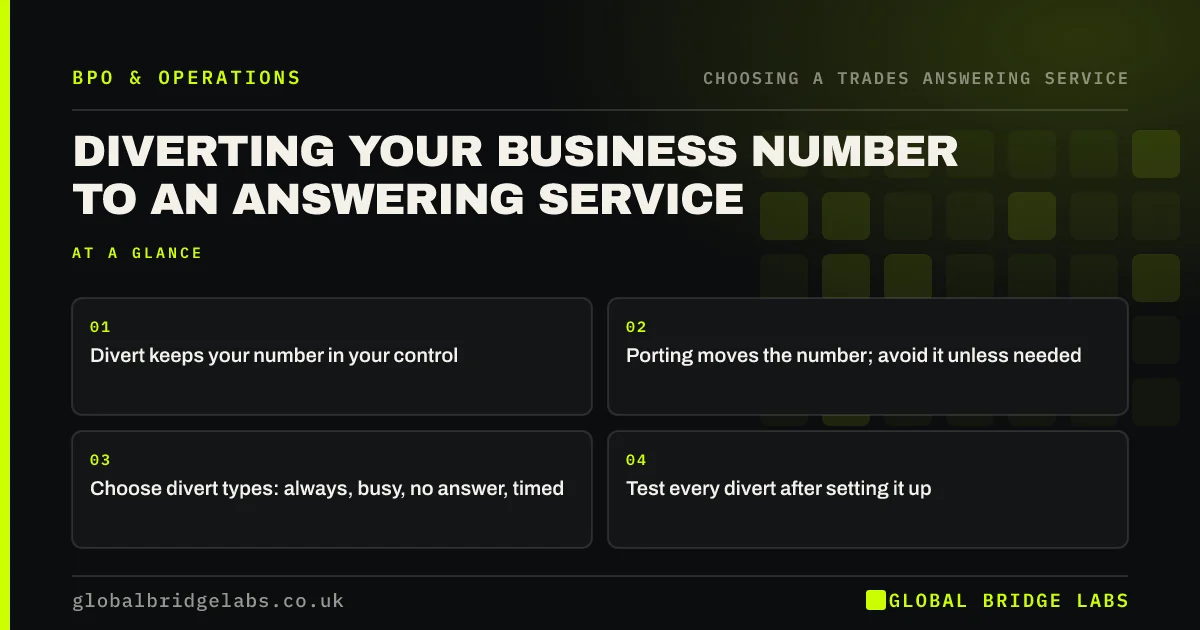
- Divert keeps your number in your control.
- Porting moves the number; avoid it unless needed.
- Choose divert types: always, busy, no answer, timed.
- Test every divert after setting it up.
Want help setting up call diverts? Message us on WhatsApp.
Chat on WhatsApp →What is the difference between diverting and porting?
Diverting forwards calls from your number to the service. Your number stays with your phone provider and you stay in control. Porting moves the number to another provider, which then controls it. For answering services, diverting is usually simpler and safer.
What types of divert are there?
Most business lines and apps offer several divert types. Combine them to match how you work.
- Always: every call goes to the service.
- Busy: calls divert when you are on another call.
- No answer: calls divert after a set number of rings.
- Timed: calls divert at set hours, such as evenings.
Does diverting cost anything?
Some tariffs charge for diverted minutes, especially to mobiles or other networks. Check with your phone provider. Ask the answering service whether its divert number costs you anything per minute.
Want a divert plan for your working day? Message us on WhatsApp and we will discuss your requirements.
Chat on WhatsApp →How do you test diverts?
Call your number from another phone at each divert setting: during the day, busy, no answer and after hours. Check the service answers in your business name. Repeat after any change to your phone system.
What about mobile business numbers?
Mobile numbers can usually divert too. If your business uses a personal mobile, consider a separate business number or app, so you can divert work calls without affecting personal ones.
What happens to the divert if you switch provider?
You simply change the divert to the new provider's number, ideally at a quiet time, and test straight away. Because you never moved the number, there is no porting delay or release fee, which is the main reason diverting is the safer choice.
What does this look like in practice?
A pattern we see: a firm ports its number to an answering service for convenience, then finds leaving slow and costly. Diverting from the start keeps switching quick and cheap.
Divert checklist
- Keep your number with your provider.
- Choose divert types.
- Check divert costs.
- Test each setting.
- Separate business and personal mobiles.
- Retest after phone system changes.
Next step
Check your phone provider's divert options and costs, then set up and test them with your chosen service.
Message us on WhatsApp for a divert set-up, or book a 30-minute consultation.
Chat on WhatsApp →Sources and further reading
- Online Nation: how the UK uses online services · Ofcom
- Contracts and liabilities between controllers and processors · Information Commissioner's Office
Frequently asked questions
Do I need to change my number to use an answering service?
No. Most answering services work by you diverting your existing number to a number they provide. Customers keep calling your usual number and are answered in your business name. Keeping your own number avoids reprinting vans and stationery and makes it easy to change provider.
Should I port my number to an answering service?
Usually not. Porting gives the provider control of your number, which can make leaving slower and costlier. Diverting achieves the same result for callers while keeping the number with you. Only port if there is a specific technical reason and the contract clearly protects your right to take it back.
Can I divert calls only after a few rings?
Yes. Most business lines and phone apps offer divert on no answer after a set number of rings. Many tradespeople ring their own phone for about four rings, then divert to the service. Test the timing, because too many rings before the divert can lose impatient callers.
Written by

Global Bridge Labs (GBL) is a UK–Sri Lanka partner for social media, websites and BPO. Everything here comes from client delivery, not theory.