On this page
- 01Key takeaways
- 02What is a right customer, and what is right-customer content?
- 03Why does most social media content attract the wrong people?
- 04What are the five parts of right-customer content?
- 05How do you define the right customer before you write?
- 06What should you post to attract buyers rather than browsers?
- 07How do you write posts the right people stop for?
- 08Which formats qualify buyers best?
- 09How do you signal price and fit without putting buyers off?
- 10What does content cost, and what should it return?
- 11When is narrowing your content the wrong move?
- 12What does this look like in practice?
- 13Which right-customer content guide do you need next?
- 14Your right-customer content checklist
- 15Next step
- 16Sources and further reading
- 17Frequently asked questions
Key takeaways
To create social media content that attracts the right customers, write every post for one named type of buyer, about one problem they already have, with proof you have solved it, a signal of who it suits, and one clear next step. Content built this way reaches fewer people and produces more enquiries worth answering.
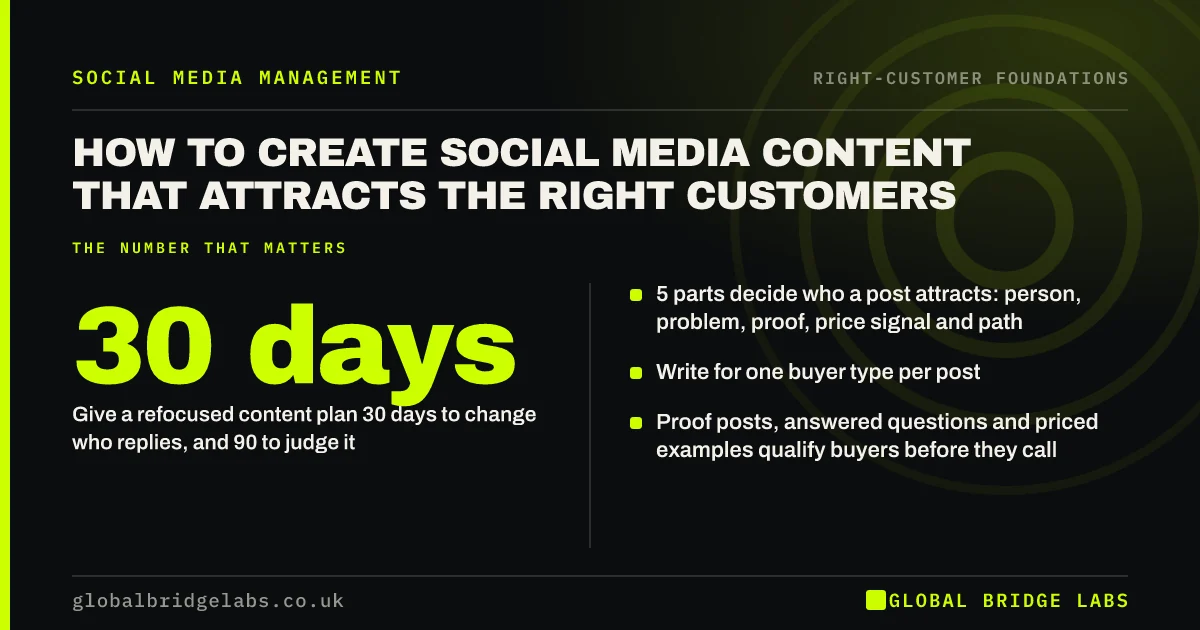
- 5 parts decide who a post attracts: person, problem, proof, price signal and path.
- Write for one buyer type per post. A post for everyone is remembered by no one.
- Proof posts, answered questions and priced examples qualify buyers before they call.
- Judge content on the quality of enquiries it brings, not on likes or followers.
- Give a refocused content plan 30 days to change who replies, and 90 to judge it.
Want to know who your content is really attracting? Send us your profile links on WhatsApp and we will score five recent posts.
Chat on WhatsApp →What is a right customer, and what is right-customer content?
A right customer is a buyer who needs what you sell, can afford it, is in the area or market you serve, and is pleasant and profitable to work with. Right-customer content is social media content written so that this buyer recognises themselves in it, and everyone else can see it is not for them.
This guide is written by Global Bridge Labs (GBL), a UK–Sri Lanka delivery partner, for UK founders, managing directors and marketing leads whose social media is busy but whose enquiries are thin, mismatched or price-led.
Why does most social media content attract the wrong people?
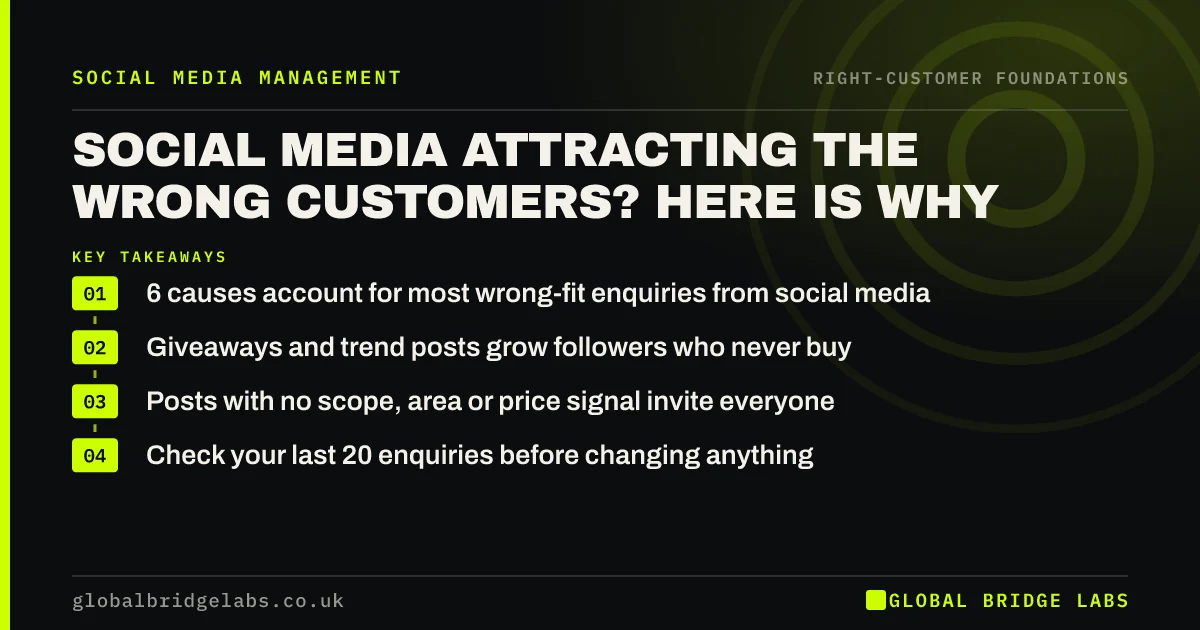
Most content attracts the wrong people because it is written to be liked, not to be useful to a buyer. Jokes, giveaways, trend audio and general tips earn reach from people who will never purchase. Platforms then show the next post to more people like them, and the audience drifts further from your market.
The cost is real even though no invoice records it. Enquiries arrive from outside your area, below your minimum job size, or for services you do not offer. Somebody still has to answer them. Meanwhile the buyers you want scroll past, because nothing on the page tells them you do the specific thing they need.
What are the five parts of right-customer content?
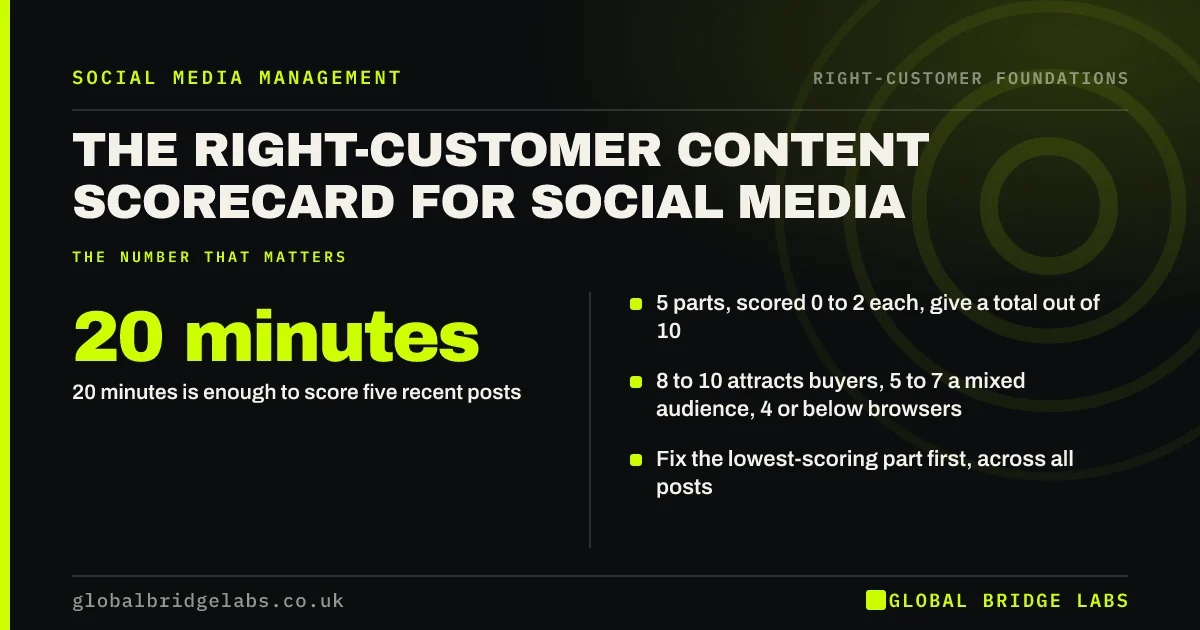
Content that attracts the right customers has five parts, which GBL scores as the Right-Customer Content Scorecard. Person: is it clear who the post is for? Problem: does it name a problem that buyer has now? Proof: does it show you have solved it? Price signal: does it indicate the level of work or budget? Path: is there one obvious next step?
Score each part 0, 1 or 2 for a total out of 10. A post scoring 8 or more attracts buyers. A post scoring 5 to 7 attracts a mixed audience. A post scoring 4 or below attracts browsers. Business accounts we score for the first time usually land in the lower half, and the weakest parts are usually price signal and path.
- Person: the post names or shows the buyer it is for.
- Problem: it opens with a situation that buyer recognises.
- Proof: it shows a result, a job, a number or a customer's words.
- Price signal: it hints at scale, budget or who it does not suit.
- Path: it ends with one next step, not three.
How do you define the right customer before you write?
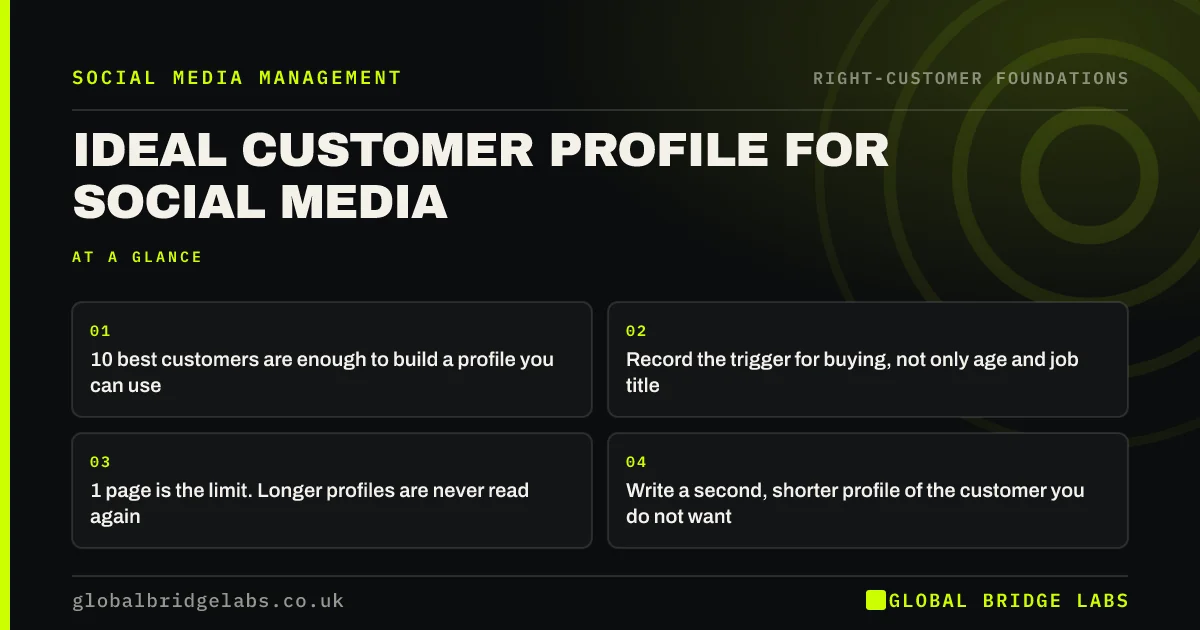
Define the right customer from your best existing customers, not from imagination. List the ten customers you would most like to clone, then write down what they bought, what triggered the purchase, what they asked before buying, where they are, and what they have in common. That description is your content brief.
Add the opposite list as well. Write down the enquiries you regret taking: the jobs that were too small, too far away or too difficult. Knowing who you do not want is what gives you permission to write posts that will not appeal to everyone.
What should you post to attract buyers rather than browsers?
Post about the problems buyers have just before they need you, in the words they use, and show how the problem was solved for someone like them. Three post types do most of the work for a small business: the proof post (a finished job or result), the answered question, and the explained decision (how to choose, what it costs, what goes wrong).
Match the post to how close the reader is to buying. Someone who has never heard of you needs the problem named. Someone comparing suppliers needs proof and an indication of price. Someone ready to act needs to know exactly how to start and what happens next.
How do you write posts the right people stop for?
Open with the buyer's situation, not your news. A first line such as 'Quoted three times for a loft conversion and none of the numbers match?' selects the reader for you. Then say one useful thing in plain English, give evidence, and end with a single next step. Clever wording that hides the subject loses the buyer in the first second.
Which formats qualify buyers best?
The formats that qualify buyers best are the ones that carry detail: carousels, case study posts, before and after posts, testimonials and short demonstrations. Each shows the kind of work you do, for whom, and to what standard. A buyer who has read three of them knows whether to enquire, which is the point.
- Carousel: walks through one problem and its fix, slide by slide.
- Case study post: situation, what was done, result, timescale.
- Before and after: visible proof with the scope stated.
- Testimonial: a named customer describing the problem solved.
- Demonstration: the product or process shown working.
How do you signal price and fit without putting buyers off?
Signal price and fit by describing real jobs with their scale. 'A four-bedroom rewire, three weeks, typically £6,000 to £9,000' tells a buyer more than any adjective. If you cannot publish prices, state a starting point, a typical range, a minimum order or who the service suits. Buyers outside the range leave quietly, and that saves you both time.
What does content cost, and what should it return?
A post that takes two hours of staff time costs about £33 at the April 2026 National Living Wage, once employer National Insurance and pension take the cost to about £16.27 per worked hour. Three posts a week is 312 hours, or roughly £5,076 a year. Most UK SMEs using an agency pay £950–£2,500 a month. Either way, the content has to earn its keep.
That is why audience quality matters more than audience size. Research from the LinkedIn B2B Institute suggests only about 5% of business buyers are in the market at any one time. Content aimed at the right people is how you are remembered by the other 95% when their turn comes. Content aimed at everyone spends the same hours on people who will never buy.
Across GBL social media clients, the average reach lift in the first 90 days is +184% and qualified leads per month rise by an average of +62%. Treat these as context, not a promise. If you would like the figures mapped to your business, let us discuss your requirements.
Want a costed plan for content aimed at your best customers? Message us on WhatsApp and we will discuss your requirements.
Chat on WhatsApp →When is narrowing your content the wrong move?
Narrowing is the wrong move when you do not yet know who your best customer is, when your market is so small that every enquiry counts, or when you sell a low-cost product to a broad public. In those cases stay wider for now and use the enquiries you get to learn who buys.
There is also a real trade-off. Tightly aimed content gets fewer likes and slower follower growth, and that can feel like failure for the first month. It is also possible to over-qualify: a post that reads as a list of who you refuse to serve is off-putting to good buyers too. State who you are for, more often than who you are against.
What does this look like in practice?
A pattern we see often with UK service firms: the most-liked posts are team birthdays and a charity bake sale, and the inbox is full of requests for work the firm stopped doing years ago. Nothing is wrong with the effort. The content simply never says who the firm serves now or what a typical job looks like.
The fix is rarely more posts. It is replacing two of the three weekly posts with a finished job that states the scope, and a question a real customer asked that month, each ending with one next step. Likes usually fall. The enquiries that arrive start to mention the posts and to describe the kind of work the firm wants.
Which right-customer content guide do you need next?
This guide is the hub of a 60-article series from Global Bridge Labs (GBL) on social media content that attracts the right customers. Start with the question that matches your situation today.
- Enquiries are the wrong fit: start with the diagnosis and the scorecard.
- Not sure what to say: start with pain points and your customers' own words.
- Posts are ignored: work on hooks, captions and the call to action.
- Need proof formats: read the case study, testimonial and before and after guides.
- Plenty of likes, no sales: read the engagement and lead quality guides.
- Ready to change course: follow the 30-day refocus plan.
- High engagement but no sales? You have the wrong fans
- How to find which social posts actually bring customers
- Social media content audit: keep, fix or stop
- Attract higher-value customers with social media content
- B2B social media content that attracts decision makers
- Social media content for service businesses
- AI-written social media content: does it attract buyers?
- A social media content brief that keeps posts on target
- A 30-day plan to refocus content on the right customers
- Social media post checklist: ten checks before you publish
- Social media strategy for UK small businesses
Your right-customer content checklist
- Describe your best customer from ten real ones, and the customer you do not want.
- Collect the exact questions customers ask before they buy.
- Write each post for one buyer type and one problem.
- Add proof to at least one post in three: a job, a number or a customer's words.
- Include a signal of scale, price or fit wherever you can.
- End every post with one next step.
- Score five recent posts on the GBL Right-Customer Content Scorecard each month.
- Record where each enquiry came from and whether it was a good fit.
Next step
Pick your last five posts and ask one question of each: would my best customer know this was written for them? If the answer is no for most of them, you do not need more content. You need the same effort aimed at a named buyer.
Message us on WhatsApp with your profile links and we will score five posts on the GBL Right-Customer Content Scorecard, or book a 30-minute consultation.
Chat on WhatsApp →Sources and further reading
- The 95-5 rule: most B2B buyers are out of market · LinkedIn B2B Institute
- The Long and the Short of It: balancing short and long-term marketing strategies · IPA
- National Minimum Wage and National Living Wage rates · GOV.UK
- Rates and thresholds for employers 2026 to 2027 · HM Revenue & Customs
- Writing to GOV.UK standards: writing guidelines · GOV.UK
Frequently asked questions
How do I attract the right customers on social media?
Write each post for one type of buyer and one problem they have now. Show proof that you have solved it, indicate the scale or price of the work, and give one next step. Posts built this way reach fewer people but bring enquiries that match what you sell.
What type of social media content attracts customers?
Content that carries detail attracts customers: finished jobs with the scope stated, answers to questions buyers ask before purchasing, case studies, testimonials and demonstrations. General tips, jokes and trend posts attract an audience, but mostly one that does not buy.
Why is my social media not bringing in customers?
Usually because the content is written to be liked instead of to be useful to a buyer. If posts never say who you serve, what a typical job looks like or how to enquire, the people who engage are not your market. Check five recent posts against those three points.
How long does it take for better content to bring better enquiries?
Expect a change in who replies and messages within about 30 days of refocusing your content, and judge the effect on enquiries over 90 days. Early signs are profile visits from your service area, saves and messages that mention a specific post.
Should I post less often to focus on quality?
Often, yes. Two or three well-aimed posts a week usually do more for enquiries than daily posts written for reach. Keep a rhythm you can hold in a busy month, and spend the time saved on proof and on replying to messages.
Written by

Global Bridge Labs (GBL) is a UK–Sri Lanka partner for social media, websites and BPO. Everything here comes from client delivery, not theory.