On this page
- 01Key takeaways
- 02What is a case study post?
- 03What structure should it follow?
- 04How do you get five posts from one job?
- 05Which case studies should you choose?
- 06What numbers can you include?
- 07What permission do you need?
- 08What does this look like in practice?
- 09Case study post checklist
- 10Next step
- 11Sources and further reading
- 12Frequently asked questions
Key takeaways
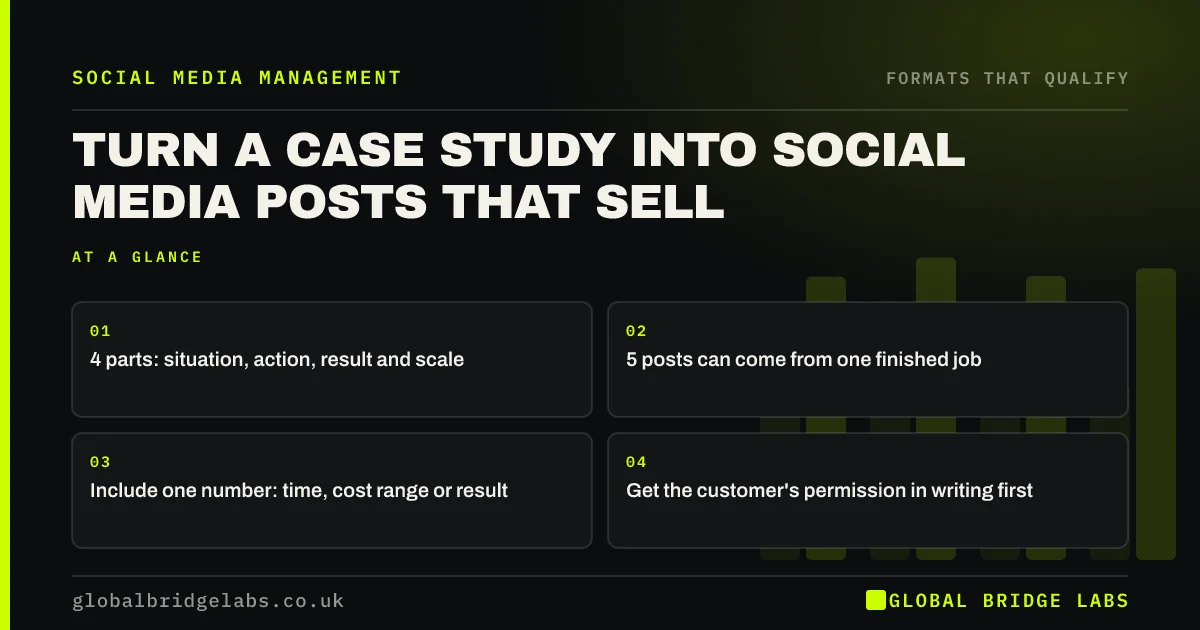
A case study social media post tells a buyer what you did for someone like them. Use four parts: the customer and their situation, what you did, the result, and the scale of the job. One completed job can supply five separate posts across a month.
- 4 parts: situation, action, result and scale.
- 5 posts can come from one finished job.
- Include one number: time, cost range or result.
- Get the customer's permission in writing first.
Want a finished job turned into five posts? Message us on WhatsApp.
Chat on WhatsApp →What is a case study post?
A case study post is a short account of one real piece of work, written so a similar buyer can see what to expect. It differs from a testimonial, which is the customer's opinion. A case study is your description of the facts, and the two work well together.
What structure should it follow?
Follow situation, action, result, scale. State who the customer was and what was wrong. Say what you did and why. Give the result with a figure where possible. Finish with the scale: how long it took, and a cost range if you can share one.
- Situation: 'A 12-room guest house losing bookings to a slow reply time.'
- Action: 'We took over enquiries seven days a week.'
- Result: 'Replies now go out within the hour.'
- Scale: 'Set up in two weeks.'
How do you get five posts from one job?
Split the job by angle. Post one is the summary. Post two is the problem on its own. Post three shows one decision you made and why. Post four is the result with the customer's words. Post five answers the question similar buyers ask most. Spread them over several weeks.
- The summary: situation to result.
- The problem, as an awareness post.
- One decision explained.
- The result, with a quote.
- The common question it raises.
Send us a recent job on WhatsApp and we will map out the five posts. Let us discuss your requirements.
Chat on WhatsApp →Which case studies should you choose?
Choose the jobs you want more of. A case study is an advertisement for that type of work and that type of customer. If you post your smallest, cheapest jobs, expect enquiries for small, cheap jobs. Three strong case studies for your ideal customer are worth more than twenty mixed ones.
What numbers can you include?
Include numbers that are true, that you can evidence, and that the customer is happy to share: duration, size, a cost range, or a before and after measure. The Advertising Standards Authority (ASA) expects marketers to hold evidence for objective claims. Do not present an exceptional result as typical.
What permission do you need?
You need the customer's agreement to be named or shown, and it is wise to have it in writing. Photos of people and details that identify an individual are personal data. If the customer prefers privacy, anonymise: describe the type of business, remove names and locations, and avoid identifiable images.
What does this look like in practice?
A pattern we see with UK small businesses: good work is finished every week and almost none of it is recorded. A habit of taking three photos and writing four lines at the end of each job produces more usable content than any brainstorm.
Case study post checklist
Before posting, confirm these.
- The job is the type you want more of.
- Situation, action, result and scale are all there.
- At least one number is included.
- Every claim can be evidenced.
- The customer has agreed, or is anonymised.
- There is one next step.
Next step
Choose one job finished in the last month and write the four lines today, while the details are fresh.
Message us on WhatsApp for the case study post template, or book a 30-minute consultation.
Chat on WhatsApp →Sources and further reading
- Recognising ads: social media and influencer marketing · ASA / CAP
- What is valid consent? · Information Commissioner's Office
- Unfair commercial practices guidance (CMA207) · Competition and Markets Authority
Frequently asked questions
How do you write a case study for social media?
Keep it to four parts: the customer's situation, what you did, the result and the scale of the job. Use five or six sentences, one real number and a photo of the work. End with one next step. Choose a job of the kind you want more of.
How long should a case study post be?
About 80 to 150 words for a caption, or five to seven slides as a carousel. Give enough detail for a similar buyer to recognise their situation, and link to a fuller version on your website if you have one.
Do I need a client's permission to post a case study?
Yes, if they could be identified. Ask in writing and say where it will appear. If they decline, share an anonymised version that describes the type of customer without names, locations or identifying images. Keep a note of what they agreed to and remove the post if they later ask.
How often should I post case studies?
Aim for one proof post a week. One finished job can supply several posts from different angles, so a small business completing a few good jobs a month has enough material. Spread the posts over several weeks so the feed does not repeat itself.
Written by

Global Bridge Labs (GBL) is a UK–Sri Lanka partner for social media, websites and BPO. Everything here comes from client delivery, not theory.