On this page
- 01Key takeaways
- 02What is a social media strategy?
- 03Why does social media fail for most UK small businesses?
- 04Step 1: What commercial goal should social media own?
- 05Step 2: Who are you actually talking to?
- 06Step 3: Which channels should you choose?
- 07Step 4: What should you post about?
- 08Step 5: What cadence can you actually hold?
- 09What does a social media strategy cost in the UK?
- 10When should a small business not invest in social media?
- 11What does this look like in practice?
- 12Your first 90 days: the checklist
- 13Next step
- 14Sources and further reading
- 15Frequently asked questions
Key takeaways
A social media strategy for a UK small business is a written decision about one commercial goal, the audience you are trying to reach, the two channels you will actually maintain, the content you will repeat, and the number you will judge it by. Everything else is production detail.
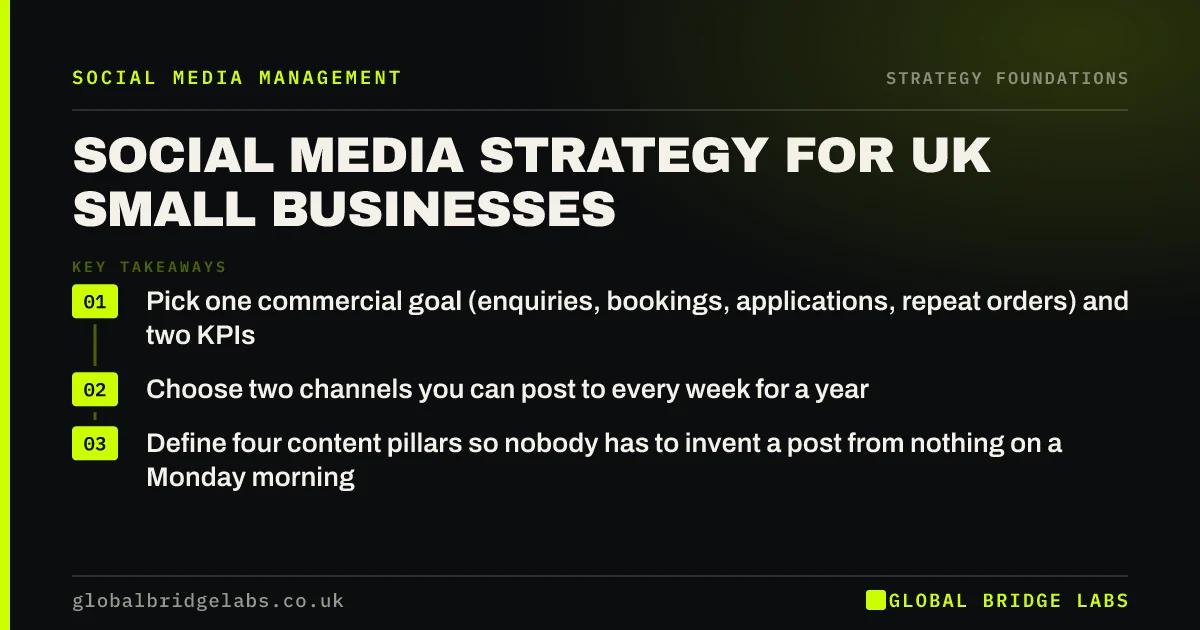
- Pick one commercial goal (enquiries, bookings, applications, repeat orders) and two KPIs. Not five.
- Choose two channels you can post to every week for a year. Consistency beats coverage.
- Define four content pillars so nobody has to invent a post from nothing on a Monday morning.
- Budget realistically: most UK SMEs need £500-£2,500 a month in combined time, tools and paid support to make social media work.
- Review at 90 days against the KPI, not against likes. Kill what has not moved.
Want this mapped to your business and your numbers? Message us on WhatsApp and we will sketch it with you.
Chat on WhatsApp →What is a social media strategy?
A social media strategy is a short written plan that states which commercial outcome your social channels are responsible for, who you are speaking to, where you will publish, what you will publish, and how you will know it worked.
Note what is not in that definition. A strategy is not a content calendar, a list of platforms, a brand mood board, or a posting schedule. Those are outputs. They are what you build after the strategy tells you what the business needs.
The practical test: if a new starter read your strategy on their first morning, could they write five posts that fit the business without asking anyone a question? If not, it is not a strategy yet.
Why does social media fail for most UK small businesses?
It fails on consistency, not creativity. The Department for Business and Trade's Business Population Estimates counted 5.7 million private sector businesses in the UK at the start of 2025, of which 99.8% were small or medium-sized. Almost all of them are competing for attention with the same fixed resource: an owner or a marketing lead with a few hours a week.
What follows is a predictable pattern. A burst of activity for six weeks, a quiet month, a guilty restart on a new platform, and no evidence either way about whether any of it produced revenue.
- Too many channels: five accounts, none of them maintained.
- No owner: social is everyone's job on top of their real job, so it slips first.
- No goal: posts are judged on how they feel rather than what they produced.
- No repeatable format: every post starts from a blank page, which is why it takes three hours.
- No measurement: nobody can say whether last quarter was better than the one before.
Step 1: What commercial goal should social media own?
Choose one goal that a finance director would recognise: more qualified enquiries, more bookings, more repeat orders, more job applications, or lower cost per lead. Then attach two KPIs to it, one leading and one lagging.
A leading KPI moves weekly and tells you whether the work is happening (profile visits, saves, link clicks, direct messages started). A lagging KPI moves monthly and tells you whether it mattered (enquiries attributed to social, booked calls, revenue from social-first customers).
Write the goal as a sentence with a number and a date in it. Vague goals cannot be failed, which is exactly why they survive so long.
Step 2: Who are you actually talking to?
Most UK SMEs serve two or three buyer types, not one. A commercial plumbing firm sells to facilities managers and to homeowners. A recruitment consultancy sells to hiring managers and to candidates. Those are different audiences with different questions, and trying to serve both in one feed is the most common reason a feed says nothing to anyone.
Pick the audience that is closest to money. Write down their job, the problem they are trying to fix, the three questions they ask before buying, and the platform they already use during the working day.
Step 3: Which channels should you choose?
Two. Choose two. One where your buyer already spends time, and one you can win because your competitors have abandoned it.
Ofcom's Online Nation research consistently finds that the overwhelming majority of UK adults use social media or messaging services each month, but the distribution matters far more than the total. If you sell to facilities managers, LinkedIn and email are where the decision gets made. If you sell hospitality covers in a market town, Instagram, Facebook and your Google Business Profile do the work.
The reason for two rather than five is simple arithmetic. A sustainable cadence is roughly three posts a week per channel. At two channels that is six pieces of content a week, which a small team can produce. At five channels it is fifteen, which they cannot, and the quality collapses before the quarter ends.
Step 4: What should you post about?
Define four content pillars. A pillar is a repeatable subject, not a one-off idea, and it exists so that content production becomes assembly rather than invention.
The four that work for most UK SMEs are: proof (work you have done), teaching (the thing your buyer keeps getting wrong), people (who does the work), and offer (what you sell and how to buy it). Roughly 40% proof, 30% teaching, 20% people, 10% offer.
- Proof: before and after, finished jobs, results with permission, site photographs.
- Teaching: the question you answer on every first call, answered once in public.
- People: the engineer, the kitchen, the van, the office, the reason to trust you.
- Offer: pricing ranges, availability, how to book, what happens next.
Step 5: What cadence can you actually hold?
Set the cadence at the level you could sustain in your worst month of the year, not your best. For most UK small businesses that is three posts a week per channel, one of which is video, plus community replies inside one working day.
Then protect it with batching. A half day a month, a phone, and a shot list will produce four weeks of raw material. The failure mode is trying to create content on the day it publishes, which means it competes with client work and always loses.
What does a social media strategy cost in the UK?
Budget across three lines: time, tools and reach. Time is the cost of the person producing and replying. Tools are scheduling and design, typically £20-£80 a month for a small business. Reach is paid amplification, which for a local UK SME starts to produce readable data at around £300-£500 a month.
For comparison, a full-time UK social media manager costs most SMEs £30,000-£40,000 a year plus employer costs. An outsourced managed service such as Global Bridge Labs (GBL) covers ongoing strategy, production and publishing for a fixed monthly fee scoped to your channels and volume; ask for a costed plan rather than a rate card.
- DIY, owner-led: £50-£150 a month in tools, plus roughly 6-8 hours a week of your time.
- Freelancer, part-time: £400-£1,200 a month, usually production only, strategy stays with you.
- Managed service: a fixed monthly fee scoped to your channels and volume, including strategy, production, publishing and reporting.
- In-house hire: £30,000-£40,000 salary plus tools, recruitment and management time.
Not sure which of those four models fits your stage? Send us your current setup on WhatsApp and we will tell you which one we would pick, and why.
Chat on WhatsApp →When should a small business not invest in social media?
Three situations where the honest answer is no, or not yet.
First, when your website cannot convert the traffic. Sending attention to a page that does not explain what you do, what it costs and how to enquire wastes the attention and the budget. Fix the destination first.
Second, when you cannot service more demand. If you are already turning work away, social media will generate enquiries you cannot answer, and unanswered enquiries damage reputation faster than silence does.
Third, when your buyer genuinely is not there. Some B2B niches buy entirely through tender portals, framework agreements and referral. Social media can still support credibility, but it will not be your lead channel, and you should budget it as brand support rather than acquisition.
What does this look like in practice?
A common pattern in our delivery work: a UK trades business with eight or nine engineers, posting occasionally to four platforms, no owner, and no record of what worked. The strategy that fixes it fits on one page.
One goal (domestic enquiries in three postcodes), two channels (Facebook and Instagram), four pillars weighted towards finished jobs, three posts a week, £400 a month of local paid reach, and one KPI reviewed monthly: enquiries that name social media as the source. The abandoned platforms get closed rather than left to rot, which also removes the impression of a dormant business.
Across our client work, the numbers we publish are a +184% average reach lift in the first 90 days and 2.4x more enquiries after a website rebuild. Reach is the easy part. The enquiry number only moves when the destination page and the response time are fixed at the same time.
Your first 90 days: the checklist
Work through these in order. Do not start producing content until item five is done.
- Write the one-sentence goal with a number and a date.
- Name the owner and the weekly hours they are protected to spend.
- Audit and close or claim every existing profile so there are no dormant accounts.
- Choose two channels and write down why each one was chosen.
- Define four content pillars with five example posts each.
- Set the cadence and book the monthly batching half-day in the calendar now.
- Set up UTM tracking so social traffic is identifiable in analytics.
- Agree the response standard for comments and messages, in working hours.
- Publish for eight weeks without changing anything.
- Review at 90 days against the KPI and cut whatever has not moved.
Next step
If you want the one-page version of this built around your business, we will do it with you in 30 minutes: goal, channels, pillars, cadence and the number you review it by. No pitch, and you keep the page whether or not you work with us.
Message us on WhatsApp for a one-page social media strategy for your business, or book a 30-minute consultation.
Chat on WhatsApp →Sources and further reading
- Online Nation: how the UK uses online services · Ofcom
- Business population estimates for the UK and regions 2025 · Department for Business and Trade
Frequently asked questions
How long does it take to build a social media strategy?
The strategy itself takes a focused half-day if you already know your buyer and your numbers. The work is in the decisions, not the document. Expect 90 days of consistent publishing before you have enough data to judge whether the channels you chose were the right ones.
How many social media platforms should a small business use?
Two. One where your buyers already spend time and one you can realistically win. A sustainable cadence is about three posts a week per channel, so two channels means six pieces of content a week, which a small UK team can produce without dropping client work.
How much should a UK small business spend on social media?
Most UK SMEs need £500-£2,500 a month across time, tools and paid reach to produce readable results. Tools cost £20-£80 a month, local paid amplification becomes measurable at around £300-£500 a month, and managed delivery is a scoped monthly fee on top of that.
Do I need a strategy if I already post regularly?
Yes, if you cannot say what commercial outcome the posting is responsible for. Regular posting without a goal produces activity data rather than business data, which is why so many UK small businesses cannot tell whether three years of social media has paid for itself.
Should a small business do social media in-house or outsource it?
Keep strategy and brand voice in-house, because they depend on knowing your customers. Outsource production, publishing and reporting, because they are repeatable and consume the most hours. That split gives most UK SMEs consistency without a full-time salary.
Written by

Global Bridge Labs (GBL) is a UK–Sri Lanka partner for social media, websites and BPO. Everything here comes from client delivery, not theory.