On this page
- 01Key takeaways
- 02Who is a price shopper?
- 03Why does your content attract them?
- 04Which content changes deter price shoppers?
- 05How do you reply to 'how much?'
- 06Should you ever compete on price?
- 07When is the price shopper telling you something?
- 08What does this look like in practice?
- 09Price shopper checklist
- 10Next step
- 11Sources and further reading
- 12Frequently asked questions
Key takeaways
To stop attracting price shoppers on social media, change what your content rewards. Price shoppers respond to discounts, vague offers and missing prices. Show the scope and value of real jobs, state a starting point, and reply to 'how much?' with a range and one question.
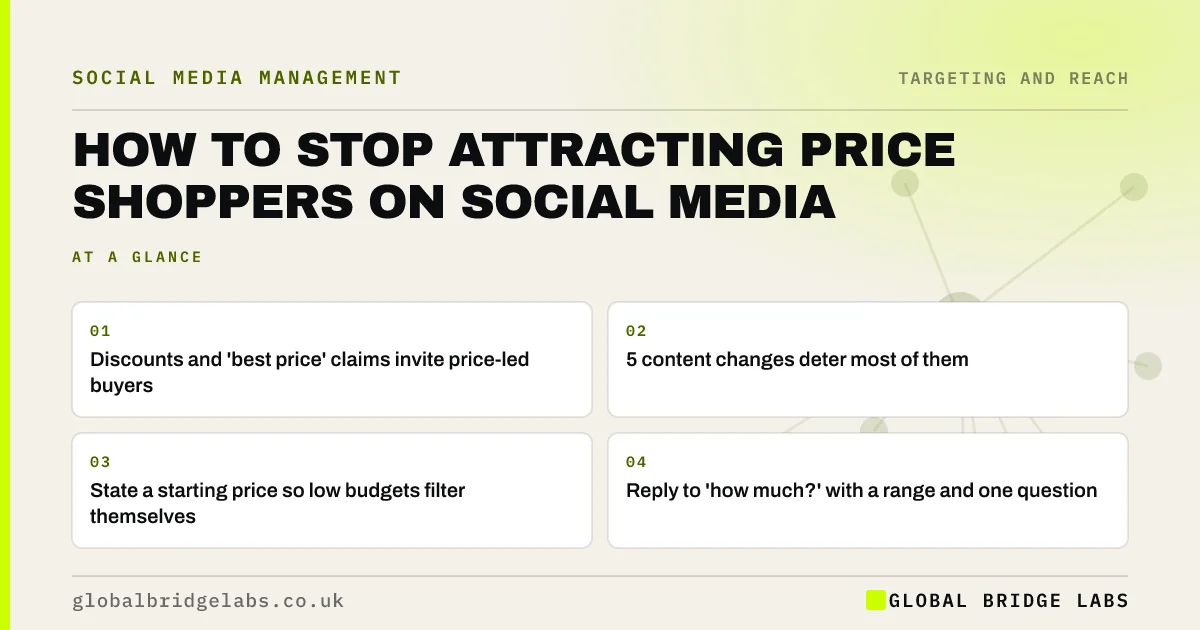
- Discounts and 'best price' claims invite price-led buyers.
- 5 content changes deter most of them.
- State a starting price so low budgets filter themselves.
- Reply to 'how much?' with a range and one question.
Tired of price-only messages? Send us an example on WhatsApp.
Chat on WhatsApp →Who is a price shopper?
A price shopper is a buyer whose main or only criterion is the lowest figure. They are not wrong to shop that way, and some businesses are built to serve them. The problem arises when your business is not, and your content keeps inviting them.
Why does your content attract them?
Content attracts price shoppers when price is the only thing it gives them to compare. If posts show a finished job with no scope, standard or process, a buyer cannot see why one supplier costs more. Offers, giveaways and 'message for a quote' then confirm that price is the game.
Which content changes deter price shoppers?
Five changes deter most of them: state a starting price, describe the scope of each job, explain what is included that cheaper options leave out, show the standard of work in detail, and stop running discounts. Together they give buyers something other than price to weigh.
- A starting price or typical range.
- The scope behind each job shown.
- What is included that others omit.
- Close-up detail of the standard.
- No routine discounting.
Want these five changes applied to your posts? Message us on WhatsApp and we will discuss your requirements.
Chat on WhatsApp →How do you reply to 'how much?'
Reply with a range and one qualifying question. 'Most jobs like that are £1,800 to £2,600 depending on access. Is it a ground floor or upper floor?' This respects the question, sets expectations and starts a conversation. Buyers who vanish at the range have saved you a visit.
- Thank them and give a range.
- Name the one or two things that move the price.
- Ask one question about their situation.
- Offer the next step for those who continue.
Should you ever compete on price?
Compete on price only if your costs are structurally lower and you intend to be the low-cost option. Otherwise you are matching someone else's model without their margins. It is more sustainable to be clear about what you include and to let buyers who want the cheapest go elsewhere.
When is the price shopper telling you something?
Sometimes the message is real. If nearly every enquiry says you are too expensive, check whether the market has moved, whether you are showing your work to the wrong area, or whether your content fails to explain the difference. Review three recent lost quotes before blaming the buyer.
What does this look like in practice?
A pattern we see with UK service firms: a monthly offer post brings a burst of messages, few of which become work at full price. Replacing the offer with a detailed job post that states the cost usually brings fewer messages and more accepted quotes.
Price shopper checklist
Check your account.
- A starting price or range is visible.
- Job posts state the scope.
- What is included is explained.
- No routine discount posts.
- A saved reply exists for 'how much?'
- Lost quotes are reviewed monthly.
Next step
Write your saved reply for 'how much?' today: a range, the factors and one question. Use it for a month and count how many conversations continue.
Message us on WhatsApp for reply wording you can save, or book a 30-minute consultation.
Chat on WhatsApp →Sources and further reading
- Unfair commercial practices guidance (CMA207) · Competition and Markets Authority
- Digital Markets, Competition and Consumers Act 2024 · legislation.gov.uk
- Recognising ads: brand-owned and paid social media · ASA / CAP
Frequently asked questions
How do I stop attracting price shoppers?
Give buyers more than price to compare. State a starting price, show the scope and standard of real jobs, explain what you include, and stop routine discounting. Low budgets filter themselves out and others see the value. Give it two months to show.
How should I respond to 'how much?' messages?
Give a realistic range, name what moves the price and ask one question about their situation. It answers honestly, sets expectations and shows quickly whether the enquiry is worth pursuing. Save the reply so anyone answering messages uses the same range and the same question.
Are discounts bad for a small business?
Occasional, purposeful offers are fine. Routine discounts train followers to wait for them and attract buyers who leave when the offer ends. Any discount claim must also be genuine under UK pricing rules. Use them for a reason, such as filling a quiet month.
Should I ignore price shoppers?
No. Reply courteously with a range. Some become good customers once they understand the difference, and those who do not have cost you one short message. Ignoring them risks a poor impression in public comments. Keep the reply short and move on.
Written by

Global Bridge Labs (GBL) is a UK–Sri Lanka partner for social media, websites and BPO. Everything here comes from client delivery, not theory.